
DEA CAPITAL S.p.A.
Registered Office at Via Brera, 21 - 20121 Milan
Share Capital of Euro 306,612,100 fully paid up
Tax Code, VAT reg. no. and Milan Register of Companies no. 07918170015

Notice of
Shareholders’
Meeting
DeA Capital - Annual Financial Statements to 31 December 2013
1

DeA Capital
S.p.A.
DeA Capital S.p.A.
Registered Office at Via Brera 21, 20121 Milan
Share capital of EUR 306,612,100, fully paid up
Tax Code, VAT reg. no. and Milan Register of Companies no. 07918170015,
Milan REA (Administrative Economic Register) 1833926
Company subject to the management and co-ordination of De Agostini S.p.A.
NOTICE OF SHAREHOLDERS' MEETING
All eligible persons are invited to attend the Ordinary and Extraordinary Shareholders' Meetings to be held at
Spazio Chiossetto, Via Chiossetto 20, Milan:
- at 11 a.m. on Thursday, 17 April 2014, on first call;
- at 11 a.m. on Friday, 18 April 2014, on second call:
to discuss and resolve upon the following.
AGENDA
Ordinary shareholders’ meeting
1. Approval of the financial statements for the year ended 31 December 2013. Related and consequent
resolutions. Presentation of the consolidated financial statements of the Group headed by DeA
Capital S.p.A. for the year ended 31 December 2013.
2. Authorisation to acquire and dispose of treasury shares. Related and consequent resolutions.
3. Approval of a performance share plan for certain employees, and/or directors with specific duties,
of DeA Capital S.p.A., the companies it controls and its parent company, as well as a stock option
plan reserved for certain employees of DeA Capital S.p.A., the companies it controls and its parent
company. Related and consequent resolutions.
4. Presentation of the DeA Capital S.p.A. Remuneration Report and advisory vote by the shareholders’
meeting on the Remuneration Policy of DeA Capital S.p.A. (section I of the Remuneration Report),
in accordance with Art. 123-ter of Legislative Decree no. 58 of 24 February 1998, as subsequently
amended and supplemented.
Extraordinary shareholders’ meeting
1. A share capital increase, against payment, in tranches and without option rights, pursuant to
Art. 2441, paragraph 8, of the Italian Civil Code for a total amount of EUR 2,000,000 by issuing a
maximum of 2,000,000 shares, reserved solely and irrevocably for subscription by the beneficiaries
of the 2014-2016 Stock Option Plan. Consequent amendment to Art. 5 of the articles of association.
Related and consequent resolutions.
* * *

Presentation of proposals for deliberation/incorporation into the agenda
Members representing, including jointly, at least 2.5% of the share capital may submit a request, within ten
days of this notice being published (i.e. by 28 March 2014), for items to be incorporated into the meeting
agenda, indicating on the request the topics suggested, and may also submit proposals for deliberation
regarding items already on the agenda.
The request, together with the share ownership certificate issued, pursuant to the regulations in force, by
the authorised intermediaries holding the ledgers in which the shareholders’ shares are registered, must
be submitted in writing, by hand or by recorded-delivery and by the above deadline, to the company’s
registered office, for the attention of the Investor Relations department, or sent by electronic mail to the
submitting the request (a contact telephone number should also be provided). Shareholders submitting
such requests must also provide, by the same deadline and by the same means, a report setting out the
reasons for the proposed deliberation of new items or further proposals for deliberation of items already
on the agenda. The company is responsible for notifying shareholders of the incorporation into the meeting
agenda of any new items or proposals for deliberations on existing items, in the same form as for the
publication of this notice convening shareholders’ meetings, at least fifteen days before the scheduled first-
call meeting date. At the same time as publication of the notice confirming incorporation into the agenda
of new items or proposals for deliberations on existing items, the proposals for incorporation/deliberation,
together with the corresponding reports submitted by the members concerned and any opinion of the Board
of Directors, must be made public pursuant to Art. 125-ter, paragraph 1, of Legislative Decree no. 58/1998.
With the exception of proposals relating to the subject areas listed in Art. 125-ter, paragraph 1, of
Legislative Decree no. 58/1998, no additions may be made to the agenda if they relate to matters which,
by law, must be decided by the shareholders’ meeting at the proposal of the Board of Directors or on the
basis of a plan or report prepared by the same.
Right to ask questions about items on the agenda
All holders of voting rights may raise questions about items on the agenda, including in advance of the
meeting. Any questions, together with the share ownership certificate issued, pursuant to the regulations
in force, by the authorised intermediaries holding the ledgers in which shareholders’ shares are registered,
must be sent to the company’s registered office for the attention of the Investor Relations department, by
recorded-delivery letter, by fax to the number +39 02 62499599 or by email to the address
[email protected]. Questions must be received by the company before close of business on the third day
before the scheduled meeting date (i.e. by 14 April 2014). Provided that questions are received before
the meeting and by the requisite deadline, a response will be provided, at the latest, during the meeting
itself; a response is deemed to have been provided at a meeting if it is made available, on paper, to
each of those entitled to vote at the start of the meeting. The company may provide a single response to
questions with the same content. The company also reserves the right to provide the information requested
by any questions received prior to the shareholders’ meeting by displaying it on a dedicated “Questions
Governance/Shareholders’ Meetings). Where this is the case, no response needs be given at the meeting.

Right to take part in meetings
Shareholders are eligible to take part in shareholders’ meetings if they are registered as holding voting
rights on the record date - i.e. by the close of business on the seventh trading day before the date
scheduled for the first-call meeting (8 April 2014) - and if the requisite statement has been received from
the authorised intermediary by the company. Individuals who only become shareholders after that date will
not be entitled to take part or vote in the shareholders’ meeting.
The statement by the authorised intermediary referred to above must be received by the company before
close of business on the third trading day prior to the date scheduled for the first-call meeting. If the
statement is received by the company after this date, shareholders will, however, still be entitled to take
part in the meeting and vote provided the statement is received before the start of the first-call meeting.
It should be remembered that the statement is communicated to the company by the authorised
intermediary at the request of the individual holding the voting right.
Representation in meetings
All those entitled to take part in a meeting may appoint a representative by issuing a written proxy in
accordance with the statutory and regulatory provisions in force. In this regard, note that a proxy may be
granted by means of a digital document in electronic form, as defined in Art. 135-novies, paragraph 6, of
Legislative Decree no. 58/1998, and that the proxy-letter template provided at www.deacapital.it may be
used for this purpose. The company may be notified of the proxy via recorded-delivery letter,
sent to the company’s registered office or via email to the company’s certified email address at
If the proxy holder provides or sends a copy of the proxy to the company instead of the original, he/she
must certify, on his/her own responsibility, that it is a true copy and confirm the proxy- giver's identity. Any
advance notification does not release the proxy holder from the obligation to certify that the proxy is a true
copy and to attest to the identity of the proxy-giver when he/she confirms his/her eligibility to take part in
the shareholders’ meeting.
Designated proxy holder
Proxies, with voting instructions for the items on the agenda, may be granted to Computershare S.p.A.,
which has its registered office at Via Lorenzo Mascheroni 19, Milan 20145, duly designated by the company
for this purpose, in accordance with Art. 135-undecies of Legislative Decree 58/1998; a printable version
of the relevant form to be signed may be downloaded from the website www.deacapital.it (under the
section Corporate Governance/Shareholders’ Meetings) or obtained from the company’s registered office
or from the registered office of Computershare S.p.A. The original of the proxy, with voting instructions,
must be received by Computershare S.p.A., Via Lorenzo Mascheroni 19, Milan 20145, by close of business
on the penultimate trading day before the date scheduled for the first-call meeting or for any second-call
meeting (i.e. by 15 April 2014 for the first-call meeting or by 16 April 2014 for the second-call meeting).
A copy of the proxy, accompanied by a statement confirming that it is a true copy of the original, may be
provided to the designated proxy holder by the above-mentioned deadlines by fax to +39 (0)2 46776850,
in respect of those items for which voting instructions are given. Proxies and voting instructions may be
revoked by the deadlines specified above. Note that the statement to be communicated to the company
by the authorised intermediary, confirming the shareholder’s eligibility to take part and exercise his voting
rights in the shareholders’ meeting, is also required if a proxy is granted to the designated proxy holder. By
law, shares for which a proxy is granted, whether in full or in part, are taken into account in determining
whether the shareholders’ meeting is duly constituted, although proxies without voting instructions do not
count for the purposes of calculating the majority and quorum required to pass resolutions. Details of the
proxies granted to Computershare S.p.A. (who can be contacted for any queries by telephone on
+39 (0)2 46776811) are also available on the relevant delegation form mentioned above.

Share capital and voting shares
The share capital is EUR 306,612,100 divided into 306,612,100 ordinary shares each with a par value of
EUR 1.00. Each ordinary share carries voting rights at the shareholders’ meeting (except ordinary treasury
shares, which currently total 32,637,004, on which voting rights are suspended in accordance with
the law).
Documentation and information
Please note that documentation relating to the items on the agenda that is required by law or under
regulatory provisions will be made available to the public at the company’s registered office and published
as well as by the means and under the terms and conditions laid down in the regulations in force;
shareholders and other parties entitled to take part in shareholders’ meetings may obtain copies of this
documentation.
The following, in particular, will be made available to the public:
- at the same time as the publication of this notice, the Directors’ Report on point 3 of the ordinary part
and the detailed documentation required pursuant to Art. 84-bis of the Issuer Regulations
- the financial report and other documents referred to in Art. 154-ter of the TUF, together with the
directors’ reports on the other items on the agenda, to be made available at least 21 days before the
scheduled meeting date (i.e. 27 March 2014).
All eligible persons have the right to read and, on request, obtain a copy thereof.
***
Milan, 18 March 2014
For the Board of Directors.
The Chairman
(Lorenzo Pellicioli)
“An abstract of the above Notice was published on MF on 18 March 2014”


Corporate Boards
Corporate information
and Controlling
DeA Capital S.p.A. is subject to the management and co-ordination of
De Agostini S.p.A.
Structure
Registered office: Via Brera 21, Milan 20121, Italy.
Share capital: EUR 306,612,100 (fully paid-up) comprising 306,612,100
shares with a nominal value of EUR 1 each (including 32,637,004 own
shares at 31 December 2013).
Tax code, VAT code and recorded in the Milan Register of Companies
under no. 07918170015.
Board of Directors (*)
Chairman
Lorenzo Pellicioli
Chief Executive Officer
Paolo Ceretti
Directors
Lino Benassi
Rosario Bifulco (1 / 4 / 5)
Marco Boroli
Stefania Boroli
Marco Drago
Roberto Drago
Francesca Golfetto (1 / 3 / 5)
Severino Salvemini (2 / 3 / 5)
Board of Statutory Auditors (*)
Chairman
Angelo Gaviani
Regular Auditors
Gian Piero Balducci
Annalisa Raffaella Donesana
Alternate Auditors
Annamaria Esposito Abate
Maurizio Ferrero
Giulio Gasloli
Secretariat of the Board of Directors
Diana Allegretti
Manager responsible for preparing the Company’s accounts
Manolo Santilli
Independent Auditors
KPMG S.p.A.
(*) In office until the approval of the financial statements to 31 December 2015
(1) Member of the Control and Risk Committee
(2) Member and Chairman of the Control and Risk Committee
(3) Member of the Remuneration and Appointments Committee
(4) Member and Chairman of the Remuneration and Appointments Committee
(5) Independent director
DeA Capital - Annual Financial Statements to 31 December 2013
7


Letter to the Shareholders
10
Report on Operations
13
1. Profile of DeA Capital S.p.A.
14
2. Information for Shareholders
18
3. The DeA Capital Group’s key Statement of Financial Position
C
ontents
and Income Statement figures
21
4. Significant events during the year
22
5. The results of the DeA Capital Group
26
6. Results of the Parent Company DeA Capital S.p.A.
64
7. Other information
67
8. Proposal to approve the financial statements of DeA Capital S.p.A.
for the year ending 31 December 2013 and related
and resulting resolutions
77
Consolidated financial statements for the
year ending 31 December 2013
79
Statement of responsibilities for the consolidated
financial statements pursuant to art. 154-bis
of Legislative Decree 58/98
141
Information pursuant to art. 149-duodecies
of the Consob Issuer Regulations -
Consolidated financial statements
143
Annual financial statements for the year
ending 31 December 2013
145
Statement of responsibilities for accounts
pursuant to art. 154-bis of Legislative
Decree 58/98
193
Information pursuant to art. 149-duodecies
of the Consob Issuer Regulation -
annual financial statements
195
Summary of subsidiaries’ financial statements
to 31 December 2013
197
Independent Auditors’ Report
201
Report of the Board of Statutory Auditors
207
DeA Capital - Annual Financial Statements to 31 December 2013
9

Letter
“Overall, the Alternative Asset
Management asset portfolio generated
returns of around EUR 95 million,
with dividends of EUR 16.6 million
(compared with EUR 15.0 million in
2012) distributed to DeA Capital and to
the intermediate holding companies.”
“… in Private Equity Investments
DeA Capital will continue to seek
opportunities for enhancing
the value of its holdings.”
10 DeA Capital - Letter to the Shareholders

to the Shareholders
D
ear shareholders,
in Europe, the year 2013 was marked by
With reference to the latter, the subsidiary Générale
persistently restrained economic growth, with all
de Santé, completed the sale of its psychiatric
countries adhering to policies aimed at maintaining
division at the end of December, which enabled it to
balanced budgets. At the same time, spreads
further concentrate on its core business of medical,
generally fell among both government and corporate
surgical and obstetric clinics and also to significantly
securities, while the stock markets’ performance
reduce its debt.
was highly positively, in Italy as in other countries
of the European Union.
On the Alternative Asset Management front, DeA
Capital has strengthened Innovation Real Estate, a
Against this backdrop, the value of DeA Capital's
primary independent operator in property, facility
investment portfolio, which is significantly
& project management, with an acquisition that
concentrated in the economies of countries other
has made possible an extraordinary increase in
than Italy and had for that reason better withstood,
turnover, and has continued to develop IDeA Capital
over recent years, the economic/financial crisis that
Funds SGR through the launch of a number of
hit our country, has almost returned to its level as
rather innovative major initiatives in the offering of
of the end of 2011: its NAV closed at EUR 2.30 on
private equity funds.
31 December 2013, compared with the EUR 2.63
per share at the end of 2012, a movement largely
Overall, the Alternative Asset Management
attributable to the stock market performance of the
asset portfolio generated returns of around EUR
investment in Migros and the devaluation of the
95 million, with dividends of EUR 16.6 million
Turkish lira.
(compared with EUR 15.0 million in 2012)
distributed to DeA Capital and to the intermediate
Migros, which continues to achieve excellent results
holding companies.
compared with the rest of the industry, was hit
by unexpected political instability in Turkey from
There was continued positive performance on
May 2013 onwards; this instability prompted many
the financial markets as 2014 began, although
international institutional investors to move their
macroeconomic prospects remain uncertain,
capital elsewhere, reflecting the more generally
especially in Italy.
reduced exposure to emerging economies.
The prospect, then, is of a year in which Alternative
Apart from realigning the value of its investment
Asset Management will continue to find fundraising
in Migros, DeA Capital has also revised the
on the domestic market slow and difficult, while in
development projections and hence the goodwill, of
Private Equity Investments DeA Capital will continue
IDeA FIMIT SGR using more prudential criteria; the
to seek opportunities for enhancing the value of its
situation in the real estate sector remains complex,
holdings.
in that, despite a number of timid signs of recovery
in transaction volumes - buoyed up by renewed
interest from foreign investors in particular - there
is a significant concentration of funds due to mature
in the next couple of years, with the need to sell
off assets potentially putting sale prices under
pressure. With this prospect in view, it is to be
Lorenzo Pellicioli
Paolo Ceretti
hoped that solutions facilitating the orderly disposal
Chairman
Chief Executive Officer
of assets may be found, including by means of
legislation and regulation.
During the year that has just ended, DeA Capital
has continued to focus on developing its operations
in the Alternative Asset Management sector
and on enhancing the value of its Private Equity
investments.
DeA Capital - Annual Financial Statements to 31 December 2013
11


Report on
Operations
DeA Capital - Annual Financial Statements to 31 December 2013
13

Profile of
With an investment portfolio of over EUR 760 million and assets
under management of EUR 10,500 million, DeA Capital S.p.A. is
one of Italy’s largest alternative investment operators.
The Company, which operates in both the Private Equity
Investment and Alternative Asset Management businesses,
is listed on the FTSE Italia STAR section of the Milan stock
exchange, and heads the De Agostini Group in the area
of financial investments.
In the Private Equity Investment business, DeA Capital S.p.A.
has "permanent" capital, and therefore has the advantage -
compared with traditional private equity funds, which are
normally restricted to a pre-determined duration - of greater
flexibility in optimising the timing of entry to and exit from
investments. In terms of investment policy, this flexibility allows
it to adopt an approach based on value creation over
the medium to long term.
In the Alternative Asset Management business, DeA Capital
S.p.A. - through its subsidiaries IDeA FIMIT SGR and IDeA
Capital Funds SGR - is Italy’s leading operator in real estate
fund management and private equity funds of funds programmes,
respectively. The two companies are active in the promotion,
management and value enhancement of investment funds, using
approaches based on sector experience and the ability to identify
opportunities for achieving the best returns.
As Alternative Asset Management focuses on managing funds
with a medium-term to long-term duration, it generates cash
flows that are relatively stable over time for DeA Capital
S.p.A. This, in turn, enables the Company to cover the typical
investment cycle of the private equity investment sector.
14 DeA Capital - Profile of DeA Capital S.p.A.

DeA Capital S.p.A.
PRIVATE EQUITY INVESTMENT
Direct investments
In the services sector, in Europe and
Emerging Europe.
Indirect investments
In private equity funds of funds, co-investment
funds and theme funds.
ALTERNATIVE ASSET
MANAGEMENT
IDeA Capital Funds SGR,
which manages private equity funds (funds of
funds, co-investment funds and theme funds)
1.3 Mld €
Assets under management: EUR 1.3 billion
IDeA FIMIT SGR,
which manages real estate funds.
Asset Under Management: EUR 9,2 billion
9.2 Mld €
IRE / IRE Advisory,
which operates in project, property and facility
management, as well as real estate brokerage
For further info:
section: Portfolio
DeA Capital - Annual Financial Statements to 31 December 2013
15

At 31 December 2013, DeA Capital S.p.A. reported Group
company Kenan Investments S.A., an investment recorded in
consolidated shareholders’ equity of EUR 629.5 million (EUR
the AFS portfolio of the DeA Capital Group (with a stake
723.1 million at 31 December 2012), corresponding to a net
of 17.03%).
asset value (NAV) of EUR 2.30 per share (EUR 2.63 per
share at 31 December 2012), with an investment portfolio
- strategic shareholding in Sigla, which provides consumer
of EUR 762.0 million (EUR 873.1 million at
credit for non-specific purposes (salary-backed loans and
31 December 2012).
personal loans) and services non-performing loans in Italy. The
investment is held through the Luxembourg-registered company
More specifically, the investment portfolio, which consists
Sigla Luxembourg S.A., an associate of the DeA Capital Group
of private equity investments of EUR 367.2 million, private
(with a stake of 41.39%).
equity investment funds of EUR 191.3 million and net assets
relating to the Alternative Asset Management business of
• Funds
EUR 203.5 million.
- units in four funds managed by the subsidiary IDeA Capital
Funds SGR i.e. in the funds of funds IDeA I Fund of Funds
Investiment portfolio
(IDeA I FoF) and ICF II, in the co-investment fund IDeA
December 31, 2013
Opportunity Fund I (IDeA OF I) and in the theme fund
IDeA Efficienza Energetica e Sviluppo Sostenibile (Energy
n.
Eur/mln.
Efficiency and Sustainable Development - IDeA EESS);
Equity investments
8
367.2
Funds
12
191.3
- a unit in the real estate fund Atlantic Value Added (AVA)
managed by IDeA FIMIT SGR;
Private Equity Investment
20
558.5
Alternative Asset Management (*)
4
203.5
- units in seven venture capital funds.
Investment portfolio
24
762.0
(*) Equity investments in subsidiaries relating to Alternative
Asset Management are valued using the equity method in
ALTERNATIVE ASSET MANAGEMENT
this table.
- controlling interest in IDeA Capital Funds SGR
(100%), which manages private equity funds (funds of
PRIVATE EQUITY INVESTMENT
funds, co-investment funds and theme funds) with about
EUR 1.3 billion in assets under management and five
• Main investments
managed funds;
- strategic shareholding in Générale de Santé (GDS),
- controlling interest in IDeA FIMIT SGR (64.30% at
France's leading private healthcare provider, whose shares
31 December 2013), Italy's largest independent real
are listed on the Eurolist market in Paris (with around
estate asset management company with about EUR 9.2
5% in outstanding shares and low trading volumes). The
billion in assets under management and 32 managed
investment is held through the Luxembourg-registered
funds (including five listed funds);
company Santé S.A., an associate of the DeA Capital Group
(with a stake of 42.89%).
- controlling stake (83.65%) in IRE/IRE Advisory, which
operate in project, property and facility management, as well
- minority shareholding in Migros, Turkey's biggest food retail
as real estate brokerage.
chain, whose shares are listed on the Istanbul Stock Exchange.
The investment is held through the Luxembourg-registered
16 DeA Capital - Profile of DeA Capital S.p.A.
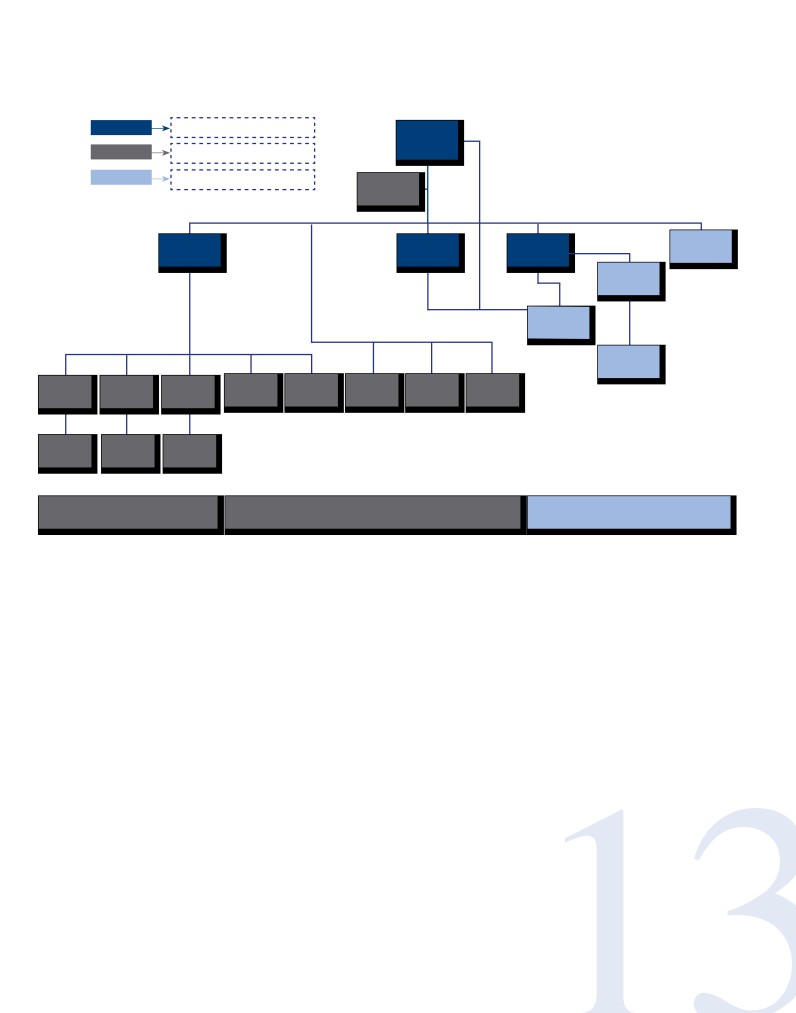
At the end of 2013, the corporate structure of the Group headed by DeA Capital S.p.A. (DeA Capital Group, or the Group) was as
summarised below:
Holding Companies
DeA Capital
S.p.A.
3.00%
Private Equity Investment
Alternative Asset Management
Funds and other
100%
Shareholdings
100%
100%
100%
IDeA
DeA Capital
83.65%(*)
DeA Capital
Capital Funds
Investments S.A.
IFIM
Real Estate
SGR
(Luxembourg)
IRE
40.32%
20.98%
IDeA FIMIT
SGR
100%
IRE
Advisory
Quota
Quota
Quota
Shareholding
Shareholding
Quota
Quota
Shareholding
Kenan
Sigla
IDeA
IDeA I
IDeA
Santé
AVA
ICF II
Investments
Luxembourg
OF I
Fund of Funds
EESS
Shareholding
Shareholding
Shareholding
GDS
Migros
Sigla
Private Equity
Private Equity Investment
Alternative
Investment “Direct”
“Indirect”
Asset Management
(*) Considering special shares, with limited economic rights, for approximately 10% of the company.
DeA Capital - Annual Financial Statements to 31 December 2013
17

Information for
SHAREHOLDER STRUCTURE - DEA CAPITAL S.P.A. (#)
22.5
%
Free float
3.8
%
58.3
%
DEB Holding
De Agostini S.p.A.
4.8
%
Mediobanca
10.6
%
Treasury stock
(#) Figures to 31 December 2013.
18 DeA Capital - Information for shareholders
shareholders
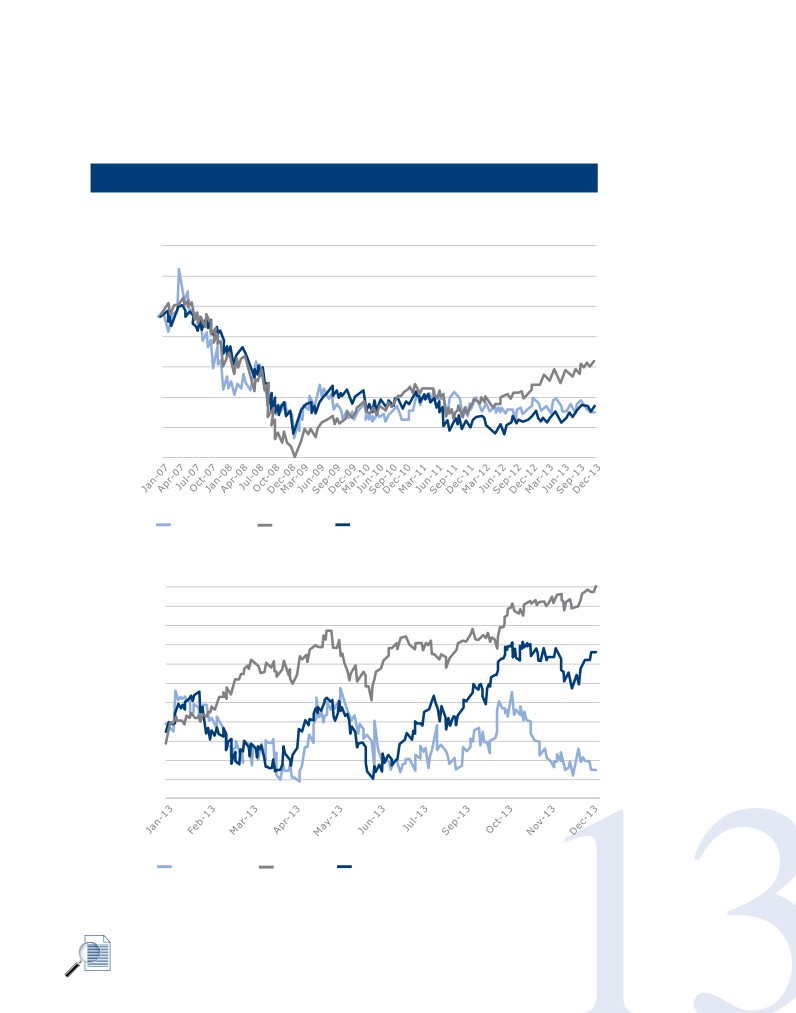
SHARE PERFORMANCE **
Period from 11 January 2007, when DeA Capital S.p.A. began operations, to 31 December 2013.
4,0
3,5
3,0
2,5
2,0
1,5
1,0
0,5
DeA Capital
LPX 50
FTSE All
Period from 1 January 2013 to 31 December 2013
1,75
1,70
1,65
1,60
1,55
1,50
1,45
1,40
1,35
1,30
1,25
1,20
DeA Capital
LPX 50
FTSE All
(**) Source: Bloomberg.
For further info:
section: Investor Relations
DeA Capital - Annual Financial Statements to 31 December 2013
19

The performance of the DeA Capital
share
The share prices recorded in 2013 are shown
The Company’s share price declined by 55.2%
below.
between 11 January 2007, when DeA Capital
S.p.A. began operations, and 31 December 2013.
(in EUR per share)
2013
In the same period, the FTSE All-Share® and
Maximum price
1.48
LPX50® fell by 52.2% and 26.7% respectively.
Minimum price
1.24
The DeA Capital share fell by 5.2% in 2013, while
Average price
1.35
the Italian market index FTSE All-Share® rose by
Price at 31 December 2013
1.27
17.6%, and the LPX50® gained 30.3%. In 2013,
the share’s liquidity was higher than in 2012, with
average daily trading volumes of around 120,000
(EUR million)
31 December 2013
shares.
Market capitalisation*
389
(*) capitalisation net of own shares: EUR 348 million.
Investor Relations
DeA Capital S.p.A. maintains stable and
In December 2008, the DeA Capital share joined
structured relationships with institutional and
the LPX50® and LPX Europe® indices.
individual investors. In 2013, as in previous
The LPX® indices measure the performance of
years, the Company has continued with its
the major listed companies operating in private
communication activities, including attendance
equity (Listed Private Equity or LPE). Due to its
at the STAR Conference, held in Milan in March
high degree of diversification by region and type
2013. In addition to one-to-one meetings with
of LPE investment, the LPX50® index has become
institutional investors, a presentation was also
one of the most popular benchmarks for the LPE
held on this occasion, to illustrate in detail new
asset class. The method used to constitute the
developments relating to the subsidiary IDeA
index is published in the LPX Equity Index Guide.
FIMIT SGR. In September, the Company met with
For further information please visit the website:
institutional investors in Paris and in October
attended the STAR Conference in London. During
on the GLPE Global Listed Private Equity Index,
the year the Company also held meetings and
the index created by Red Rocks Capital, a US
conference calls with institutional investors,
asset management company specialising in
portfolio managers and financial analysts from
listed private equity companies. The index was
Italy and abroad.
created to monitor the performance of listed
private equity companies around the world and is
Coverage of the DeA Capital stock is currently
composed of 40 to 75 stocks.
carried out by Equita SIM and Intermonte
For more information: www.redrockscapital.com
SIM, the two main intermediaries on the
(GLPE Index).
Italian market, with Intermonte SIM acting as
a specialist. The research prepared by these
The website is the primary mode of contact for
intermediaries is available in the Investor
investors, who may choose to subscribe to a
Relations section of the website www.deacapital.it.
For further info:
section: Investor Relations
20 DeA Capital - Report on Operations

mailing list and send questions or requests for
3. The DeA Capital Group’s
information and documents to the Company's
key Statement of Financial
Investor Relations area, which is committed to
Position and Income
answering queries promptly, as stated in the
Investor Relations Policy published on the site. A
Statement figures
quarterly newsletter is also published for investors
to keep them updated on the main items of news
The DeA Capital Group’s key income statement and statement
of financial position figures to 31 December 2013 are shown
on the Group, and analyse the Group’s quarterly
below, compared with the corresponding figure to
results and share performance. The mobile site,
31 December 2012.
stakeholders a further tool with which to access
December December
key information about the DeA Capital Group via
(EUR million)
31,2013
31,2012
their mobile phone or smartphone.
NAV/share (EUR)
2.30
2.60
Since July 2013, DeA Capital has strengthened
Group NAV
629.5
723.1
its presence on social networks: it has a profile
Investment portfolio
762.0
873.1
on Linkedin, appears on Slideshare with the most
Net financial position - Holding
recent of its key presentations to institutional
Companies
(138.7)
(141.6)
investors, and has an entry in Wikipedia. DeA
Net financial position consolidated
(127.7)
(123.6)
Capital is therefore continuing with its intention to
strengthen its presence on the web and to make
information for stakeholders available through
Year
Year
(EUR million)
2013
2012
many channels.
Parent Company net profit/(loss)
62.9
2.3
Group net profit/(loss)
(31.1)
(26.3)
Comprehensive income
(Group share)
(Statement of Performance - IAS 1)
(94.3)
62.5
The table below shows the change in the NAV during 2013.
Value
Change in
No.
per
Group NAV
Total value
Shares
share
(EUR m)
(m)
(€)
Group NAV at 31.12.12
723.1
274.6
2.63
Purchase of own shares
(0.9)
(0.6)
1.40*
Other comprehensive
income - Statement of
Performance - IAS 1
(94.3)
Other movements of NAV
1.6
Group NAV at 31.12.13
629.5
274.0
2.30
(*) Average price of purchases in 2013.
DeA Capital - Annual Financial Statements to 31 December 2013
21

The table below provides details of the Group’s Net Asset Value at 31 December 2013.
December 31,2013
December 31,2012
M€
% NIC €/Share
M€
% NIC
€/Share
Private Equity Investment
- Santè / GDS
221.2
29%
0.81
226.1
26%
0.82
- Kenan Inv. / Migros
132.4
17%
0.48
223.6
26%
0.81
- Funds- Private Equity / Real Estate
191.3
25%
0.70
180.8
21%
0.66
- Other (Sigla,..)
13.6
2%
0.05
15.0
2%
0.05
Total PEI (A)
558.5
73%
2.04
645.5
75%
2.34
Alternative Asset Management
- IDeA FIMIT SGR
145.5
19%
0.53
168.5
19%
0.61
- IDeA Capital Funds SGR
51.8
7%
0.19
53.8
6%
0.20
- IRE / IRE Advisory
6.2
1%
0.02
5.3
1%
0.02
Total AAM (B)
203.5
26%
0.74
227.6
26%
0.83
Investment Portfolio (A+B)
762.0
99%
2.78
873.1
101%
3.17
Otehr net assets (liabilities)
6.2
1%
0.02
(8.4)
-1%
(0.02)
NET INVESTED CAPITAL ("NIC")
768.2
100%
2.80
864.7
100%
3.15
Net Financial Debt Holdings
(138.7)
-18%
(0.50)
(141.6)
-16%
(0.52)
NAV
629.5
82%
2.30
723.1
84%
2.63
4. Significant events during
Loan agreement with Mediobanca - use
of the revolving line
the year
The significant events that occurred in 2013 are reported
In 2013, DeA Capital S.p.A. made net use of a further EUR
below.
20 million of its revolving credit line with Mediobanca - Banca
di Credito Finanziario S.p.A., bringing its overall exposure to
Private equity funds - paid calls/
EUR 120 million as of 31 December 2013.
distributions
Note that the above-mentioned lines are due to be repaid
In 2013, the DeA Capital Group increased its investment in the
via a single payment on 16 December 2015, although DeA
IDeA I FoF, ICF II, IDeA OF I and IDeA EESS funds following
Capital S.p.A. has the option to make full or partial early
total payments of EUR 24.5 million (EUR 5.9 million, EUR 8.0
repayment.
million, EUR 7.8 million and EUR 2.8 million respectively).
At the same time, the DeA Capital Group received capital
Purchase of 30% of IDeA SIM shares
distributions totalling EUR 22.9 million from the IDeA I FoF,
and subsequent liquidation of the
ICF II, IDeA OF I funds (EUR 20.3 million, EUR 2.1 million and
company
EUR 0.5 million respectively) to be used in full to reduce the
carrying value of the units.
On 25 February 2013, in compliance with the provisions of
various agreements reached with the former CEO of IDeA SIM,
In terms of net cash outlay, the IDeA EESS completed the
DeA Capital S.p.A. acquired the shares he held in IDeA SIM,
fourth and final closing on 12 April 2013, reaching the stated
equal to 30% of the company’s capital, bringing its stake
commitment target of EUR 100 million, with the DeA Capital
to 95%.
Group subscribing to a further commitment of EUR 2.5 million,
taking its total commitment in the fund to EUR 15.3 million.
Subsequently, on 11 April 2013, the shareholders’ meeting of
IDeA SIM voted to convert the company and rename it IDeA
Consulenza S.r.l., and at the same time put it into liquidation.
The shareholders’ meeting that approved the liquidation was
held on 3 September 2013.
22 DeA Capital - Report on Operations

Purchase of a further shareholding
Appointment of new Corporate Bodies
in IDeA FIMIT SGR
On 19 April 2013, the shareholders’ meeting of DeA Capital
On 27 February 2013, DeA Capital S.p.A. signed an
S.p.A. appointed the Company’s new Board of Directors
agreement with Inarcassa to acquire shares from the latter
and the new Board of Statutory Auditors, which will remain
representing 2.98% of the capital of IDeA FIMIT SGR; financial
in office for the three-year period until the approval of the
equity instruments issued by IDeA FIMIT SGR and held by
financial statements to 31 December 2015.
Inarcassa are excluded from the sale.
At the end of the shareholders’ meeting, the new Board of
The transaction was closed on 29 April 2013, once the pre-
Directors met to appoint Paolo Ceretti as the Chief Executive
emptive rights had expired. As a result of this, together with
Officer, and to vest the Chairman (Lorenzo Pellicoli) and the
other purchases, the DeA Capital Group’s total stake in IDeA
Chief Executive Officer with the necessary powers.
FIMIT SGR rose to 64.30%.
The Board of Directors also adopted resolutions relating to
corporate governance, and appointed independent director
IRE capital increase
Rosario Bifulco as Lead Independent Director. Furthermore,
it decided not to create a specific appointments committee,
On 19 March 2013 and 17 July 2013, the shareholders'
but to attribute its functions to the Remuneration and
meetings of IRE approved, respectively:
Appointments Committee, for which the related operating
regulations have been approved. The Board appointed
• a capital increase reserved for the company’s CEO, for
directors Severino Salvemini, Francesca Golfetto and Rosario
a stake of 3.75% in the company, against a payment of
Bifulco to the Remuneration and Appointments Committee,
approximately EUR 151 thousand, equal to a pro-rata
with Rosario Bifulco as chairman, and appointed Rosario
portion of the shareholders’ equity;
Bifulco, Francesca Golfetto and Severino Salvemini to the
• the issue of special shares, with limited economic rights,
Control and Risks Committee, with Severino Salvemini as
reserved for the company’s CEO, for 10% of the company.
chairman.
Lastly, the Board of Directors confirmed the appointment of
Dividends from Alternative
Lorenzo Pellicioli, the Chairman of the Board of Directors,
Asset Management
as the executive director responsible for monitoring the
effectiveness of the internal control and risk management
On 27 March 2013, the shareholders' meeting of IRE
system, and appointed Gian Piero Balducci (Chairman),
approved the company's financial statements to 31 December
Davide Bossi (Internal Audit) and Severino Salvemini to the
2012 and voted to pay out dividends (paid on 10 May 2013)
Supervisory Body pursuant to Legislative Decree 231/2001 for
totalling EUR 2.3 million, including EUR 2.2 million to the DeA
the period 2013-2015.
Capital Group.
On 16 April 2013, the shareholders’ meeting of IDeA Capital
Share buy-back plan
Funds SGR approved the company’s financial statements to
31 December 2012 and voted to pay dividends totalling EUR
On 19 April 2013, the shareholders’ meeting authorised the
4.4 million entirely to DeA Capital S.p.A. The dividend was
Board of Directors to buy and sell, on one or more occasions,
paid on 22 April 2013.
on a rotating basis, a maximum number of ordinary shares
in the Company representing a stake of up to 20% of share
On 17 April 2013, the shareholders’ meeting of IDeA FIMIT
capital.
SGR S.p.A. approved the company’s financial statements to 31
December 2012 and voted to pay out dividends totalling EUR
The plan replaced its predecessor approved by the
15.6 million (paid on 9 May 2013), including around EUR 10.0
shareholders’ meeting on 17 April 2012 (which was scheduled
million to the DeA Capital Group (taking account of the stake
to expire on 17 October 2013) and will pursue the same
actually held on the dividend payment date).
objectives as the previous plan, including the purchase of
own shares to be used for extraordinary transactions and
In summary, dividends paid during 2013 by the Alternative
share incentive schemes, to offer shareholders a means of
Asset Management business to the DeA Capital Group's
monetising their investment, to stabilise the share price and to
holding companies totalled EUR 16.6 million
regulate trading within the limits of current legislation.
(EUR 15.0 million in 2012).
The authorisation specifies that purchases may be carried
out up to the date of the shareholders’ meeting to approve
DeA Capital - Annual Financial Statements to 31 December 2013
23

the financial statements to 31 December 2013, and in any
allocated at EUR 1.289, which is the arithmetic mean of the
case not beyond the maximum duration allowed by law,
official price of ordinary DeA Capital shares on the Mercato
in accordance with all the procedures allowed by current
Telematico Azionario, the Italian screen-based trading system
regulations, and that DeA Capital may also sell the shares
organised and managed by Borsa Italiana S.p.A., on the
purchased for the purposes of trading, without time limits.
trading days between 19 March 2013 and 18 April 2013.
The unit price for the purchase of the shares will be set on a
case-by-case basis by the Board of Directors, but must not
The shareholders’ meeting of 19 April 2013 also approved a
be more than 20% above or below the share’s reference price
paid capital increase, in divisible form, without option rights,
on the trading day prior to each purchase. In contrast, the
via the issue of a maximum of 2,000,000 ordinary shares to
authorisation to sell own shares already held in the Company’s
service the DeA Capital S.p.A. Stock Option Plan for
portfolio, and any shares bought in the future, was granted
2013-2015.
for an unlimited period, to be implemented using the methods
considered most appropriate and at a price to be determined
The shareholders’ meeting also approved the adoption of the
on a case-by-case basis by the Board of Directors, which must
Performance Share Plan for 2013-2015. On the same date,
not, however, be more than 20% below the share's reference
in implementation of the shareholders’ resolution, the Board
price on the trading day prior to each individual sale (apart
of Directors of DeA Capital S.p.A. voted (i) to implement the
from in certain exceptional cases specified in the plan).
DeA Capital S.p.A. Performance Share Plan for 2013-2015
approved by the shareholders’ meeting, vesting the Chairman
On the same date, the Board of Directors voted to launch
of the Board of Directors and the Chief Executive Officer with
the plan to buy and sell own shares authorised by the
all the necessary powers, to be exercised severally and with
shareholders’ meeting, and to this end vested the Chairman of
full power of delegation; and (ii) to allocate a total of 393,500
the Board of Directors and the Chief Executive Officer with all
units (representing the right to receive ordinary shares in
the necessary powers, to be exercised severally and with full
the Company free of charge, under the terms and conditions
power of delegation.
of the plan) to certain employees of the Company, of its
subsidiaries and of the Parent Company De Agostini S.p.A.
In 2013, DeA Capital S.p.A. purchased around 0.6 million
who carry out important roles for the Company.
shares valued at about EUR 0.9 million (at an average price of
EUR 1.40 per share).
The shares allocated due to the vesting of units will be drawn
from the own shares already held by the Company so that the
Taking into account purchases made in previous years for
allocation will not have a nominally dilutive effect.
plans in place at the time, and uses of own shares to service
purchases relating to the alternative asset management
The shareholders’ meeting also approved the Company’s
business, at 31 December 2013 the Company owned
Remuneration Policy pursuant to art. 123-ter of the Testo
32,637,004 own shares (equal to about 10.6% of the share
Unico della Finanza law.
capital).
Stock option and performance
share plans
On 19 April 2013, the shareholders’ meeting approved
the DeA Capital S.p.A. Stock Option Plan 2013-2015. To
implement the resolution of the shareholders’ meeting, the
Board of Directors voted (i) to implement the DeA Capital
S.p.A. Stock Option Plan for 2013-2015 approved by the
shareholders’ meeting, vesting the Chairman of the Board of
Directors and the Chief Executive Officer with all the necessary
powers, to be exercised jointly or severally and with full power
of delegation; and (ii) to allocate a total of 1,550,000 options
to certain employees of the Company, its subsidiaries and the
Parent Company De Agostini S.p.A. who carry out important
roles for the Company.
In line with the criteria specified in the regulations governing
the DeA Capital S.p.A. Stock Option Plan for 2013-2015, the
Board of Directors also set the exercise price for the options
24 DeA Capital - Report on Operations

Sale of the stake held in Alkimis SGR
First closing of the IDeA Crescita
Globale (global growth) fund
On 11 July 2013, after obtaining the necessary authorisation,
DeA Capital S.p.A. sold its entire stake (10%) in Alkimis SGR
On 5 November 2013, the Board of Directors of IDeA Capital
for around EUR 0.1 million (in line with its carrying value at
Funds SGR authorised the first closing of the newly-created
30 June 2013).
IDeA Crescita Globale fund, for a commitment of around EUR
55 million, raised with the support of a leading Italian bank's
network of financial advisors.
"Milano Santa Giulia” initiative
The objective of the IDeA Crescita Globale fund is to invest in
On 31 July 2013, the Board of Directors of Risanamento S.p.A.
both private equity funds managed by operators with a proven
voted to accept the proposal formulated by IDeA FIMIT SGR,
track record of returns and solidity - focusing mainly on the
containing guidelines for the operation relating to the “Milano
buy-out, capital growth and emerging markets sectors - and
Santa Giulia” initiative, which provides for the creation of a
directly in operating companies, by jointly investing with
fund managed by IDeA FIMIT SGR.
other funds.
The completion of the above transaction depends on the
conditions precedent set out in the agreement being met,
Sale by subsidiary Générale de Santé
including, in particular, the finalisation of the necessary
of its psychiatric activities
agreements relating to the contribution, IDeA FIMIT SGR
obtaining the necessary financing on the Fund’s behalf, and
On 18 December 2013, Générale de Santé finalised the sale
the absence of impediments associated with the seizure order
of its psychiatric division (Medipsy), which has a turnover
currently in place for part of the real estate area.
of around EUR 150 million and 29 clinics in France, to the
Australian group, Ramsay Health Care.
On 23 December 2013, IDeA FIMIT SGR exercised its right
to extend the deadline for the binding offer until 31 March
Following this transfer and the sale of four rehabilitation
2014. On this date, should one or more of the conditions
centres, Générale de Santé has completed its plan to
precedent not be met, the parties will be free of all obligations
focus once again on medicine, surgery, obstetrics and the
arising from the acceptance of the new binding offer.
rehabilitation clinics included in the geographical centres in
which the Group is organised.
Purchase of Colliers business division
The combined operations had a beneficial effect of around EUR
200 million on the subsidiary’s net financial position.
On 16 October 2013, the subsidiary Innovation Real Estate
S.p.A. (IRE) purchased the business division of Colliers Real
Estate Services Italia S.r.l. (Colliers) relating to its property,
facility, project management and technical property services
activities (e.g. due diligence, regularisation etc.) against
payment in newly-issued IRE shares and the entry of Colliers
into the share capital of IRE in various phases.
Specifically, Colliers was granted a 3% stake in the share
capital of IRE in exchange for the transfer of the business
division.
Once two years from the date of the transfer have elapsed,
and subject to the achievement of the results set out in the
business plan of the division in question, Colliers will be
granted a further 3% stake in IRE.
The parties also agreed that should the business division post
a considerable overperformance, Colliers will be granted a
further 2% stake in IRE via the placement of another tranche
of the capital increase in cash (at nominal value).
DeA Capital - Annual Financial Statements to 31 December 2013
25

5. The results of the DeA Capital
restrict the credit market and increase the cost of capital. In
most of the emerging economies, domestic demand proved
Group
to be weaker than forecast, in contrast to foreign demand
from the advanced economies and China.
Consolidated results for the period relate to the operations of
the DeA Capital Group in the following businesses:
The financial markets were significantly influenced by
the quantity of liquidity injected into the global “system”.
• Private Equity Investment, which includes the reporting units
Volatility in the US and Europe abated slightly, and the main
involved in private equity investment, broken down into
international equities markets recorded positive returns (in
equity investments (Direct Investments) and investments in
local currency): in 2013, indices were therefore positive in
funds (Indirect Investments).
the US (29.6% for the S&P 500 and 38.3% for the NASDAQ)
and in Japan (56.7% for the NIKKEI 225). In Europe, the
• Alternative Asset Management, which includes reporting
gap between the peripheral countries, such as Italy (16.6%
units involved in asset management activities and related
for the FTSE MIB) and Spain (21.4% for the IBEX), and the
services, with a current focus on the management of private
central countries, such as Germany (25.5% for the DAX 30)
equity and real estate funds.
and France (18% for the CAC 40) narrowed significantly.
In the emerging countries, returns in local currency varied
Private Equity
widely in 2013: +2% in Russia, +9% in India, - 5.5% in
Brazil and -6.7% in China.
Global economic growth accelerated in the second half of
In terms of global indices, bond markets recorded a
2013, and a further improvement is expected in 2014 and
marginally negative return in 2013, due mainly to the
2015, mainly on the back of the recovery in the advanced
contribution of the US, which accounts for around 50% of
economies. However, there are still downside risks associated
the total. In Italy, however, the bond market recorded a
with the fragile situation in some countries.
positive return across all maturities, due to the reduction
in the country risk; the yield spread on ten-year treasury
In the US, the huge injections of liquidity by the Fed -
certificates fell in comparison with their German bund
together with low interest rates - have proved effective
counterparts, as did the default risk measured by the five-
in bolstering the economy. In Japan, too, expansionary
year credit default swap (CDS), which closed at 219 and 168
monetary policy combined with fiscal policy stimulus
bps respectively.
packages has generated positive effects on growth; the
devaluation of the yen triggered by such measures has
In general terms, the risks threatening the outlook for global
also helped. In China, despite the restrictive measures
economic recovery have not changed; these include the high
implemented by the government and central bank to prevent
unemployment level and the instability that could affect the
the development of property bubbles, total loans increased
financial and currency markets, especially in the emerging
substantially on the back of interest rates that are lower than
countries, following the end of expansionary monetary policy
the historical average. In the eurozone, however, the ECB
in the US. Added to these factors, there is the risk associated
did not introduce new monetary stimuli, and lending fell for
with the effects of very low inflation, especially in the
the fifth year running in most EU countries. This hampered
eurozone, which increases the burden of public debt in real
economic growth and hence made it difficult for employment
terms. In Europe, more sustained growth will be necessary
levels to rise.
to rebalance the public accounts; the ECB will therefore have
to adopt further longer-term expansionary monetary policy
The IMF’s latest estimates forecast growth of 3.7% in the
measures to stimulate lending and hence domestic demand.
global economy in 2014. Specifically the advanced economies
Moreover, it is essential that the banks are recapitalised and
are expected to experience growth of 2.2% (2.8% for the US
banking union is achieved through the centralisation of both
and 1% for the eurozone) and emerging economies growth
the supervisory and crisis management functions.
of 5.1%. In the US, domestic demand is expected to drive
growth, supported partly by the reduction in the tax burden.
However, signs of improvement in the macroeconomic
In the eurozone, the recession is giving way to recovery, albeit
environment continue to materialise. As an example, a
at different speeds in the various countries, thanks especially
recent update to the Composite Leading Indicator, the super-
to exports rather than public and consumer spending, which is
index developed by the OECD to assess growth prospects,
hampered by high levels of public and private debt.
showed an improvement in most of the advanced economies,
including the entire eurozone, especially Italy and France.
In China, the improvement recorded in the second half
In addition, rating agency Moody’s recently confirmed Italy’s
of 2013, mainly on the back of investment, will remain
creditworthiness at Baa2, while upgrading its outlook from
temporary to some extent, as a result of the measures to
negative to stable.
26 DeA Capital - Report on Operations
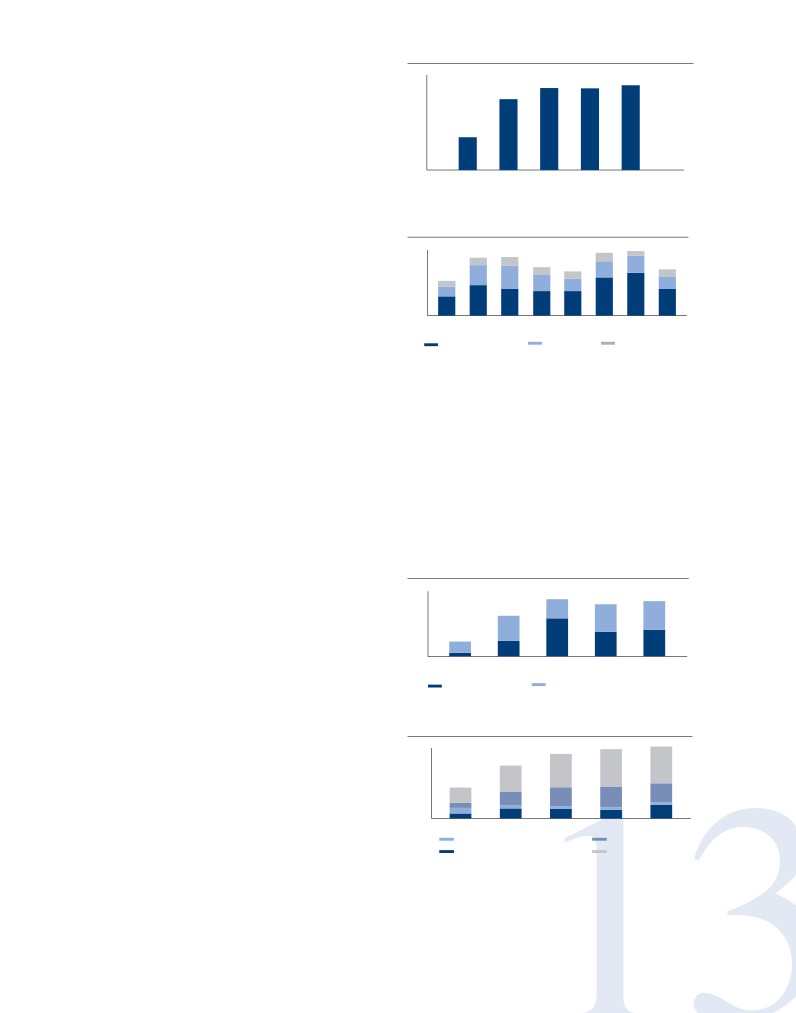
Investment prospects and the outlook for
Global value of investments in buy-outs (USD billion)
the European and global private equity
300
274
265
264
markets
250
229
Expectations that 2013 would be a positive year for the
200
private equity industry, expressed at the outset of the year,
150
106
were borne out by an increase in distribution flows, funds
100
raised and allocations to the asset class. Continuing low
50
interest rates increasingly drove investors to pursue returns.
0
2009
2010
2011
2012
2013
This is reflected in a particularly healthy high-yield debt
Source: Preqin
market, in which it was possible to finance new transactions
and refinance the capital structure, with the resulting
Global value of investments in buy-outs, by region
distributions to investors. Disposals of the best companies
(USD billion)
in the funds’ portfolios were also supported by a general
155
159
160
143
145
7%
13%
increase in the level of exit multiples.
13%
15%
120
120
109
27%
114
16%
26%
15%
86
35%
16%
80
17%
39%
28%
33%
28%
There have been a number of important new developments
28%
40
in the relevant regulatory framework and in the industry's
55%
53%
46%
51%
56%
61%
66%
57%
0
public profile in the US and Europe. In the US, as a result
1S
2S
1S
2S
1S
2S
1S
2S
2010
2010
2011
2011
2012
2012
2013
2013
of the Jobs Act, the SEC has eased some of the restrictions
North America
Europe
Asia and rest
on the offer of private equity funds to the public. This will
of the world
Source: Preqin
probably result in greater efforts to market retail products
by the large management companies with consolidated
structures that are better suited to responding to the
Investment increased compared with 2012 (+4%). However,
demands of a large database of limited partners. In Europe,
the trend is the exact opposite of that seen in 2012: the
the Alternative Investment Fund Managers Directive
second half of 2013 saw a reduction in investment levels.
(AIFMD), which imposes limits on fundraising from European
It is possible that activity has declined due to a more
investors by non-European managers, came into force in
cautious approach by managers in response to higher
July 2013. The effects of this legislation further restrict
prices. In geographical terms, investment growth has
European investors’ ability to access the best non-EU
been driven by activity in the US, supported mainly by the
private equity managers, who will have fewer opportunities
availability of low-cost credit with covenant-lite or covenant-
to market their funds in Europe.
free structures. The situation in Europe is broadly stable
compared with 2012.
The relationships between fund managers (FMs) and
Volume of disinvestments of buy-out funds
investors (LPs) have continued - albeit with a few
(USD billion)
exceptions - to move in favour of LPs. The level of
350
313
303
sophistication of investors has paved the way for some
285
300
250
222
33%
necessary changes in the industry. The search for
52%
200
53%
better returns is reflected in the desire to minimise fees
150
62%
81
100
67%
as a proportion of the fund’s performance. Most FMs
77%
47%
48%
50
38%
23%
have noticed that LPs are very keen to enter into joint
0
2009
2010
2011
2012
2013
investments, which are usually offered without management
2nd Half
1st Half
and performance fees. Moreover, the trend to reduce
Source: Preqin
management fees, driven by the collection of larger funds or
funds with more economies of scale, is continuing.
Number of disinvestments of buy-out funds
1,299
1,348
1500
1,210
1200
992
51%
51%
55%
900
49%
578
600
49%
26%
27%
30%
29%
300
16%
3%
19%
5%
4%
4%
17%
19%
15%
12%
19%
0
2009
2010
2011
2012
2013
Restructuring
Sale to GP
IPO
Trade Sale
Source: Preqin
DeA Capital - Annual Financial Statements to 31 December 2013
27
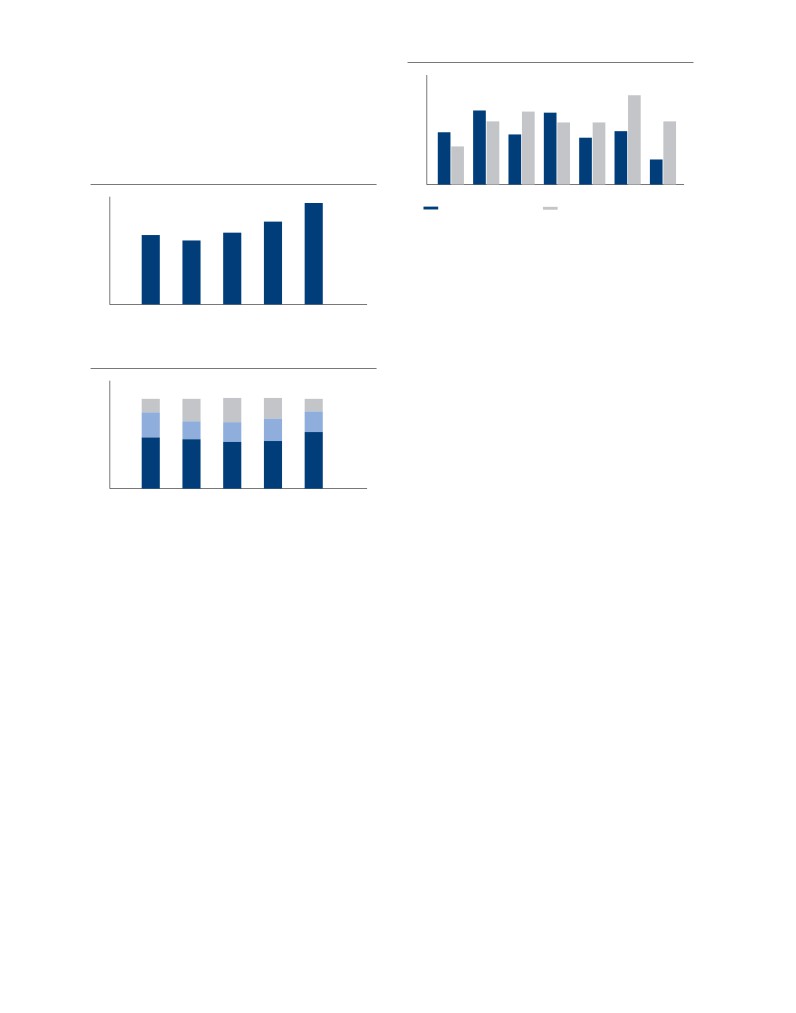
Global capital calls and distributions of PE funds (USD billion)
Disposals also showed an upward trend, increasing by 6%
from 2012 to 2013. This trend accelerated in the second half
100
82
of 2013, which gives rise to positive expectations for the
80
68
67
66
current year. The positive performance of the financial markets
58
57
57
58
60
re-opened a window for IPOs, which represented nearly
48
49
46
43
20% of exits by number in 2013. Secondary buy-out activity
40
35
decreased, and was probably hampered by high prices.
23
20
Global PE fundraising (USD billion)
0
468
1S2010 2S2010 1S2011 2S2011
1S2012 2S2012 1S2013
500
Capital calls (US$ Mld)
Distributions (US$ Mld)
382
400
320
331
Source: Thomson Venture Economics
295
300
200
As shown in figure 7, in the first half of 2013 and the whole
of 2012, distributions considerably exceeded capital calls at
100
global level. In view of the exit figures, we expect the same
0
performance in the second half of 2013 and for 2014, as the
2009
2010
2011
2012
2013
markets are relatively stable.
Source: Preqin
It is also possible to detect a number of investment themes
Global PE fundraising by region (USD billion)
associated with the current uncertain situation:
120
320
295
331
382
468
100
• in Europe, investment opportunities are concentrated in
ROW
15%
14%
25%
27%
23%
80
transactions involving SMEs in peripheral countries (Italy
EU
28%
23%
20%
22%
25%
and Spain), which are at a discount compared with prices in
60
other markets. Moreover, the regulatory and deleveraging
40
63%
NA
processes of the credit institutions will constitute a significant
57%
55%
52%
53%
20
opportunity for private credit and distressed debt funds;
0
• in the US, the traditional activities of buying medium-sized
2009
2010
2011
2012
2013
to large companies using loans, and restructuring company
Source: Preqin
processes or balance sheets, are continuing. Managers
with strong operating and company turnaround skills are
2013 was a good year for fundraising. Higher inflows,
in an advantageous position. In addition, managers able to
associated with a reduction in the number of funds collected,
offer loan capital to middle-market companies that are not
signify an increase in the average size of funds compared
financed by traditional sources are operating in a particularly
with 2013. The increase in inflows was mainly due to two
favourable environment;
factors: (i) the rising level of distributions, which implies
• lastly, emerging markets are likely to continue to be the
a reduction in investors' exposure, and (ii) an increase
main driver of global growth, albeit at a slower pace than
in allocations to private equity resulting from the higher
in recent years. The recent fall in public market valuations,
value of public equity (the “denominator effect”) generated
along with the depreciation of the respective currencies
by the financial markets’ good performances. Conversely,
and the continuation of the growth trend in domestic
fundraising in emerging countries, which fell by 25%, lost out
consumables, will enable managers focusing on these
to the more developed markets. The lower inflows associated
markets to obtain particularly attractive buying conditions.
with a reasonable level of valuations leads us to believe that
there are good prospects for investment in the next few
quarters in those geographical areas.
Private equity in Italy
The increase in global inflows involves a general rise in dry
Statistics provided by the Italian Association of Private Equity
powder (liquidity to be invested), which, in tandem with the
and Venture Capital (AIFI), and currently updated to the first
availability of debt, helps keep prices high. All of this augurs
half of 2013, show an increase in inflows compared with the
well for the continuation of the sell-offs of the more mature
same period in 2012. Capital raised by independent operators
portfolios in 2014.
on the market totalled EUR 162 million (a fall of 40% on the
first half of 2012).
The number of new investments increased to 161, with a total
value of EUR 1,407 million, i.e. a rise of 10% on the same
28 DeA Capital - Report on Operations

period in 2012. In value terms, the bulk of the resources
165% on 2012) and Milan (up 123% on 2012), while in the
invested, in line with previous years, went into buy-out
main markets of the core countries, investment remained
transactions, which attracted EUR 923 million, equivalent to an
more or less stable with good performances reported by
80% rise on the same half in the previous year.
London (up 94%) and Munich (up 86%)3.
Looking at the number of transactions, early stage,
with 65 investments, was in first place, having overtaken
expansion (+18%).
Real Estate in Italy
Turning to disinvestments, 65 investments were sold in the first
After a poor year in 2012, the worst year for property
half of 2013, an increase of 48% on the same period in 2012.
investment since the introduction of the euro, in 2013
The amount disinvested, calculated at historical acquisition cost,
institutional investors rediscovered an interest in the area,
totalled EUR 1,106 million, compared with EUR 141 million in
especially in retail property.
the first half of 2012 (+683%).
Institutional non-residential investment, including purchase
transactions completed via the transfer of units in property
Real Estate
funds, totalled around EUR 4.7 billion in 2013 (approximately
EUR 2.6 billion in 2012); of this, some EUR 2 billion
Real Estate in Europe
constituted investment in the retail sector, with the bulk of this
concentrated in the fourth quarter of the year.
Direct institutional investment in non-residential European
real estate in the fourth quarter of 2013 was EUR 53.4 billion,
In 2013, foreign investors, which are looking with increasing
up 46% quarter-on-quarter and 19% year-on-year. For the
interest at Italy thanks to the better returns offered,
full year 2013, investment came to EUR 153.9 billion, up 21%
represented 72% of the total, and showed a keen interest, in
compared with 20121.
particular, in purchases of large-scale retail products: shopping
centres, retail parks and factory outlet centres4. This positive
Although the main core countries in Europe, such as the
trend is likely to continue in 2014, thanks to the adjustment to
UK, Germany and France, continued to record good results,
the prices recorded, especially secondary assets.
the peripheral countries achieved the highest investment
growth in 2013. The positive signs were mainly apparent in
The geographical distribution of investments continued to be
commercial sales and purchases in Italy and Spain, which
concentrated in Milan and Rome. The volume of investment in
more than doubled their volume of investment compared with
commercial real estate in Milan and Rome grew significantly in
2012. In 2013, Italy and Spain combined represented 6.7%
2013, to EUR 2.3 billion from EUR 1.1 billion in 2012, beating
of European investment activity, compared with 3.4% in the
the average for the last five years5.
previous year.
In the Italian market as a whole, i.e. including non-
In 2013, net investment in Europe by investors outside the
institutional sales and purchases, prices continue to erode, and
region increased, especially in the peripheral countries.
have fallen significantly since 2008. With specific reference
70% of investment in these countries was made by cross-
to the 13 main markets, prices have fallen by 16.7% for new
border investors in 2013, compared with 46% in 2009, with
builds, 17.3% for offices and 14.1% for shops6. In the second
a substantial proportion of investors coming from North
half of 2013, prices fell 2% for new builds, 2.3% for offices
America2.
and 1.9% for stores. The process of repricing, which started
with a slight lag behind the fall in sales and purchases, will
With reference to office use, a comparison of the Milan
continue for the next two years, albeit at a slower pace, before
market with the major European cities is encouraging. With
reversing in 2016.
the exception of Brussels, where there was a 186% increase in
investment compared with 2012, Milan, at 84%, outperformed
Returns in the prime segment were largely unchanged with
many of Europe's main cities, with London up 38%, Hamburg
regard both to office use (6% in Milano and 6.25% in Rome)
30%, Frankfurt 16%, Munich 4% and Paris 2%. Conversely,
and retail (5.5% for high street, a slight fall on the third
Berlin and Madrid recorded falls of 14% and 32% respectively.
quarter of 2013, and 7% for shopping centres, in both cities).
Property for retail use, on the other hand, recorded excellent
The latest figures provided by the Osservatorio sul Mercato
performances in Europe in 2013, with considerable investment
Immobiliare (OMI) of the Italian Land Agency (which include
growth in the main peripheral countries, such as Madrid (up
non-institutional operations) show that the fall in the volume
1. CBRE, European Investment Quarterly Q4 2013.
3. BNP Real Estate, Main Investment Markets in Western Europe, Q4 2013.
2 .BNP Real Estate, performance of real estate market in 10 European Tier
4. CBRE, Italy Investment Market View Q4 2013.
2 markets.
5. BNP Real Estate, Investments in Italy Q3 2013.
6. Nomisma, 3rd Report on Property Market
DeA Capital - Annual Financial Statements to 31 December 2013
29
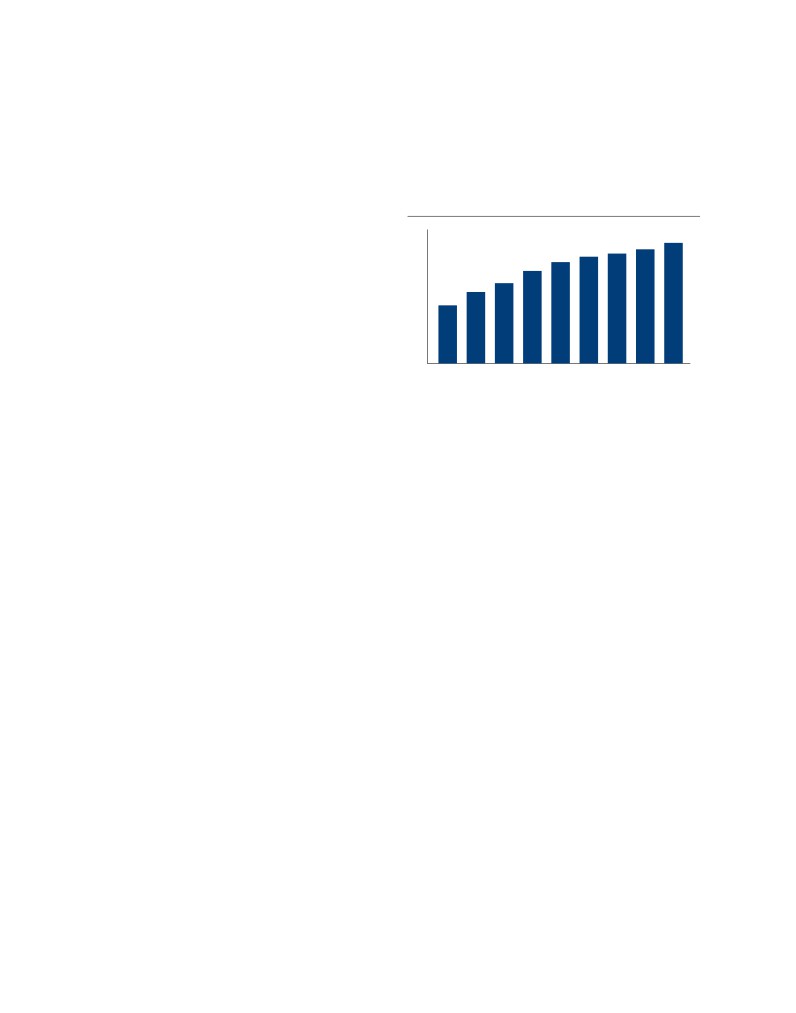
Real estate funds in Italy
of sales and purchases of real estate is slowing. In the first
three quarters of 2013, the number of transactions fell by
Estimated to total about EUR 38.3 billion, Italian real estate
13.8%, 7.7% and 6.6% respectively compared with the first
funds represent about 10.4% of European real estate funds in
three quarters of the previous year7.
terms of net assets, and in 2014 this percentage is projected
to increase to about 10.8%8. Real estate assets consisting of
Non-residential sectors also recorded significantly lower
372 property funds operating in Italy increased to EUR 49.2
volumes in the first three quarters of 2013. The biggest falls
billion, from approximately EUR 47.3 billion in December
were in the office sector, which reported a decrease of 11.7%
2012. The assets of all funds are forecast to exceed EUR 50
in the volume of sales and purchases in the third quarter,
billion in 20149.
while the commercial sector and production sector declined by
NAV of real estate funds in Italy (EUR billion)
8.2% and 9.4% respectively.
45
40
35
30
25
20
15
10
5
0
2006
2007
2008
2009
2010
2011
2012 2013E 2014E
Source: Scenari Immobiliari
The first-half 2013 report on real estate funds prepared by
Assogestioni and IPD indicates the countercyclical properties of
the Italian real estate fund market, which continues to expand
despite the adverse macroeconomic situation. Inflow in the
first half of 2013 was EUR 701 billion, while total assets were
around EUR 42 billion, an increase of 0.4% on the previous
half year (-0.5% year-on-year). The net assets of the 209 real
estate funds reviewed remained stable at about EUR 26 billion,
compared with December 201210.
7. Italian Land Agency, OMI - 3rd Quarter 2013
9. Real Estate Scenarios, Real Estate Funds in Italy and Abroad,
8. Real Estate Scenarios, Real Estate Funds in Italy and Abroad,
November 2013
November 2013
10. Amount refers only to Italian real estate funds surveyed by Assogestioni.
30 DeA Capital - Report on Operations
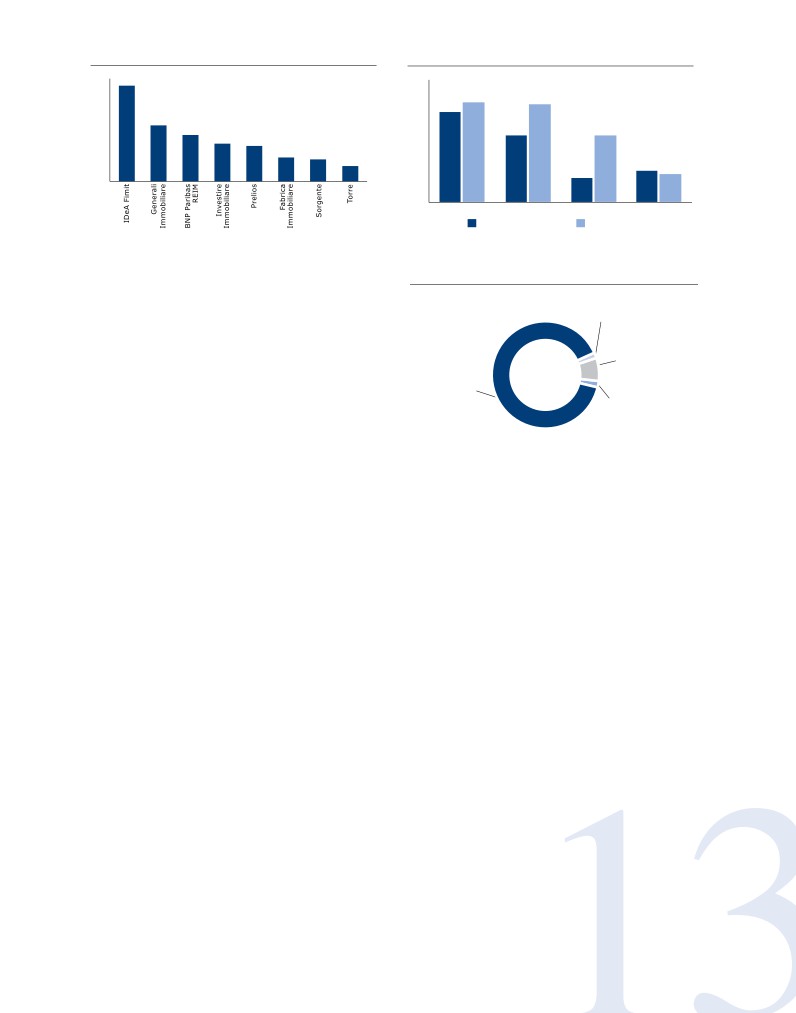
AUM of the eight largest real estate asset managers (EUR billion)
Purchases and sales (EUR billion)
10
3,0
9
8
2,5
7
6
2,0
5
4
1,5
3
2
1,0
1
0
0,5
0,0
2010
2011
2012
giu-13
Purchases
Sales
Source: Assogestioni - June 2013
During the first half of 2013, nine new funds were launched,
Allocation of assets
one of which was speculative and all of which targeted
qualified or institutional investors and were created from
1,8
%
contributions.
Shareholdings
At the end of the first half of 2013, properties and real
%
6,8
property rights made up 89.5% of the assets of the property
Transferable
funds surveyed by Assogestioni. The percentage by intended
89,5
%
securities
use remained unchanged with 53.8% of investments
Real estate
1,9
%
concentrated in the office space sector. Retail properties
Other
accounted for 14.6%, while residential made up 10.1%
Source: Assogestioni
and other investments (barracks, telephone exchanges
and land) 9.5%.
In the first six months of 2013, property worth EUR 675
At the end of the first half of 2013, 90% of supply in the
million was purchased, reflecting a significant increase on the
sector consisted of reserved funds holding assets of about
previous year’s volumes. Purchases in the first half of 2013
EUR 21 billion. Retail funds, however, represented 10% of
alone exceeded total property purchases for the whole of 2012
supply, with net assets of around EUR 4.6 billion (EUR 5 billion
(EUR 498 million, of which EUR 217 million were in the first
including funds not surveyed by Assogestioni).
half). Disposals were in line with the previous year. In the first
half of 2013, disposals totalled EUR 673 million, compared
In terms of retail funds, direct property assets, net of portfolio
with EUR 609 million in the first six months of 2012. In the
movements, fell by around 2.35% in value in the first half of
whole of 2012, the figure was EUR 1,633 million11.
2013 compared with the second half of 2012 and around 4.4%
11. Assogestioni - Half-year report on Italian real estate funds, 1H 2013.
DeA Capital - Annual Financial Statements to 31 December 2013
31
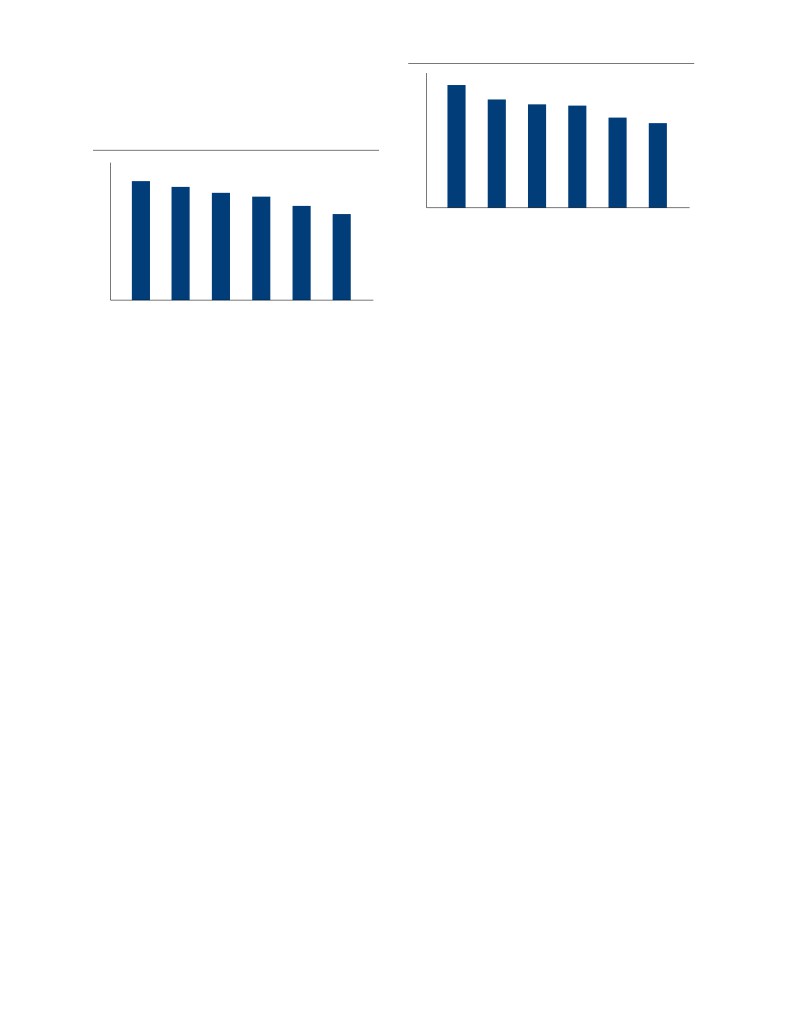
NAV of retail funds (EUR billion)
versus the first half of 2012 . In June 2013, retail property
fund assets totalled around EUR 6.7 billion (EUR 7.3 billion
8
including those not surveyed by Assogestioni).
7
6
5
Real estate assets of retail funds (EUR billion)
4
3
10
9
2
8
1
7
0
6
1H 2008
1H 2009
1H 2010
1H 2011
1H 2012
1H 2013
5
Source: Scenari Immobiliari
4
3
60% of existing retail property funds are due to expire by
2
2016, generating an excess of supply that the market will
1
struggle to absorb. The Finance Ministry is examining a decree
0
1H 2008
1H 2009
1H 2010
1H 2011
1H 2012
1H 2013
that will allow for a further two-year extension for property
Source: Scenari Immobiliari
funds with expiry dates of 31 December 2014 at the latest.
It will only be possible to use this period, if granted, for the
purposes of completing the liquidation of investments.
12. Nomisma, 3rd Report on 2013 Property Market
32 DeA Capital - Report on Operations

The DeA Capital Group’s investment
Private Equity Investment
portfolio
In terms of equity investments, at 31 December 2013, the
The composition of the DeA Capital Group's investment
DeA Capital Group was a shareholder of:
portfolio in the Private Equity Investment and Alternative
Asset Management businesses, as defined above, are
• Santé, the indirect parent company of Générale de Santé
summarised in the table below.
(valued at EUR 221.2 million);
• Kenan Investments, the indirect Parent Company of Migros
(valued at EUR 132.4 million);
Investment portfolio
• Sigla Luxembourg, the parent company of Sigla (valued at
December 31, 2013
EUR 12.1 million).
n.
Euro/Mln.
The DeA Capital Group is also a shareholder in five companies
Equity investments
8
367.2
(Elixir Pharmaceuticals Inc., Kovio Inc., Stepstone, Harvip
Funds
12
191.3
Investimenti and Soprarno SGR - whose total value at
31 December 2013 was EUR 1.5 million).
Private Equity Investment
20
558.5
Alternative Asset Management(*)
4
203.5
With regard to funds, at 31 December 2013, the DeA Capital
Group held units in:
Investment portfolio
24
762.0
(*) Equity investments in subsidiaries relating to Alternative
• IDeA I FoF (valued at EUR 94.7 million);
Asset Management are valued using the equity method
• IDeA OF I (valued at EUR 56.9 million);
in this table.
• ICF II (valued at EUR 23.8 million);
• IDeA EESS (valued at EUR 3.0 million);
Details of portfolio asset movements in 2013 are provided
• AVA (valued at EUR 2.2 million);
in the sections on Private Equity Investment and Alternative
• seven venture capital funds (with a total value of
Asset Management below.
approximately EUR 10.7 million).
Valuations of equity investments and funds in the portfolio
reflect estimates made using the information available on the
date this document was prepared.
DeA Capital - Annual Financial Statements to 31 December 2013
33

Equity investments in associates
SANTÉ (PARENT COMPANY OF GDS)
HEADQUARTERS:
INVESTMENT DETAILS:
France
On 3 July 2007, DeA Capital S.p.A. finalised the
purchase, through its wholly-owned subsidiary
SECTOR:
DeA Capital Investments S.A., of a 43.01%
Healthcare
stake in Santé S.A., the parent company of
Générale de Santé S.A. both directly and
WEBSITE:
through Santé Dévéloppement Europe S.A.S.
At 31 December 2013, the DeA Capital Group's
stake was 42.89% (i.e. 42.99% in economic
terms).
Its activities include medicine, surgery, obstetrics,
oncology and radiotherapy, subacute pathologies
BRIEF DESCRIPTION:
and rehabilitation.
Founded in 1987 and listed on the Eurolist
market in Paris since 2001, Générale de Santé
The company operates under the following names:
is a leading player in the private healthcare
Générale de Santé Cliniques (acute care), Dynamis
sector in France with revenues of about EUR
(rehabilitation) and Généridis (radiotherapy).
1,900 million at end-2013.
Générale de Santé
Change
France is the second largest country in Europe
(mln E)
2013
2012
%
in terms of annual healthcare expenditure
Revenues
1,870
1,929
-3.1%
after Germany. Its healthcare system is one
EBITDA
226
240
-5.8%
of the most advanced in the world, is still
heavily fragmented and contains numerous
EBIT
104
115
-9.4%
Leading player in the
independent hospitals.
Group net profit
111
56
99.8%
private healthcare
+159
The company has approximately 19,000
Net financial debt
(610)
(769)
mln €
sector in France
employees and a total of around 75 clinics. In
addition, it is the main independent association
of doctors in France (almost 4,500 doctors).
In the consolidated financial statements to 31
December 2013, the investment in Santé, which
is recorded under “Investments in associates”, is
valued at EUR 221.2 million (EUR 226.1 million
at 31 December 2012). The change compared
with the figure reported at 31 December 2012 is
attributable to the combined effect of the increase
in shareholders’ equity of EUR 2.7 million (largely
34 DeA Capital - Report on Operations

due to the positive change in fair value of the
This revenues performance translated into a
interest rate swaps taken out to hedge interest
lower EBITDA figure, although the decline was
rate risk on debt exposure) and the impact on the
minimal thanks to the prudent management of
income statement (EUR -7.6 million), including the
operating costs. The significant improvement
effect of aligning the value of the holding.
in net profit compared with 2012 is attributable
to the net capital gains from the disposals
Despite operating in an environment of constant
mentioned above.
pressure on prices (tariffs in the medicine, surgery
and obstetrics sector fell by 0.21%) and strong
Net financial debt at the end of December 2013
competition from the public sector (supported, in
(EUR -610 million) was a huge improvement on
an environment of excess supply, by government
the end-2012 figure (EUR -769 million), due to
policies), GDS’ operating performance confirmed
positive operating cash flow and a significant
the company’s ability to develop through service
positive contribution from clinic sales.
volume growth and a resilient operating result
based on close attention to improving operating
Going forward, the completion of the Medipsy
efficiency.
sale allows the Group to focus more on its core
business of medicine, surgery and obstetrics
At the same time, following the completion of
and to continue with its reorganisation into
the sale of Medipsy (psychiatric sector), related
“hubs” (chains of clinics that optimise provision
rehabilitation clinics and some other non-strategic
of a service by tailoring it to the requirements
clinics in the medicine, surgery and obstetrics
of the relevant geographical area). The
sector, GDS achieved a considerable reduction in
aim of the reorganisation is to develop the
net debt, creating the ideal conditions in which to
increasingly integrated and customised
tackle the expiring refinancing operations this year
provision of medical care, which will support
(October 2014).
revenues growth and operating efficiency
improvements.
More specifically, in terms of operating
performance, revenues in 2013 declined compared
The company is ideally placed to take
with the previous year (-3.1% as reported), but
advantage of the gradual market transition
rose (+1.3%) on a same-structure basis, despite
from full hospitalisation services to outpatient
the unfavourable effect of there being two fewer
provision (which is subject to less price
working days than in 2012 and the trend in tariffs
pressure in relative terms). Outpatient
noted above.
provision has now exceeded 50% of total
services provided by GDS, placing the company
in a clear leadership position vis-a-vis its
public- and private-sector competitors.
DeA Capital - Annual Financial Statements to 31 December 2013
35
SIGLA LUXEMBOURG (PARENT COMPANY OF SIGLA)
Change
Sigla (mln E)
2013
2012
%
Loans to customers*
74.5
81.7
-8.9%
Revenues from loans
to customers
1.9
3.6
-48.5%
HEADQUARTERS:
INVESTMENT DETAILS:
CQS granted
90.8
78.2
16.2%
Italy
On 5 October 2007, DeA Capital Investments
Revenues from CQS
5.3
3.6
46.5%
finalised the acquisition of a stake (currently
SECTOR:
41.39%) in Sigla Luxembourg, the holding
Group net profit
(0.4)
(1.7)
75.2%
Consumer credit
company that controls Sigla, which operates
* Net receivables exclude salary-backed loans (CQS)
in Italy and provides consumer credit for non-
WEBSITE:
specific purposes.
With specific reference to salary-backed loans,
BRIEF DESCRIPTION:
the reversal of the trend of monthly declines that
Sigla, which is recorded in the special list
had dogged this sector throughout the whole
pursuant to art. 107 of the T.U.B. (Italian
of the 2012 financial year continued in 2013;
consolidated banking law) with effect from
this was due to the increasing effectiveness of
31 March 2011, specialises in personal loans
the legal measures relating to the restructuring
and "salary-backed loans". It is a benchmark
of the distribution chain for loans (inter alia,
operator in the provision of financial services to
the obligation for agents to stipulate one-firm
households throughout Italy, chiefly through a
agreements, with the resulting concentration of
network of agents.
loans in a limited number of larger partners such
as Sigla).
The company’s product range of salary-backed
loans and personal loans was expanded in
In an environment where the difficulties associated
2011 to include the servicing of portfolios of
with both the ongoing effects of the economic crisis
unsecured non-performing loans (personal
on the propensity to spend and the consequences
loans and credit cards).
of the deleveraging by lending banks continue to
Innovative operator
be felt, Sigla - one of the few remaining operators
of non-performing
The investment in Sigla Luxembourg,
in the sector that is independent from banks - is
which is recorded under “Investments in
gradually focusing its business model on its role
loans
associates”, is worth around EUR 12.1 million
as a link in the distribution chain for salary-backed
in the consolidated financial statements to
loans. In this way, it aims to supplement the direct
31 December 2013 (EUR 12.3 million at 31
distribution channel provided by the banks and to
December 2012). The decrease compared with
act as a hub for agents in the territory, the size
31 December 2012 is largely due to the loss
of which is not consistent with the management
made in the period.
needs of an increasingly complex regulatory
framework.
In terms of operating performance, Sigla
recorded a net loss in 2013, although it was
At the same time, pending a stronger recovery
an improvement on the figure for the same
in lending volumes, the company is maintaining
period of the previous year, thanks to the
its focus on gradually reducing operating risks
positive impact of the rise in revenues from
(specifically, it has recently started to arrange
salary-backed loans and measures to make
personal loans on behalf of banks, in contrast to its
the company’s structure more efficient, which
original direct lending approach, and has created
offset the reduction in revenues from personal
a without-recourse salary-backed product) and
loans.
on continuously improving the efficiency of the
structure.
36 DeA Capital - Report on Operations

Equity investments in other companies
KENAN INVESTMENTS (INDIRECT PARENT COMPANY OF MIGROS) >>
INVESTMENT DETAILS:
HEADQUARTERS:
In 2008, the DeA Capital Group acquired about
Turkey
17% of the capital of Kenan Investments, the
company heading the structure to acquire the
SECTOR:
controlling interest in Migros.
Food retail
The investment in Kenan Investments
BRIEF DESCRIPTION:
is recorded in the consolidated financial
WEBSITE:
Migros was established in 1954, and is the leading
statements to 31 December 2013 at EUR 132.4
company in the food retail sector in Turkey.
million (compared with EUR 223.6 million at
31 December 2012). The decrease of EUR
Growth in the food retail sector in Turkey is a
91.2 million was due to the fall in the value
relatively recent phenomenon, brought about by
of Migros shares (TRY 16.00 per share at 31
the transition from traditional systems such as
December 2013, compared with approximately
bakkals (small stores typically run by families) to
TRY 21.5 per share at 31 December 2012, and
an increasingly widespread organised distribution
the depreciation of the Turkish lira against the
model driven by expansion and the modernisation
euro (2.97 TRY/EUR at 31 December 2013
process under way in Turkey.
versus 2.36 TRY/EUR at 31 December 2012).
The effect on the DeA Capital Group’s NAV of
The company has a total of 995 outlets
this change in fair value was partially offset by
(at 30 September 2013) with a total net sales area
the reduction in estimated carried interest to
of approximately 883,000 square metres.
be paid, based on the total capital gain. This
has also fallen compared with the figure at
Migros is present in all seven regions of Turkey,
31 December 2012 (positive effect of EUR
Leading company
and has a marginal presence in Kazakhstan and
12.8 million).
Macedonia.
in the food retail
2013 was a year of mixed fortunes for
The company operates under the following names:
the Turkish economy. While the country
sector in Turkey
Migros, Tansas and Macrocenter (supermarkets),
experienced more sustained growth than
5M (hypermarkets), Ramstore (supermarkets
in the previous year (an estimated 3.9%
abroad) and Kangurum (online store).
at December 2013 compared with 2.2% in
2012), the economy’s extreme volatility to
foreign investment flows associated with the
current account deficit (7.5% of GDP in 2013)
Chenge
Migros (mln YTL)
2013
2012
%
Revenues
7,127
6,482
9.9%
EBITDA
469
430
9.1%
EBIT
230
194
18.4%
Group net profit
(463)
88
n.a.
Net financial debt
(1,883)
(1,465)
-418 mln YTL
DeA Capital - Annual Financial Statements to 31 December 2013
37

translated into a strong devaluation of the
In terms of operating performance, Migros
currency (-26% against the euro in 2013),
recorded revenues growth of 9.9% from 2012
given the country’s wait-and-see monetary
to 2013, driven by the expansion of the sales
policy. In turn, this currency depreciation,
network (122 new supermarkets in 12 months),
driven by internal socio-political unrest and the
accompanied by parallel growth in EBITDA.
outflow of foreign investment associated with
the withdrawal in the expansionary monetary
Net profit fell in 2013 versus 2012, due to the
policy in the US, contributed to the rise in
effect of the performance of the Turkish lira on the
inflation (+7.4% in December 2013 compared
debt component in euro (in 2013 it weakened from
with +6.2% in 2012).
2.36 TRY/EUR to 2.97 TRY/EUR, while in 2012 it
had strengthened from 2.44 TRY/EUR to 2.36
The greater stability in the TRY/EUR exchange
TRY/EUR).
rate seen in February 2014 occasioned by a
decisive move in interest rates by the Turkish
Note that Migros has confirmed its intention, for
central bank, can only be assessed in light
the medium term, to maintain a sustained rate
of political developments in the near future,
of expansion of its network, by opening 100-150
depending on which party wins the imminent
new supermarkets a year, with a focus on areas of
round of political elections (local elections at
150-350 square metres (with a particular emphasis
end-March, presidential elections in summer
on fresh products, a growing proportion of private
2014 and political elections in summer 2015).
label products and a much broader choice than
that offered by discount stores), as well as two
The food retail sector in Turkey remained
to three hypermarkets each year. At the same
buoyant in the first nine months of 2013, with
time, the company confirmed double-digit revenue
sustained growth in commercial space (8.4%)
growth guidance and an EBITDA margin in the 6%
and the supermarket sector (2.9% y/y), which
to 6.5% range.
maintained its dominant position. Note too
that in 2013, the Sabanci Group acquired a
controlling stake in Carrefour Turkey, a joint
venture between Sabanci and Carrefour (which
now holds a minority interest). During the
same period, the new owners of the discount
chain ok completed the acquisition of DiaSa,
Turkey’s fourth-largest discount chain.
38 DeA Capital - Report on Operations

Other investments
OTHER INVESTMENTS
Other equity investments, managed
to 31 December 2013, due mainly to the
opportunistically with a view to increasing their
investment in Soprarno SGR (EUR 1.3 million).
value, were valued at approximately EUR 1.5
million in the consolidated financial statements
Registered
Business
Company
office
sector
% holding
Elixir Pharmaceuticals Inc.
USA
Biotech
1.30
Distressed real estate
Harvip Investimenti S.p.A. Italy
and other investments
19.18
Kovio Inc.
USA
Printed circuitry
0.42
Soprarno SGR
Italy
Asset management company
20.00
Stepstone Acquisition Sàrl
Luxembourg
Special Opportunities
36.72
DeA Capital - Annual Financial Statements to 31 December 2013
39

Funds
At 31 December 2013, the DeA Capital Group’s Private
EUR 191.3 million (corresponding to the estimated fair value
Equity Investment business included investments (other
calculated using the information available on the date this
than the investment in the IDeA OF I fund and in the AVA
document was prepared).
real estate fund, which are classified under “Investments in
associates”, based on the units held) in two funds of funds
Residual commitments for all the funds in the portfolio were
(IDeA I FoF and ICF II), one theme fund (IDeA EESS) and
approximately EUR 104.8 million.
another seven venture capital funds, totalling approximately
40 DeA Capital - Report on Operations
IDeA OF I
IDEA OPPORTUNITY FUND I >>
INVESTMENT DETAILS:
HEADQUARTERS:
IDeA OF I is a closed-end fund under Italian law for
- on 31 March 2009, it acquired a 17.43%
Italy
qualified investors, which began operations on
stake in Grandi Navi Veloci S.p.A., an
9 May 2008, and is managed by IDeA Capital
Italian shipping company that transports
SECTOR:
Funds SGR.
passengers and goods on various routes
Private equity
around the Mediterranean Sea. On 2 May
At its meeting on 20 July 2011, the Board of
2011, with the finalisation of Marinvest's
WEBSITE:
Directors of IDeA Capital Funds SGR approved a
entry into the shareholder structure of
number of regulatory changes. These included
Grandi Navi Veloci S.p.A. through the
changing the name of the IDeA Co-Investment
subscription of a reserved capital increase,
Fund I to IDeA Opportunity Fund I
the stake held by IDeA OF I was diluted to
(IDeA OF I) and extending investment
9.21%. Subsequently, IDeA OF I’s decision
opportunities to qualified minority interests,
not to subscribe, on a pro-rata basis, to
independently or via syndicates.
two further capital increases (August 2012,
January 2014) led to a dilution in its holding
The DeA Capital Group has a total commitment of
to 3.12%;
up to EUR 101.8 million in the fund.
- on 10 February 2011, it invested in bonds
BRIEF DESCRIPTION:
convertible into shares of Euticals S.p.A.,
IDeA OF I has total assets of approximately
Italian leader in the production of active
EUR 217 million. Its objective is to invest via
ingredients for pharmaceutical companies
syndicates with a lead investor, independently, or
that operate in the generics sector. As part
Fund size:
by purchasing qualified minority interests.
of the extraordinary operation that led to the
transfer of the controlling share in Euticals
At 31 December 2013, IDeA OF I had called up
S.p.A., on 3 April 2012 these bonds were
217 million
76.6% of the total commitment and distributed
transferred into the acquisition vehicle,
1.0% of that commitment, after making nine
Lauro 57, which now owns 100% of Euticals
Euro
investments:
S.p.A.; in exchange, a stake of 7.77% was
acquired in the same acquisition vehicle;
- on 8 October 2008, it acquired a 5% stake in
Giochi Preziosi S.p.A., a company active in the
- on 25 February 2011, it purchased a 9.29%
production, marketing and sale of children’s
stake in Telit Communications PLC, the third-
games with a product line covering childhood to
largest producer of machine-to-machine
early adolescence;
communications systems in the world.
The stake held by IDeA OF I was
- on 22 December 2008, it acquired a 4% stake
subsequently diluted to 8.53% due to the
in Manutencoop Facility Management S.p.A.
exercise of stock options by the company's
by subscribing to a reserved capital increase.
management;
This company is Italy’s leading integrated
facility management company, providing and
- on 11 September 2012, an agreement was
managing a wide range of property management
signed with the main shareholder Filocapital
services and other services for individuals and
S.r.l. for an investment in Iacobucci HF
government agencies;
Electronics S.p.A. (Iacobucci), a company
DeA Capital - Annual Financial Statements to 31 December 2013
41

that manufactures trolleys for aeroplanes
- on 12 December 2012, IDeA OF I acquired
and trains, and specialises in the design,
a stake of 29.34% in 2IL Orthopaedics, a
production and marketing of components
Luxembourg-registered vehicle which, through
for aircraft fittings and furnishings. At the
an initial purchase offer and subsequent delisting
date of this document, the investment
of previously listed shares, obtained full control
in Iacobucci consists of (i) a stake of
(on 15 February 2013) of English company
12.4%, subscribed following the reserved
Corin Group PLC (Corin) Corin is active in the
capital increase on 7 August 2013 (EUR 3
production and marketing of orthopaedic devices,
million) and (ii) a bond that is convertible
especially for hips and knees;
into shares of Iacobucci, of EUR 6 million,
subscribed at the closing date. Under the
- on 27 February 2013, the fund acquired a
signed agreement, IDeA OF I may invest a
stake of 10% in Elemaster S.p.A. (Elemaster),
maximum of EUR 12 million in Iacobucci;
the leading operator in ODM (original
in addition to the foregoing, the fund may
design manufacturing) and EMS (electronic
subscribe to a further capital increase of
manufacturing service) i.e. the design and
EUR 3 million following the approval of
construction of electronic equipment. At the same
the financial statements to 31 December
time, the IDeA Efficienza Energetica e Sviluppo
2013, subject to the achievement of specific
Sostenibile Fund, also managed by IDeA Capital
levels of EBITDA and Net Financial Debt.
Funds SGR, invested an equal amount.
If the above-mentioned convertible bond
were converted and the conditions for a
The units held in IDeA OF I were reported in the
capital increase materialised, IDeA OF I
consolidated financial statements to 31 December
would acquire an overall stake of 34.9% in
2013 at around EUR 56.9 million, versus EUR
Iacobucci;
48.1 million at 31 December 2012. The change is
attributable to capital calls of EUR +7.8 million,
- on 9 October 2012, IDeA OF I acquired an
capital distributions of EUR -0.5 million and an
indirect stake of 4.6% in Patentes Talgo S.A.
increase of EUR 6.2 million in the fair value, and
(Talgo), a Spanish company that designs and
pro-rata net loss for the period of EUR 4.7 million.
produces solutions for the rail sector, chiefly
sold on the international market (high-
The table below shows the key figures for
speed trains, and maintenance vehicles and
IDeA OF I at 31 December 2013.
systems);
Registered
Year of
Fund Subscribed % DeA Capital
Fondo IDeA OF I (E)
office commitment
Size commitment
in fund
IDeA Opportunity
Fund I
Italy
2008
216,550,000
101,750,000
46.99
Residual
Commitments
Total residual
commitment in:
Eur
23,829,850
42 DeA Capital - Report on Operations
IDeA I FoF
IDEA I FUND OF FUNDS >>
INVESTMENT DETAILS:
HEADQUARTERS:
IDeA I FoF is a closed-end fund under Italian law
The funds are diversified in the buy-out
Italy
for qualified investors, which began operations on
(control) and expansion (minorities) categories,
30 January 2007 and is managed by IDeA Capital
with overweighting towards medium- and
SECTOR:
Funds SGR.
small-scale transactions and special situations
Private equity
(distressed debt/equity and turnaround).
The DeA Capital Group has a total commitment
WEBSITE:
of up to EUR 173.5 million in the fund.
At 31 December 2013, IDeA I FoF had called
up 78.5% of its total commitment and had
BRIEF DESCRIPTION:
made distributions totalling approximately
IDeA I FoF, which has total assets of approximately
34.5% of that commitment.
EUR 681 million, invests its assets in units of
unlisted closed-end funds that are mainly active in
the local private equity sector in various countries.
It optimises the risk-return profile through careful
diversification of assets among managers with
Fund size:
a proven track record of returns and solidity,
different investment approaches, geographical
areas and maturities.
681 million
At the date of the latest report available, the IDeA
Euro
I FOF portfolio was invested in 42 funds with
different investment strategies; these funds in
turn hold 438 positions, with varying maturities,
in companies active in geographical regions with
different growth rates.
DeA Capital - Annual Financial Statements to 31 December 2013
43
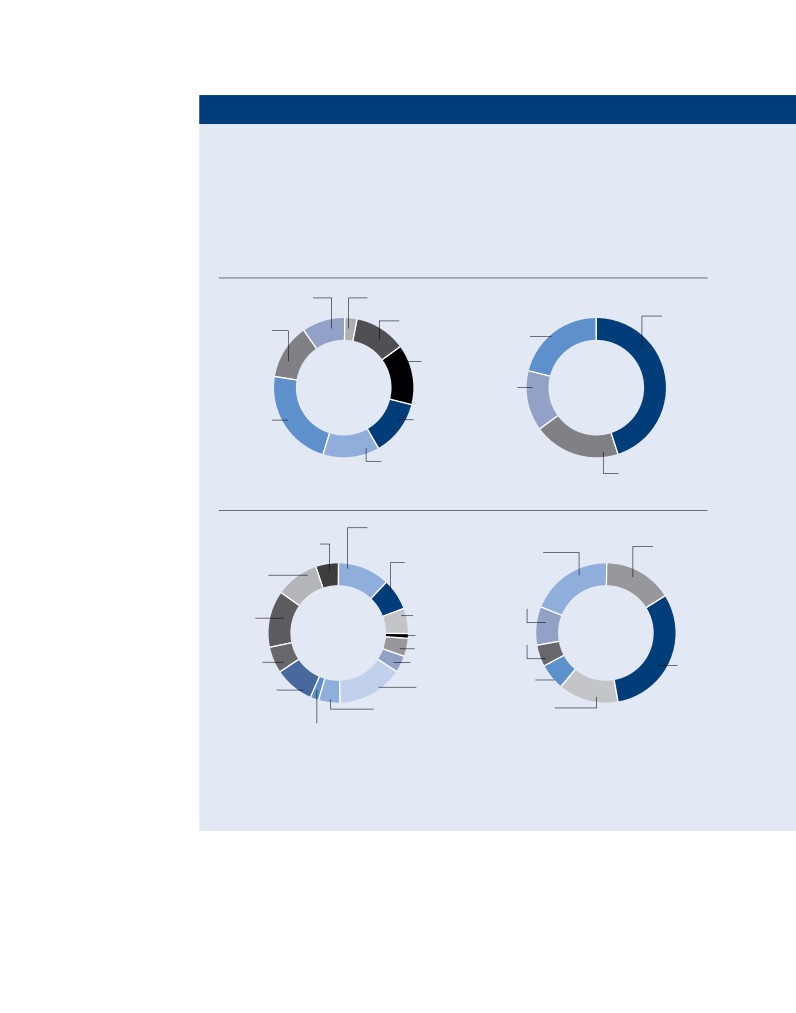
IDEA I FOF
OTHER IMPORTANT
INFORMATION:
Below is an analysis of the portfolio, updated to
the date of the latest report available, broken
down by year of investment, geographical area,
sector and type.
Breakdown by vintage1 (%)
Breakdown by geography2 (%)
2012
2013
10
3
Europe
2000-2006
45
2011
12
Global
13
21
2007
14
RoW
14
2010
2008
23
13
2009
13
US
20
Breakdown by industry1 (%)
Breakdown by type2 (%)
Cons.
Distressed
Discretionary
portfolio
Large
12
Special
5
Buyout
Raw
Cons.
Situations
16
materials
Staples
19
10
7
Expansion
Energy
Medicale
6
9
13
Healthcare 1
VC
Financials 4
5
Mid
Transport
Media
4
Buyout
6
Asset Based PE
31
Industrial
IT 15
6
9
Luxury 5
Small Buyout
14
RE 2
Notes:
1. % of the FMV of the investment at 31 December 2013.
2. % of fund size based on paid-in exposure (capital invested + residual commitments) at 31 December 2013.
44 DeA Capital - Report on Operations

The units in IDeA I FoF had a value of
distributions of EUR 20.3 million and an
approximately EUR 94.7 million in the consolidated
increase in fair value of EUR 6.0 million.
financial statements to 31 December 2013 (EUR
103.1 million at 31 December 2012). The decrease
The table below shows the key figures for IDeA
was due to capital calls of EUR 5.9 million, capital
I FOF at 31 December 2013:
Registered
Year of
Fund Subscribed % DeA Capital
IDeA I FoF (E)
office commitment
Size commitment
in fund
IDeA I Fund of Funds
Italy
2007
681,050,000
173,500,000
25.48
Residual
Commitments
Total residual
commitment in:
Eur
37,354,542
DeA Capital - Annual Financial Statements to 31 December 2013
45

ICF II
ICF II
HEADQUARTERS:
INVESTMENT DETAILS:
Italy
ICF II is a closed-end fund for qualified
The fund started building its portfolio by focusing
investors under Italian law, which began
on funds in the area of mid-market buy-
SECTOR:
operations on 24 February 2009 and is
outs, distressed and special situations, loans,
Private equity
managed by IDeA Capital Funds SGR.
turnarounds and funds with a specific sector slant,
targeting in particular opportunities offered in the
WEBSITE:
The DeA Capital Group has a total commitment
secondary market.
of up to EUR 51 million in the fund.
At the date of the latest report available, the ICF
BRIEF DESCRIPTION:
II portfolio was invested in 27 funds with different
ICF II, with total assets of EUR 281 million,
investment strategies; these funds in turn hold
invests in units of unlisted closed-end funds
positions in around 254 companies with varying
that are mainly active in the local private
maturities that are active in geographical areas
equity sector of various countries. It optimises
with different growth rates.
Fund size:
the risk-return profile through careful
diversification of assets among managers with
At 31 December 2013, ICF II had called up 49.7%
a proven track record of returns and solidity,
of its total commitment and had made distributions
281 million
different investment approaches, geographical
totalling approximately 6.7% of that commitment.
areas and maturities.
Euro
OTHER IMPORTANT
INFORMATION:
Below is an analysis of the portfolio, updated to
the date of the latest report available, broken
down by year of investment, geographical area,
sector and type.
46 DeA Capital - Report on Operations
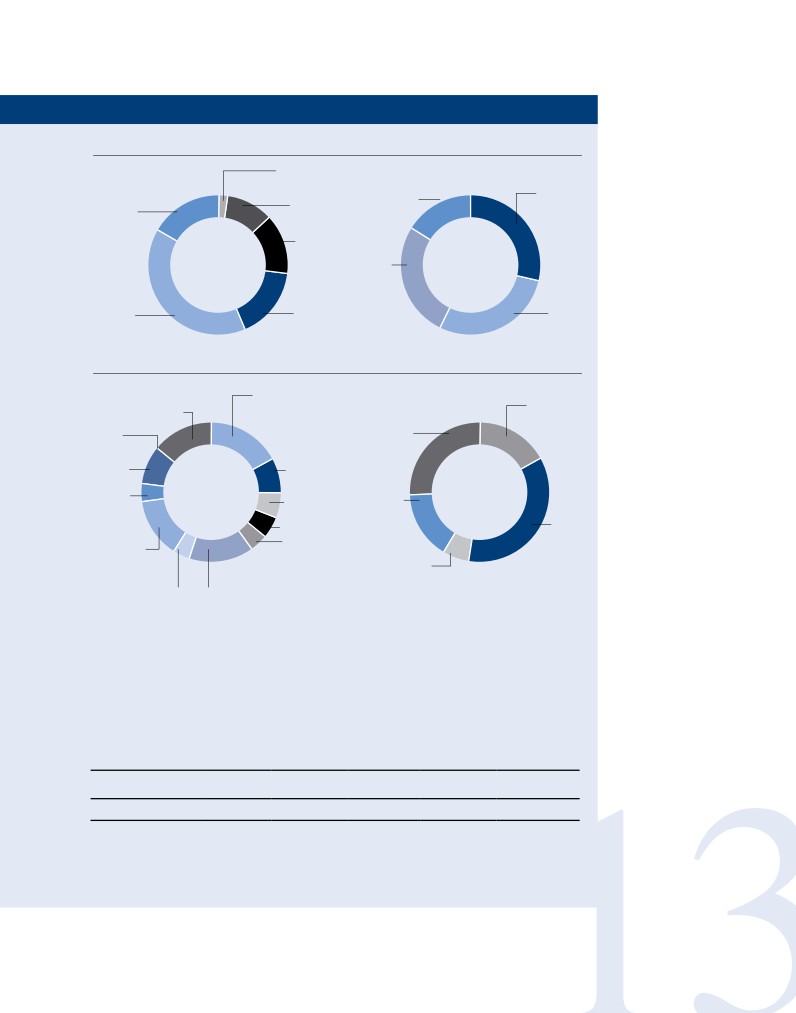
Breakdown by vintage1 (%)
Breakdown by geography2 (%)
2004-2008
2
Europe
Global
2009
29
2013
16
11
17
2010
14
RoW
27
2012
2011
US
40
17
29
Breakdown by industry1 (%)
Breakdown by type2 (%)
Cons.
Distressed
Discretionary
Large
Portfolio
17
Buy-out
14
17
Other
Special
Situations
0
26
Energy
Cons.
9
Staples 8
Materials
Expansion
Healthcare 6
4
16
Small /
Financial 5
Mid
Media 4
Buy-out
Industrial
36
14
VC
6
Leisure 4
IT 15
1. % of the FMV of the investment at 31 December 2013.
2. % of the commitment based on paid-in exposure (capital invested + residual commitments) at 31 December 2013.
The units in ICF II had a value of approximately
capital distributions of EUR 2.1 million and an
EUR 23.8 million in the consolidated financial
increase in fair value of EUR 1.4 million.
statements to 31 December 2013 (EUR 16.5
million at 31 December 2012). The increase
The table below shows the key figures for ICF
was due to net investments of EUR 8.0 million,
II at 31 December 2013:
Registered
Year of
Fund Subscribed % DeA Capital
ICF II (E)
office commitment
Size commitment
in fund
ICF II
Italy
2009
281,000,000
51,000,000
18.15
DeA Capital - Annual Financial Statements to 31 December 2013
47
IDeA EESS
IDEA - EFFICIENZA ENERGETICA E SVILUPPO SOSTENIBILE
HEADQUARTERS:
INVESTMENT DETAILS:
Italy
IDeA EESS is a closed-end fund under Italian
On 27 February 2013, the fund invested EUR 8.5
law for qualified investors, which began
million to acquire a stake of 10% in Elemaster
SECTOR:
operating on 1 August 2011 and is managed
S.p.A. (Elemaster), the leading operator in ODM
Private equity
by IDeA Capital Funds SGR.
(original design manufacturing) and EMS (electronic
manufacturing service) i.e. the design and
WEBSITE:
The DeA Capital Group has a total
construction of electronic equipment. At the same
commitment in the fund of EUR 15.3 million
time, the IDeA OF I fund, also managed by IDeA
(increased since 31 March 2013 at the time of
Capital Funds SGR, invested an equal amount.
the fourth and final closing on 12 April 2013).
On 23 April 2013, the fund invested EUR 3.5
BRIEF DESCRIPTION:
million to acquire a 29.9% stake in SMRE, which
IDeA EESS is a closed-end mutual fund under
specialises in the design and construction of
Italian law for qualified investors, which
industrial systems to cut and process fabric,
seeks to acquire minority and controlling
and also has know-how in electrical drives with
Fund size:
interests in unlisted companies in Italy
particularly innovative technology in integrated
and abroad, by investing jointly with local
electric transmission. The acquisition was
partners.
conducted via subscription to a reserved capital
100 million
increase in SMRE.
The fund is dedicated to investing in small
Euro
and medium-sized manufacturing and service
On 27 December 2013, the fund invested EUR
companies operating in the field of energy
3.9 million in the special purpose acquisition
savings and the efficient use of natural
company (SPAC) GreenItaly 1, of which EUR 3.5
resources. It focuses on the development of
million was in ordinary shares, which entitle it
faster and cheaper solutions in the use of
to 10% of the company, and EUR 0.4 million,
renewable energy sources while continuing
in its capacity as promoter of the vehicle, in
to reduce CO2 emissions effectively, against
special shares without voting rights. The aim
a backdrop of sustained growth in global
of GreenItaly 1, a themed SPAC, is to acquire
energy demand.
a non-listed medium-sized Italian company
operating in the efficient use of resources,
On 8 May 2012, the fund made its first
efficient energy or environmental sector within
investment, acquiring 48% of Domotecnica
24 months of the IPO (completed on
Italiana S.r.l. (independent Italian
27 December 2013).
franchising of thermo-hydraulic installers)
for approximately EUR 2.6 million, as well
After the end of the financial year, on 13 February
as a commitment to subscribe, within the
2014, the fund invested EUR 7.8 million relating to
next 18 months, to capital increases totalling
a first tranche in Meta System S.p.A. and in one
approximately EUR 1.0 million (IDeA EESS
of its affiliates. Under the terms of the agreement,
pro-rata share, of which EUR 0.3 million was
the fund can invest up to a total of EUR 12.5
paid on 7 December 2012).
million, for a stake of 17%, by 30 May 2014. Meta
48 DeA Capital - Report on Operations

System is active in the production of transmission
consolidated financial statements to 31
equipment, electronic antennas, alarm systems for
December 2013 (EUR 0.6 million at 31
the automotive sector, as well as home telematics
December 2012). The increase was the
systems and battery chargers for electric vehicles.
combined effect of net investments of EUR
2.8 million and the decrease in fair value of
At 31 December 2013, IDeA EESS had called up
EUR 0.4 million.
about 26.0% of the total commitment.
The table below shows the key figures for
The units in IDeA EESS had a value of
IDeA EESS at 31 December 2013:
approximately EUR 3.0 million in the
Registered
Year of
Fund Subscribed % DeA Capital
IDeA EESS (E)
office commitment
Size commitment
in fund
IDeA Efficienza
Energetica e Sviluppo
Sostenibile
Italy
2011
100,000,000
15,300,000
15.30
Residual
Commitments
Total residual
commitment in:
Eur
11,329,645
DeA Capital - Annual Financial Statements to 31 December 2013
49

AVA
AVA - ATLANTIC VALUE ADDED
HEADQUARTERS:
INVESTMENT DETAILS:
Italy
Atlantic Value Added - Closed-End Speculative
On 29 December 2011, the fund made its first
Real Estate Mutual Fund is a mixed-
investment totalling EUR 41.5 million through the
SECTOR:
contribution fund for qualified investors that
purchase/subscription of units in the Venere Fund,
Private equity - Real Estate
began operations on 23 December 2011.
a closed-end speculative reserved real estate fund
managed by IDeA FIMIT SGR. The Venere Fund's
WEBSITE:
DeA Capital Investments subscribed to a
real estate portfolio consists of 16 properties
commitment in the fund of up to EUR 5
primarily for residential use located in northern
million (corresponding to 9.1% of the total
Italy.
commitment), with payments of EUR 2.6
million already made at 31 December 2013.
The units in the AVA fund had a value of
approximately EUR 2.2 million in the consolidated
BRIEF DESCRIPTION:
financial statements at 31 December 2013
The Atlantic Value Added fund began its
(compared with EUR 2.4 million at 31 December
operations with a primary focus on real estate
2012). The decrease was mainly due to the result
investments in the office and residential
for the period.
markets. The duration of the fund is eight years.
The table below shows the key figures for the AVA
The fund, which is managed by the subsidiary
fund at 31 December 2013.
IDeA FIMIT SGR, has a commitment of around
EUR 55 million.
Fund size:
Registered
Year of
Fund Subscribed % DeA Capital
AVA (E)
office commitment
Size commitment
in fund
55 million
Atlantic Value Added
Italy
2011
55,000,000
5,000,000
9.08
Residual
Commitments
Euro
Total residual
commitment in:
Eur
2,370,000
50 DeA Capital - Report on Operations

UNITS IN VENTURE CAPITAL FUNDS
Units in venture capital funds are all concentrated
The table below shows the key figures for
in the Parent Company DeA Capital S.p.A., and are
venture capital funds in the portfolio at 31
valued at approximately EUR 10.7 million in the
December 2013.
financial statements to 31 December 2013
(EUR 10.1 million at end-2012).
Venture Capital
Funds
Registered
Year of
Fund Subscribed % DeA Capital
Dollars (USD)
office
commitment
Size
commitment
in fund
Doughty Hanson & Co
Technology
UK EU
2004
271,534,000
1,925,000
0.71
GIZA GE Venture Fund
Delaware
III
U.S.A.
2003
211,680,000
10.000.000
4.72
Cayman
Israel Seed IV
Islands
2003
200,000,000
5,000,000
2.50
Pitango Venture
Delaware
Capital II
U.S.A.
2003
125,000,000
5,000,000
4.00
Pitango Venture
Delaware
Capital III
U.S.A.
2003
417,172,000
5,000,000
1.20
Total Dollars
26,925,000
Eur (€)
Nexit Infocom 2000
Guernsey
2000
66,325,790
3,819,167
5.76
Sterlings (GBP)
Amadeus Capital II
UK EU
2000
235,000,000
13,500,000
5.74
Residual
Commitments
Total residual
commitment in:
Eur
4,228,169
Alternative Asset Management
At 31 December 2013, DeA Capital S.p.A. was
20.98% through IFIM and the remaining 3%
the owner of:
directly);
• 83.65%(*) of IRE/IRE Advisory (which
• 100% of IDeA Capital Funds SGR;
operates in project, property and facility
• 64.30% of IDeA FIMIT SGR (including
management and real estate brokerage).
40.32% held through DeA Capital Real Estate,
(*) Taking into account the B shares, of approximately 10% of share capital, with limited economic rights.
DeA Capital - Annual Financial Statements to 31 December 2013
51

IDEA CAPITAL FUNDS SGR
HEADQUARTERS:
INVESTMENT DETAILS:
Italy
IDeA Capital Funds SGR operates in the
• Industrial sector;
management of private equity funds (funds of
• Investment strategy and stage (buy-outs,
SECTOR:
funds, co-investment funds and theme funds).
venture capital, special situations, etc.);
Alternative Asset
The asset management company manages five
• Geographical area (Europe, US and the Rest of
Management -
closed-end private equity funds, including three
the World);
Private Equity
funds of funds (IDeA I FoF and ICF II, and
• Maturity (commitments with investment periods
IDeA Crescita Globale which targets the retail
diluted over time).
WEBSITE:
market), a "direct" co-investment fund (IDeA
OF I) and a sector fund dedicated to energy
The investment strategies of the "direct" co-
efficiency (IDeA EESS).
investment fund focus on minority interests in
businesses that primarily concentrate on Europe,
The investment programmes of IDeA Capital
and diversification as a function of the appeal of
Funds SGR, which are regulated by the Bank
individual sectors by limiting investments during
of Italy and Consob, leverage the management
the early stage and excluding purely real estate
team's wealth of experience in the sector.
investments.
The investment strategies of funds of funds
The investment philosophy of the EESS sector
focus on building a diversified portfolio in
fund focuses on growth capital and buyout
private equity funds in the top quartile or that
private equity to support the growth of small and
are next-generation leaders with balanced
medium-sized enterprises with excellent products/
asset allocation through diversification by:
services in the energy efficiency and sustainable
development arena. Investments in infrastructure
Assets under
for the generation of energy from renewable
management:
sources or early stage investments can be made in
compliance with regulatory restrictions.
1.3 billion Euro
52 DeA Capital - Report on Operations

The table below summarises the value of assets under management and management fees for IDeA
Capital Funds SGR at 31 December 2013:
Assets Under
Management
Management fees
(EUR million)
at 31.12.2013
at 31.12.2013
Breakdown of funds
IDeA I FoF
681
5.1
IDeA OF I
216
2.5
ICF II
281
2.8
IDeA EESS
100
3.5
IDeA Crescita Globale
55
0.4
Total IDeA Capital Funds SGR
1,333
14.2
With regard to operating performance, the
that the company’s net result was hit by the
company launched a new fund of funds, IDeA
unfavourable one-off effect of the increase
Crescita Globale, in November 2013. The fund,
in the IRES tax rate to 36% (compared with
which is intended for retail investors, entailed
27.5% ordinary tax). This effectively cancelled
a total commitment of EUR 55 million. Note
out the increase in revenues recorded.
IDeA Capital Funds SGR
(EUR million)
2013
2012
AUM
1,333
1,238
Management fees
14.2
13.5
EBT
7.2
6.9
Net profit
4.0
4.5
DeA Capital - Annual Financial Statements to 31 December 2013
53
IDEA FIMIT SGR
HEADQUARTERS:
INVESTMENT DETAILS:
Italy
IDeA FIMIT SGR is the biggest independent
real estate asset management company in
SECTOR:
Italy, with around EUR 9.2 billion in assets
Alternative Asset
under management and 32 managed funds
Management - Real Estate
(including five listed funds). This puts it among
the major partners of Italian and international
WEBSITE:
investors in promoting, creating and managing
closed-end mutual real estate investment
funds.
IDeA FIMIT SGR undertakes three main lines of
business:
• the development of mutual real estate
investment funds designed for institutional
clients and private investors;
most importantly, an emphasis on real estate
• the promotion of innovative real estate
value. In particular, the asset management
financial instruments to satisfy investors’
company specialises in "core" and "core plus"
increasing demands;
properties, but its major investments also include
• the professional management (technical,
major "value added" transactions.
administrative and financial) of real estate
Assets under
funds with the assistance of in-house experts
Due in part to successful transactions concluded in
management:
as well as the best independent technical,
recent years, the asset management company is
legal and tax advisors on the market.
able to rely on a panel of prominent unit-holders
9.2 billion Euro
consisting of Italian and international investors
The company has concentrated its investments
with a high standing such as pension funds, bank
in transactions with low risk, stable returns,
and insurance groups, capital companies and
low volatility, simple financial structures and,
sovereign funds.
54 DeA Capital - Report on Operations

The table below summarises the value of assets
under management and management fees for
IDeA FIMIT SGR at 31 December 2013:
Assets Under
Management
Management fees
(EUR million)
at 31.12.2013
at 31.12.2013
Breakdown of funds
Atlantic 1
637
5.6
Atlantic 2 Berenice
399
2.3
Alpha
449
4.1
Beta
203
2.6
Delta
334
2.7
Listed funds
2,022
17.3
Reserved funds
7,157
47.3
Total IDeA FIMIT SGR
9,179
64.6
DeA Capital - Annual Financial Statements to 31 December 2013
55
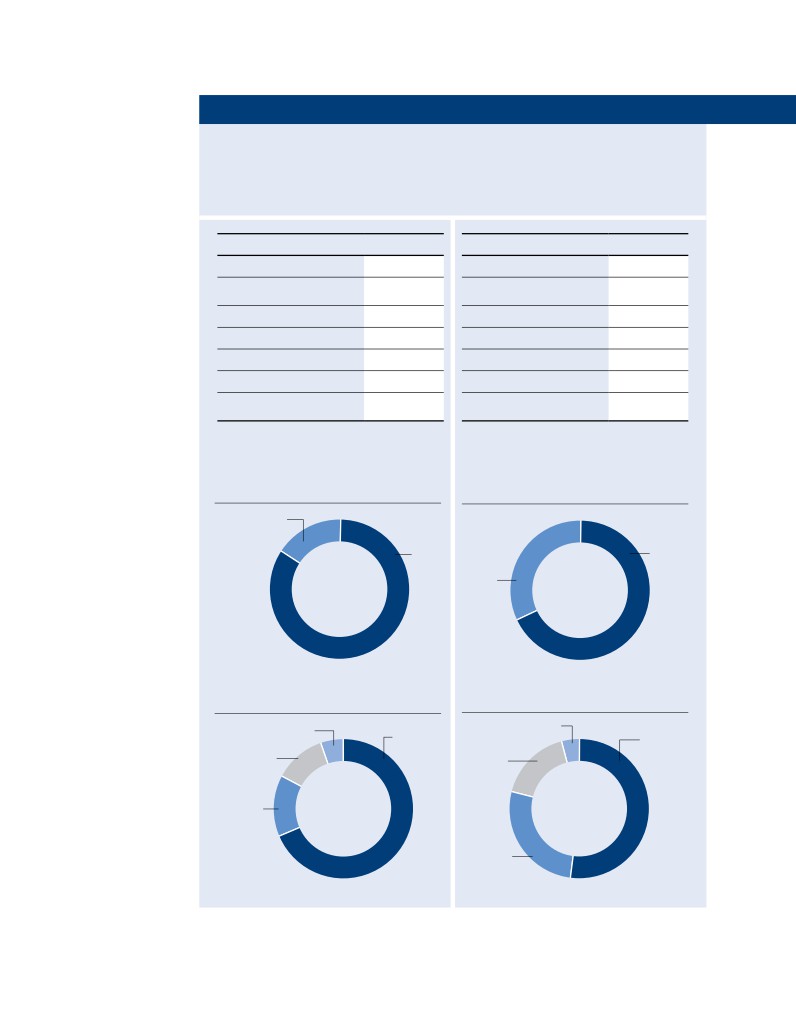
Some of the key financials of the listed funds
analysis of the real estate portfolio at the date
(Atlantic 1, Atlantic 2, Alpha, Beta and Delta
of the latest report available, broken down by
- figures in EUR) in the asset management
geographical area and by intended use.
portfolio are also provided below, with an
Atlantic 1
31.12.2013
Atlantic 2 - Berenice
31.12.2013
Market value of properties
608,170,000
Market value of properties
385,580,000
Historical cost and
Historical cost and
capitalised charges
622,150,590
capitalised charges
408,254,622
Financing
355,596,609
Financing
181,641,936
Net Asset Value (NAV)
263,447,963
Net Asset Value (NAV)
206,556,333
NAV/unit (EUR)
505.2
NAV/unit (EUR)
344.3
Market price/unit (EUR)
252.9
Market price/unit (EUR)
187.5
Dividend yield from
Dividend yield from
investment*
5.08%
investment*
10.48%
* Ratio between income per unit and average annual
* Ratio between income per unit and average annual
nominal value per unit.
nominal value per unit.
Atlantic 1:
Atlantic 2:
Diversification by intended use (%)
Diversification by intended use (%)
Commercial
16
Offices
Offices
84
68
Other
32
Atlantic 1:
Atlantic 2:
Diversification by geographical area (%)
Diversification by geographical area (%)
Other
Piemonte/Emilia R.
Lombardia
4
5
Lombardia
68
52
Campania
Piemonte
12
17
Lazio
14
Lazio
27
56 DeA Capital - Report on Operations

Alpha
31.12.2013
Beta
31.12.2013
Market value of properties
400,610,000
Market value of properties
161,549,940
Historical cost and
Historical cost and
capitalised charges
323,701,076
capitalised charges
163,833,441
Financing
50,344,623
Financing
30,402,582
Net Asset Value (NAV)
386,784,050
Net Asset Value (NAV)
142,694,059
NAV/unit (EUR)
3,723.6
NAV/unit (EUR)
531.5
Market price/unit (EUR)
952.0
Market price/unit (EUR)
323.5
Dividend yield from
Dividend yield from
investment*
5.88%
investment*
8.93%
* Ratio between income per unit and average annual
* Ratio between income per unit and average annual
nominal value per unit.
nominal value per unit.
Alpha:
Beta:
Diversification by intended use (%)
Diversification by intended use (%)
Commercial
Special
1
Use
19
Offices
60
Offices
Other
41
40
Hotels
39
Alpha:
Beta:
Diversification by geographical area (%)
Diversification by geographical area (%)
Emila
Romagna
Umbria
Sardegna
Lazio
5
26
39
83
Lombardia
12
Lazio
35
DeA Capital - Annual Financial Statements to 31 December 2013
57
Delta
31.12.2013
With regard to IDeA FIMIT SGR’s operating
performance, commissions in 2013 were
Market value of properties
315,654,333
broadly in line with those of 2012, while net
Historical cost and
profit fell due to a number of extraordinary
capitalised charges
375,120,678
items:
Financing
124,191,295
• the impact on the 2013 figure of the
Net Asset Value (NAV)
207,914,635
impairment of EUR 10.3 million on financial
NAV/unit (EUR)
98.8
equity instruments (strumenti finanziari
Market price/unit (EUR)
32.7
partecipativi, or SFP), which entitle former
FIMIT shareholders to variable commission
Dividend yield from
investment*
n.a.
relating to the funds managed by FIMIT at
the date of the merger with FARE SGR; the
* No reimbursement from investment.
value is shown in the financial statements
as the effect of the merger of the two asset
management companies;
Delta:
• the impact on the 2013 figure of the one-off
Diversification by intended use (%)
increase in the IRES tax rate (from 27.5%
Offices
to 36%);
4
Hotels
62
• the positive one-off impact, totalling EUR 6.3
million, on the 2012 figure, due to the tax
redemption (affrancamento fiscale) operation
Other
relating to customer relationships reported
34
with the purchase price allocation (PPA) at
the time of the merger of FARE SGR and
FIMIT SGR.
IDeA FIMIT SGR
(EUR million)
2013
2012
Delta:
AUM
9,179
9,410
Diversification by geographical area (%)
Piemonte
Toscana
Management fees
64.6
65.4
3
3
Campania
EBT - before PPA
31.5
32.7
4
Sardegna
Lombardia
39
EBT
6.2
21.1
5
Net profit
1.2
19.4
Emila R.
11
Abruzzo
8
Veneto
Calabria
17
10
58 DeA Capital - Report on Operations

Comprehensive income -
Alternative Asset Management, EUR 1.0 million to Private
Income statement
Equity Investment and EUR 5.2 million to holding company
activities. Alternative Asset Management costs include the
The Group reported a net loss of approximately EUR 31.1
effects of the amortisation of intangible assets recorded
million for 2013, compared with a net loss of around EUR
when a portion of the purchase price of the investments was
26.3 million in 2012.
allocated, totalling EUR 27.5 million, and goodwill impairment
of EUR 43.7 million.
In light of the deconsolidation of the investment in Soprarno
SGR from the fourth quarter of 2012 (following the sale
Financial income and charges, which totalled EUR -0.5 million
of the controlling stake), in order to provide a like-for-like
at 31 December 2013 mainly relate to income generated from
comparison between the results of 2013 and 2012, the results
cash and cash equivalents, the return on the quasi-equity loan
for the latter period have been restated (on a pro-forma
granted to the subsidiary Santé S.A. (EUR 2.7 million) and
basis). The comments below relate to the restated figures.
financial charges. In contrast, the corresponding figure at
31 December 2012, of EUR -6.8 million, included a one-off
Revenues and other income break down as follows:
charge relating to the exercise of the put options on the
minority stakes of subsidiaries (EUR 3.1 million).
- alternative asset management fees of EUR 78.8 million
(EUR 79.2 million in 2012);
The full tax impact for 2013 (EUR -4.4 million, compared with
- a contribution from investments valued at equity of EUR 1.9
EUR +1.7 million in 2012) is the combined result of tax credits
million (EUR -18.4 million in 2012), due to the investment in
of EUR 1.3 million relating to Private Equity Investment,
Santé (EUR +7.2 million) and the investment in IDeA OF I
taxes of EUR 9.2 million due in respect of Alternative Asset
(EUR -4.6 million);
Management and tax credits of EUR 3.5 million relating to
- other investment proceeds, net of liabilities, totalling EUR
holding company activities. The change is due to the positive
-18.2 million, due to the partial writedown of the investment
one-off impact on the 2012 figures of the tax redemption
in Santé of EUR 14.8 million (EUR 7.9 million in 2012, which
operation, totalling EUR 6.3 million, conducted by the
included the partial writedown of the investment in Sigla of
subsidiary IDeA FIMIT SGR.
EUR 9.0 million);
- service revenues of EUR 20.2 million (up from the figure
Of the Group’s net loss of EUR 31.1 million, about EUR
of EUR 12.5 million recorded in 2012, thanks to the
8.7 million was attributable to Private Equity Investment,
contribution of the business division of Ingenium Real Estate
EUR 18.3 million to Alternative Asset Management
acquired by the subsidiary IRE at the end of 2012).
and approximately EUR 4.1 million to holding
companyoperations/eliminations.
Operating costs totalled EUR 128.2 million (EUR 78.6 million
in 2012), of which EUR 122.0 million was attributable to
DeA Capital - Annual Financial Statements to 31 December 2013
59

Summary Group income statement
Year 2012
(Euro thousands)
Year 2013
Year 2012
Pro-forma (*)
Alternative Asset Management fees
78,810
82,004
79,220
Income (loss) from equity investments
1,861
(18,442)
(18,442)
Other investment income/expense
(18,217)
(7,884)
(7,914)
Income from services
16,329
10,863
10,863
Other income
3,906
1,658
1,675
Other expenses
(128,169)
(81,270)
(78,568)
Financial income and expenses
(439)
(6,759)
(6,761)
PROFIT/(LOSS) BEFORE TAX
(45,919)
(19,830)
(19,927)
Income tax
(4,380)
1,621
1,718
PROFIT/(LOSS) FOR THE PERIOD FROM CONTINUING
OPERATIONS
(50,299)
(18,209)
(18,209)
Profit (Loss) from discontinued operations/held-for-sale assets
0
0
0
PROFIT/(LOSS) FOR THE PERIOD
(50,299)
(18,209)
(18,209)
- Group share
(31,130)
(26,277)
(26,277)
- Non controlling interests
(19,169)
8,068
8,068
Earnings per share, basic (€)
(0.114)
(0.095)
(0.095)
Earnings per share, diluted (€)
(0.114)
(0.095)
(0.095)
(*) Riclassified data with the shareholding in Soprarno at equity value.
Performance by business in 2013
Alternative
Private Equity
Asset
Holdings/
(Euro thousands)
Investment Management Eliminations Consolidated
Alternative Asset Management fees
0
78,810
0
78,810
Income (loss) from equity investments
2,178
(354)
37
1,861
Other investment income/expense
(15,518)
(1,353)
(1,346)
(18,217)
Income from services
3,055
16,750
430
20,235
Other expenses
(1,016)
(121,962)
(5,191)
(128,169)
Financial income and expenses
1,276
(190)
(1,525)
(439)
PROFIT/(LOSS) BEFORE TAXES
(10,025)
(28,299)
(7,595)
(45,919)
Income tax
1,295
(9,213)
3,538
(4,380)
PROFIT/(LOSS) FOR THE PERIOD FROM
CONTINUING OPERATIONS
(8,730)
(37,512)
(4,057)
(50,299)
Profit (Loss) from discontinued operations/
held-for-sale assets
0
0
0
0
PROFIT/(LOSS) FOR THE PERIOD
(8,730)
(37,512)
(4,057)
(50,299)
- Group share
(8,730)
(18,343)
(4,057)
(31,130)
- Non controlling interests
0
(19,169)
0
(19,169)
60 DeA Capital - Report on Operations

Performance by business 2012 - Pro-forma
Alternative
Private Equity
Asset
Holdings/
(Euro thousands)
Investment
Management
Eliminations
Consolidated
Alternative Asset Management fees
0
79,220
0
79,220
Income (loss) from equity investments
(17,855)
(245)
(342)
(18,442)
Other investment income/expense
(9,014)
569
531
(7,914)
Income from services
555
11,776
207
12,538
Other expenses
(4,452)
(61,458)
(12,658)
(78,568)
Financial income and expenses
(327)
(44)
(6,390)
(6,761)
PROFIT/(LOSS) BEFORE TAXES
(31,093)
29,818
(18,652)
(19,927)
Income tax
977
(4,833)
5,574
1,718
PROFIT/(LOSS) FOR THE PERIOD FROM
CONTINUING OPERATIONS
(30,116)
24,985
(13,078)
(18,209)
Profit (Loss) from discontinued operations/
held-for-sale assets
0
0
0
0
PROFIT/(LOSS) FOR THE PERIOD
(30,116)
24,985
(13,078)
(18,209)
- Group share
(30,116)
16,574
(12,735)
(26,277)
- Non controlling interests
0
8,411
(343)
8,068
Comprehensive income - Statement
of Performance - IAS 1
Comprehensive Income or the Statement of Performance
(Euro thousands)
Year 2013
Year 2012
(IAS 1), in which performance for the period attributable
to the Group is reported including results posted directly
Profit/(loss) for the
period (A)
(50,299)
(18,209)
to shareholders' equity, reflects a net negative balance of
Comprehensive income/
approximately EUR 94.3 million compared with a net positive
expense which might be
balance of approximately EUR 62.5 million in 2012. This
subsequently reclassified within
the profit (loss) for the period
(62,345)
87,535
comprised:
Comprehensive income/expense
which will not be subsequently
• a net loss of EUR 31.1 million recorded on the income
reclassified within the profit
statement;
(loss) for the period
25
0
• losses posted directly to shareholders’ equity totalling EUR
Other comprehensive
income, net of tax (B)
(62,320)
87,535
63.2 million.
Total comprehensive
income for the period
As regards the latter, the largest component was the decrease
(A)+(B)
(112,619)
69,326
in fair value of Kenan Inv. / Migros. The decrease of EUR 91.2
Total comprehensive
million versus 31 December 2012 in the value of this equity
income attributable to:
investment was due to the fall in the value of Migros shares
- Group Share
(94,310)
62,496
(TRY 16.00 per share at 31 December 2013, compared with
- Non Controlling Interests
(18,309)
6,830
approximately TRY 21.5 per share at 31 December 2012),
and the depreciation of the Turkish lira against the euro (2.97
TRY/EUR at 31 December 2013 versus 2.36 TRY/EUR at 31
December 2012). The effect on the DeA Capital Group’s NAV
of this change in fair value was partially offset by the reduction
in estimated carried interest to be paid, based on the total
capital gain. This has also fallen with respect to the figure at
31 December 2012 (positive effect of EUR 12.8 million).
DeA Capital - Annual Financial Statements to 31 December 2013
61

Comprehensive income - statement of financial position
Below is the Group’s statement of financial position at 31 December 2013 compared with 31 December 2012.
(Euro thousand)
31.12.2013
31.12.2012
ASSETS
Non-current assets
Intangible and tangible assets
Goodwill
166,315
208,891
Intangible assets
78,463
105,992
Property, plant and equipment
4,855
2,527
Total intangible and tangible assets
249,633
317,410
Investments
Investments valued at equity
296,975
296,366
Other available-for-sale companies
132,536
223,896
Available-for-sale funds
166,260
166,504
Other avalaible-for-sale financial assets
330
327
Total Investments
596,101
687,093
Other non-current assets
Deferred tax assets
2,657
2,754
Loans and receivables
30,372
27,444
Tax receivables from Parent companies
2,984
-
Other non-current assets
26,168
25,944
Total other non-current assets
62,181
56,142
Total non-current assets
907,915
1,060,645
Current assets
Trade receivables
21,078
12,256
Available-for-sale financial assets
5,464
5,666
Financial receivables
-
2,003
Tax receivables from Parent companies
3,467
7,489
Other tax receivables
4,649
2,522
Other receivables
18,350
7,792
Cash and cash equivalents
26,096
29,156
Total current assets
79,104
66,884
Total current assets
79,104
66,884
Held-for-sale assets
1,285
-
TOTAL ASSETS
988,304
1,127,529
SHAREHOLDERS' EQUITY AND LIABILITIES
SHAREHOLDERS' EQUITY
Profit/(loss) for the year
629,489
723,138
Minority interests
112,890
136,309
Shareholders' equity
742,379
859,447
LIABILITIES
Non-current liabilities
Deferred tax liabilities
19,537
25,668
Provisions for employee termination benefits
3,529
3,035
Long term financial loans
150,198
142,802
Payables to staff
406
1,956
Total non-current liabilities
173,670
173,461
Current liabilities
Trade payables
15,516
27,420
Payables to staff and social security organisations
6,833
8,868
Current tax
6,956
7,473
Other tax payables
1,478
4,276
Other payables
2,054
1,495
Short term financial loans
39,418
45,089
Total current liabilities
72,255
94,621
Held-for-sale liabilities
-
-
TOTAL SHAREHOLDERS' EQUITY AND LIABILITIES
988,304
1,127,529
62 DeA Capital - Report on Operations

At 31 December 2013, Group shareholders’ equity was
The following points relate to the individual items that make
EUR 629.5 million, compared with EUR 723.1 million at 31
up the consolidated net financial position:
December 2012. The decrease of around EUR 93.6 million
in this item in 2013 was mainly due to the events described
• “Non-current financial liabilities” mainly include EUR 120.0
in the Statement of Performance - IAS 1 (totalling
million relating to the use of the credit line provided by
EUR -94.1 million).
Mediobanca;
• “Current financial liabilities” mainly include EUR 27 million in
respect of the short-term loan from Intesa Sanpaolo, used
Comprehensive income -
to make payment in December 2013 of amounts still due
Net financial position
relating to the acquisition of 30% of FARE Holding (now DeA
Capital Real Estate) and EUR 11.7 million relating to the use
At 31 December 2013, the consolidated net financial position
of the credit line that IDeA FIMIT SGR agreed with Banca
was approximately EUR 127.7 million, as shown in the table
Intermobiliare di Investimenti e Gestioni.
below, which provides a breakdown of assets and liabilities
and a comparison with the same figures at
31 December 2012:
Net financial position
31.12.2013
31.12.2012
Change
(Eur million)
Cash and cash
equivalents
26.1
29.2
(3.1)
Available-for-sale
financial assets
5.4
7.7
(2.3)
Financial receivables
30.4
27.4
3.0
Non-current financial
liabilities
(150.2)
(142.8)
(7.4)
Current financial
liabilities
(39.4)
(45.1)
5.7
TOTAL
(127.7)
(123.6)
(4.1)
The change in the consolidated net financial position in 2013
was due to the combined effect of the following factors:
• a decrease in the net financial position of Alternative Asset
Management companies of EUR 7.0 million (chiefly related
to dividends of EUR 22.3 million that were distributed and
partially offset by operating cash flow generated);
• an increase of EUR 2.9 million in the net financial position
of holding companies, of which EUR +16.6 million relates to
dividends received, EUR - 7.1 million to investment made
net of distributions received, and EUR -0.9 million to the
outlay for the share buyback plan.
The Company believes that the cash and cash equivalents and
the other financial resources available are sufficient to meet
the requirement relating to payment commitments already
subscribed in funds, also taking into account the amounts
expected to be called up/distributed by these funds. With
regard to these residual commitments, the Company believes
that the resources currently available, as well as those that
will be generated by its operating and financing activities, will
enable the DeA Capital Group to meet the financing required
for its investment activity and to manage working capital and
repay debts when they become due.
DeA Capital - Annual Financial Statements to 31 December 2013
63

6. Results of the Parent
Company DeA Capital S.p.A.
The Parent Company DeA Capital S.p.A. operates as a holding
A summary of the income statement and balance sheet of DeA
company that carries out activities of coordination, development
Capital S.p.A. for the year ended 31 December 2013 is shown
and strategic management of its subsidiaries, and also acts as
below.
an entity that makes financial investments directly.
Income statement of the Parent Company
(Eur)
Year 2013
Year 2012
Other investment income/expense
(60,979,549)
8,919,489
Income from services
1,132,082
459,075
Other income
171,624
154,812
Personnel costs
(5,795,787)
(9,704,209)
Financial income
(1,128,767)
(2,609,470)
PROFIT/(LOSS) BEFORE TAX
(66,600,397)
(2,780,303)
Income tax
3,734,194
5,049,571
PROFIT/(LOSS) FOR THE YEAR FROM CONTINUING OPERATIONS
(62,866,203)
2,269,268
Profit (Loss) from discontinued operations/held-for-sale assets
0
0
PROFIT/(LOSS) FOR THE YEAR
(62,866,203)
2,269,268
The Parent Company recorded a loss of approximately
This loss for the period compares with a profit for 2012 of
EUR 62.9 million for 2013, mainly due to the writedown
around EUR 2.3 million (achieved largely thanks to dividend
of investments in subsidiaries (specifically, DeA Capital
flows from investments in the Alternative Asset Management
Investments, as a result of the impairment associated with
business, which more than offset structure costs and financial
Kenan Investments / Migros), which was partly offset by
charges).
dividend flows from investee companies. In this regard, note
that all financial investments (including the shareholdings in
subsidiaries/affiliates) are classified in the annual financial
statements in accordance with IAS 39. Specifically, these
financial assets are designated as available for sale.
64 DeA Capital - Report on Operations

Balance sheet of the Parent Company
Below is the Parent Company's balance sheet at 31 December 2013 compared with 31 December 2012.
(Dati in Euro)
31.12.2013
31.12.2012
ASSETS
Non-current assets
Intangible and tangible assets
Intangible assets
7.183
14.981
Tangible assets
804.965
491.494
Total intangible and tangible assets
812.148
506.475
Investments
Subsidiaries and joint ventures
592.580.468
831.253.419
Associates
0
2.597.643
Available-for-sale investments
184.443
286.618
Available-for-sale funds
133.146.396
13.364.643
Total Investments
725.911.307
847.502.323
Other non-current assets
Deferred tax assets
0
0
Tax receivables from Parent companies
2.983.813
0
Other non-current assets
0
0
Total other non-current assets
2.983.813
0
Total non-current assets
729.707.268
848.008.798
Current assets
Trade receivables
646.711
2.149.347
Financial receivables
42.549.349
31.269.662
Tax receivables from Parent companies
3.106.824
7.488.867
Tax receivables VAT from Parent companies
558.488
0
Other tax receivables
778.432
1.269.537
Other receivables
524.323
67.622
Cash and cash equivalents
3.776.078
2.153.095
Total current assets
51.940.205
44.398.130
Total current assets
51.940.205
44.398.130
Held-for-sale assets
1.285.190
0
TOTAL ASSETS
782.932.663
892.406.928
SHAREHOLDERS' EQUITY AND LIABILITIES
SHAREHOLDERS' EQUITY
Shareholders' equity
630.049.918
740.383.923
LIABILITIES
Non-current liabilities
Deferred tax liabilities
0
0
Provisions for employee termination benefits
384.413
316.221
Long term financial loans
122.206.023
102.986.561
Payables to staff and social security organisations
0
1.189.425
Total non-current liabilities
122.590.436
104.492.207
Current liabilities
Trade payables
1.859.878
2.525.591
Payables to staff and social security organisations
859.470
1.200.959
Current tax payables- Subsidiaries
63.926
0
Other tax payables
184.763
194.516
Other payables
975
24.528
Short term financial loans
27.323.297
43.585.204
Total current liabilities
30.292.309
47.530.798
Held-for-sale liabilities
0
0
TOTAL SHAREHOLDERS' EQUITY AND LIABILITIES
782.932.663
892.406.928
DeA Capital - Annual Financial Statements to 31 December 2013
65

At 31 December 2013, the Parent Company's shareholders'
EUR 110.4 million (due largely to the overall net loss for the
equity totalled about EUR 630.0 million compared with EUR
period).
740.4 million at 31 December 2012, a decrease of about
Pursuant to the Consob Communication of 28 July 2006, a reconciliation between the loss and shareholders' equity at 31 December
2013 reported by the Parent Company DeA Capital S.p.A. is shown below together with the corresponding consolidated figures.
Net Equity
Net Profit/
Net Equity
Net Profit/
at Dec. 31,
(Loss)
at Dec. 31,
(Loss)
(Euro thousand)
2013
2013
2013 2
2012
EQUITY and net profit/(loss) for the year, as reported in the
Parent Company financial statements
630.050
(62.866)
740.384
2.269
Elimination of book values from consolidated shareholdings:
- Surplus of net equity reported in financial statements compared to
book values of shareholdings in consolidated companies
(561)
0
(17.246)
0
- Pro-rata results achieved by shareholdings
0
(14.747)
0
15.371
- Pro-rata results achieved by associated companies, valued as
Shareholders’ Equity
0
1.861
0
(18.357)
- Elimination of impairment of investments in DeA Capital S.p.A.
0
59.634
0
(3.236)
- Elimination of dividends received by shareholdings
0
(15.013)
0
(22.324)
EQUITY and Group share of net profit/(loss)
629.489
(31.130)
723.138
(26.277)
EQUITY and minority interests share of net profit/(loss)
112.890
(19.169)
136.309
8.068
EQUITY and net profit for the year, as reported in the
consolidated financial statements
742.379
(50.299)
859.447
(18.209)
66 DeA Capital - Report on Operations

7. Other information
management business, at 31 December 2013 the company
owned 32,637,004 own shares (equal to about 10.6% of the
share capital).
Own shares and Parent
Company shares
During 2013, the company did not hold, purchase or sell, on
its own account or through a trust company, any shares in the
On 19 April 2013, the shareholders’ meeting authorised the
Parent Company De Agostini S.p.A..
Board of Directors to buy and sell, on one or more occasions,
on a rotating basis, a maximum number of ordinary shares
in the company representing a stake of up to 20% of share
Stock option and performance
capital.
share plans
The plan to buy and sell own shares (Plan) cancels and
On 19 April 2013, the shareholders’ meeting approved the
replaces the previous plan approved by the shareholders'
Stock Option Plan 2013-2015. To implement the resolution
meeting on 17 April 2012 (which was due to expire on
of the shareholders’ meeting, the Board of Directors of DeA
17 October 2013) and will pursue the same objectives as
Capital S.p.A. voted (i) to implement the Stock Option Plan for
the previous plan, including the purchase of own shares to
2013-2015 approved by the shareholders’ meeting, vesting
be used for extraordinary transactions and share incentive
the Chairman of the Board of Directors and the Chief Executive
schemes, offering shareholders a means of monetising their
Officer with all the necessary powers, to be exercised jointly
investment, stabilising the share price and regulating trading
or severally and with full power of delegation; and (ii) to
within the limits of current legislation.
allocate a total of 1,550,000 options to certain employees of
the Company, of its subsidiaries and of the Parent Company De
The authorisation specifies that purchases may be carried
Agostini S.p.A. who carry out important roles for the Company.
out up to the date of the shareholders’ meeting to approve
the financial statements to 31 December 2013, and in any
In line with the criteria specified in the regulations governing
case, not beyond the maximum duration allowed by law,
the Stock Option Plan for 2013-2015, the Board of Directors
in accordance with all the procedures allowed by current
also set the exercise price for the options allocated at EUR
regulations, and that DeA Capital S.p.A. may also sell the
1.289, which is the arithmetic mean of the official price of the
shares purchased for the purposes of trading, without time
ordinary shares of the Company on the Mercato Telematico
limits. The unit price for the purchase of the shares will be
Azionario, the Italian screen-based trading system organised
set on a case-by-case basis by the Board of Directors, but
and managed by Borsa Italiana S.p.A., on the trading days
must not be more than 20% above or below the share’s
between 18 March 2013 and 18 April 2013.
reference price on the trading day prior to each purchase. In
contrast, the authorisation to sell own shares already held in
The shareholders’ meeting of 19 April 2013 also approved a
the company’s portfolio, and any shares bought in the future,
paid capital increase, in divisible form, without option rights,
was granted for an unlimited period, to be implemented
via the issue of a maximum of 2,000,000 ordinary shares to
using the methods considered most appropriate and at a
service the Stock Option Plan for 2013-2015.
price to be determined on a case-by-case basis by the Board
of Directors, which must not, however, be more than 20%
The shareholders’ meeting also approved the adoption of the
below the share's reference price on the trading day prior to
Performance Share Plan for 2013-2015. On the same date,
each individual sale (apart from in certain exceptional cases
in implementation of the shareholders’ resolution, the Board
specified in the Plan).
of Directors of DeA Capital S.p.A. voted (i) to implement
the Performance Share Plan for 2013-2015 approved by the
On the same date, the Board of Directors voted to implement
shareholders’ meeting, vesting the Chairman of the Board
the plan to buy and sell own shares, granting the Chairman of
of Directors and the Chief Executive Officer with all the
the Board of Directors and the Chief Executive Officer all the
necessary powers, to be exercised severally and with full
necessary powers, to be exercised jointly or severally and with
power of delegation; and (ii) to allocate a total of 393,500
full power of delegation.
units (representing the right to receive ordinary shares in the
Company free of charge, under the terms and conditions of
In 2013, DeA Capital S.p.A. purchased around 0.6 million
the plan) to certain employees of the Company, its subsidiaries
shares valued at about EUR 0.9 million (at an average price of
and of the parent company De Agostini S.p.A. who carry out
EUR 1.40 per share).
important roles for the company.
Taking into account purchases made in previous years
The shares allocated due to the vesting of units will be drawn
for plans in place at the time, and the use of own shares
from the own shares already held by the company so that the
to service purchases relating to the alternative asset
allocation will not have a nominally dilutive effect.
DeA Capital - Annual Financial Statements to 31 December 2013
67

The shareholders’ meeting also approved the Company’s
This agreement, which is renewable every six years after
Remuneration Policy pursuant to art. 123-ter of the Testo
an initial term of seven years, is priced at market rates.
Unico della Finanza law.
2) DeA Capital S.p.A., IDeA Capital Funds SGR, DeA Capital
The terms and conditions of the Stock Option Plan for
Real Estate, Innovation Real Estate, Innovation Real
2013-2015 and the Performance Share Plan for 2013-2015
Estate Advisory and IFIM have adopted the national
are described in the Information Prospectus prepared in
tax consolidation scheme of the De Agostini Group (the
accordance with art. 84-bis of Consob Resolution 11971 of
Group headed by De Agostini S.p.A., formerly B&D
14 May 1999 (Issuer Regulations), available to the public
Holding di Marco Drago e C. S.a.p.a.). This option was
at the registered office of DeA Capital S.p.A. and on the
exercised jointly by each company and De Agostini
S.p.A. by signing the "Regulation for participation in
Governance/Incentive Plans.
the national tax consolidation scheme for companies in
the De Agostini Group" and notifying the tax authorities
of this option pursuant to the procedures and terms
Transactions with parent companies,
and conditions set out by law. The option is irrevocable
subsidiaries and related parties
unless the requirements for applying the scheme are
not met.
Transactions with related parties
The option for DeA Capital S.p.A. is irrevocable for the
Transactions with related parties, including those with other
three-year period 2011-2013, and for IDeA Capital Funds
Group companies, were carried out in accordance with the
SGR, for the three-year period 2012-2014. For the other
Procedure for Related Party Transactions adopted by the
companies, the option is irrevocable for the three-year
Company with effect from 1 January 2011 in accordance
period 2013-2015.
with the provisions of the Regulation adopted pursuant
to art. 2391-bis of the Italian Civil Code with Consob
3) In order to enable a more efficient use of liquidity and
Resolution 17221 of 12 March 2010 as subsequently
the activation of credit lines with potentially better
amended. During the year, the Company did not carry out
terms and conditions compared with those that may be
any atypical or unusual transactions with related parties but
obtained from banks, DeA Capital S.p.A. has signed a
only those that are part of the normal business activities of
framework agreement (Framework Agreement) with the
Group companies. It also did not carry out any "significant
Parent Company De Agostini S.p.A. for the provision of
transactions" as defined in the aforementioned procedure.
short-term intercompany loans.
Transactions with related parties during the year were
concluded under standard market conditions for the nature
Deposit/financing operations falling within this
of the goods and/or services offered.
Framework Agreement shall only be activated subject
to verification that the terms and conditions determined
With regard to transactions with parent companies, note
at any time are advantageous, and will be provided on
the following:
a revolving basis, and with maturities of not more than
three months. The Framework Agreement shall have a
1) DeA Capital S.p.A. signed a service agreement with
duration of one year and is renewable.
the controlling shareholder, De Agostini S.p.A., for the
latter to provide operating services in the administration,
The amounts involved in the deposit/financing operations
finance, control, legal, corporate and tax areas.
will, however, be below the thresholds defined for
“transactions of lesser importance” pursuant to Consob
This agreement, which is renewable annually, is priced
Regulation 17221/2010 (Transactions with Related
at market rates, and is intended to allow the company
Parties) and the internal procedure on Transactions with
to maintain a streamlined organisational structure in
Related Parties adopted by DeA Capital S.p.A..
keeping with its development policy, while obtaining
sufficient operational support.
At the same time, on 1 January 2013, DeA Capital S.p.A.
signed an “Agreement to sub-let property for intended
use other than residential use” with the controlling
shareholder, De Agostini S.p.A. The agreement relates
to parts of a building located at Via Brera, 21, Milan,
comprising space for office use, warehousing and car
parking.
68 DeA Capital - Report on Operations

Remuneration and stock options to
Atypical or unusual transactions and
directors, auditors, general managers and
non-recurring significant events and
managers with strategic responsibilities
transactions
The information on compensation and stock options allocated
to directors, auditors, general managers and managers with
Pursuant to Consob Communication 6064293 of 28 July 2006,
strategic responsibilities is provided in the related sections of
in 2013 neither the Company nor the Group carried out any
the annual and consolidated financial statements and in the
atypical and/or unusual transactions or significant transactions
Remuneration Report pursuant to art. 123-ter of the TUF in
that were not a part of its ordinary operations.
accordance with art. 84-quater of the Issuer Regulation, which
is available to the public at the headquarters of DeA Capital
S.p.A. and on the company's website www.deacapital.it.
Corporate governance
With regard to the corporate governance system of DeA
Equity interests held by directors,
Capital S.p.A., adopted to bring the company in line with the
auditors, general managers
principles of the Code of Conduct approved by the "Committee
and managers with strategic
for the Corporate Governance of Listed Companies” (the “Code
responsibilities
of Conduct”), please see the document entitled "Report on
Corporate Governance and Ownership Structure" (found in
Information regarding the equity interests held by directors,
the Corporate Governance section of the Company's website).
auditors, general managers and managers with strategic
Below is a summary of the main information governing DeA
responsibilities is reported in the relevant sections of the
Capital S.p.A.'s corporate governance.
annual and consolidated financial statements.
Issuer profile
The Issuer's corporate governance structure is based on the
Management and coordination
traditional administration and control model, and hinges on
the central role played by the Board of Directors, the proper
Since 30 January 2007, the Company has been controlled by
disclosure of management decisions, an effective internal
De Agostini S.p.A., which, in accordance with art. 2497-sexies
control system, the appropriate regulation of potential conflicts
of the Italian Civil Code, carries out management and
of interest, and on rigorous standards of conduct for carrying
coordination activities in respect of the Company.
out transactions with related parties.
Please see the notes to the financial statements above for key
figures from the latest approved financial statements of
Extent of application of the Code of Conduct
De Agostini S.p.A..
DeA Capital S.p.A. adheres to the Code of Conduct. Please
see the “Report on Corporate Governance and Ownership
Structure” published on the Company’s website (Corporate
Research and development activities
Governance section) for information on the degree of
application of the provisions contained in the Code
Note that pursuant to art. 2428, para. 3 of the Italian Civil
of Conduct.
Code, the Company did not carry out any research and
development activity in 2013.
DeA Capital - Annual Financial Statements to 31 December 2013
69

Corporate bodies
In 2013, the Board of Directors met five times. For 2013, the
• The Board of Directors consists of ten members, eight of
calendar of scheduled meetings has been published in both
whom are non-executive directors, and three of whom are
independent directors. It plays a key role in the corporate
governance system of DeA Capital S.p.A. In particular, it
• The Board of Auditors comprises six members (the
has the power and the duty to manage the operations of
chairman, two permanent auditors and three deputy
the Issuer with the ultimate and main goal of creating value
auditors). It monitors compliance with the law and the
for shareholders.
company’s articles of association, observance of the
principles of proper management, and the suitability and
Pursuant to the articles of association, the Board manages
proper functioning of the organisational, administrative and
the company's business, and is invested with all the
accounting structure. In 2013, the Board of Auditors met 11
administrative powers needed for this purpose, with the
times.
exception of those powers reserved for the shareholders'
meeting, pursuant to legislation and the articles of
• The Remuneration Committee comprises three
association. The Board of Directors has conferred on the
independent directors. The Committee submits proposals
Chairman, Lorenzo Pellicioli, and the CEO, Paolo Ceretti, all
to the Board of Directors concerning the remuneration of
the powers of ordinary and extraordinary administration,
the chief executive officer, and assesses the chief executive
with the authority to sign (i) with individual signature,
officer’s recommendations regarding the remuneration
any deed, document or contract that involves an actual or
of managers with strategic responsibility. In 2013, the
prospective expenditure commitment, or is connected with
Remuneration Committee met once.
an investment of up to and including EUR 20,000,000; (ii)
with joint signature, any deed, document or contract that
• The Control and Risk Committee comprises three
involves an actual or prospective expenditure commitment or
independent directors. The Committee has a consultative
is connected with an investment of between EUR 20,000,000
role and makes proposals to the Board of Directors. In 2013,
and EUR 100,000,000. The Board of Directors, however,
the Control and Risk Committee met five times.
has the exclusive authority for any decision on expenditure
commitments and investment of over EUR 100,000,000.00.
Corporate Governance Chart as at 31 December 2013:
Shareholders’ Meeting
Statutory Auditors:
External Auditors:
Chairman: Angelo Gaviani
KPMG
Permanent Auditors: Annalisa R.
Donesana, Gian Piero Balducci
Board of Directors:
Deputy Auditors: Giulio Gasloli,
Internal Audit Board:
Executive: Lorenzo Pellicioli (Chair.), Paolo Ceretti (CEO)
Annamaria Esposito Abate,
Chairman: Gian Piero Balducci
Non executive: Lino Benassi, Marco Drago,
Maurizio Ferrero
(St. audit.)
Roberto Drago, Marco Boroli, Stefania Boroli
Membri: Severino Salvemini (Indep.),
Non executive Independent: Rosario Bifulco,
Davide Bossi (Internal Audit)
Severino Salvemini, Francesca Golfetto
Lead Independent
Director:
Rosario Bifulco (Indep.)
Remuneration and Appointments
Control and Risk Committee:
Committee:
Coordinator: Severino Salvemini (Indep.)
Coordinator: Rosario Bifulco (Indep.)
Members: Rosario Bifulco (Indep.),
Members: Francesca Golfetto (Indep.),
Francesca Golfetto (Indep.)
Severino Salvemini (Indep.)
Manager responsible
for the company
Internal Audit:
accounting
Davide Bossi
statements:
Manolo Santilli (CFO)
For further info:
section: Corporate Governance
70 DeA Capital - Report on Operations

Main risks and uncertainties to which
• Risks relating to changes in prices (Risques liés à
the Parent Company and consolidated
l’évolution de la tarification)
Group companies are exposed
• Risks relating to competition (Risques liés à la
compétitivité)
As described in the Report on Operations, the DeA Capital
• Risks relating to the recruitment and retention of staff
Group operates through, and is structured as, two business
and practitioners (Risques liés au recrutement et à la
areas, Private Equity Investment and Alternative Asset
fidélisation du personnel et des praticiens)
Management.
• Risks relating to applicable legislation (Risques liés à la
réglementation applicable)
The risks set out below consider the characteristics of
• Risks of a deterioration in the reputation of Générale de
the market and the operations of Parent Company DeA
Santé in the event of legal proceedings being brought
Capital S.p.A. and the companies included in the Group’s
against a group facility or practitioner (Risques liés à la
consolidated financial statements, and the main findings of a
dégradation de la réputation de Générale de Santé
risk assessment, carried out in 2013, as well as the periodic
en cas de mise en jeu de la responsabilité d’un
monitoring conducted partly through the regulatory policies
établissement ou d’un praticien du Groupe)
adopted by the Group.
• Risks relating to environmental protection legislation
(Risques liés à la réglementation relative à la
The Group has adopted a modern corporate governance
protection de l’environnement)
system that provides effective management of the
• Risks relating to the adequacy, costs and availability of
complexities of its operations, and enables both individual
insurance cover (Risques liés à l’adéquation, aux coûts
companies and the Group to achieve their strategic
et à la disponibilité de couverture d’assurance)
objectives. Furthermore, the assessments conducted by the
• Exceptional events and disputes (Faits exceptionnels et
organisational units and the directors confirm both the non-
litiges)
critical nature of these risks and uncertainties and the financial
• Risks relating to IT suppliers (Risques liés au fournisseur
solidity of the DeA Capital Group.
en matière informatique)
With reference to the specific risks relating to the main Private
A. Contextual risks
Equity investments, i.e. Générale de Santé and Migros, please
see the respective annual reports, and more specifically
A.1. Risks relating to general economic conditions
Générale de Santé’s Document de référence and Migros’
The operating performance and financial position of the DeA
Annual Report (available on their websites).
Capital Group are affected by the various factors that make up
the macro-economic environment in the countries in which the
In particular, the latest Registration Document
Group has invested, including increases or decreases in GDP,
(sections 4.1 - RISQUES LIES AUX ACTIVITES DU GROUPE
investor and consumer confidence, interest rates, inflation, the
and 4.2 - GESTION DES RISQUES) available as of the date of
costs of raw materials and unemployment.
this report, indicates the following as the main risk factors for
The ability to meet medium- to long-term objectives could be
Générale de Santé:
affected by general economic performance, which could slow
the development of sectors the Group has invested in, and at
• Risks related to company debt (Risques liés à
the same time, the business of the investee companies.
l’endettement de Générale de Santé)
• Liquidity risks (Risques de liquidité)
A.2. Socio-political events
• Interest rate risks (Risques de taux d’intérêt)
In line with its own strategic growth guidelines, one of the
• Risks relating to obtaining financing (Risques liés à
DeA Capital Group’s activities is private equity investment in
l’obtention de financements)
companies and funds in different jurisdictions and countries
• Risks relating to commitments contained in leases signed
around the world, which, in turn, invest in a number of
by the Group (Risques liés aux engagements contenus
countries and geographical areas. The DeA Capital Group may
dans les baux commerciaux souscrits par le Groupe)
have invested in foreign countries whose social, political and
• Risks relating to the clinic restructuring and construction
economic conditions put the achievement of its investment
programme (Risques liés aux programmes de
objectives at risk.
restructuration ou de construction majeures de
cliniques)
A.3. Regulatory changes
• Risks relating to the sale of some clinics (Risques liés à la
Many Group companies conduct their operations in regulated
cession de certains établissements)
sectors and markets. Any changes to or developments in the
• Risks relating to the external growth strategy (Risques liés
legislative or regulatory framework that affect the costs and
à la stratégie de croissance externe)
revenues structure of investee companies or the tax regime
applied, could have negative effects on the Group’s financial
DeA Capital - Annual Financial Statements to 31 December 2013
71

B. Strategic risks
results, and necessitate changes in the Group’s strategy. To
combat this risk, the Group has established procedures to
B.1. Concentration of the Private Equity
constantly monitor sector regulation and any changes thereto,
investment portfolio
in order to take advantage of business opportunities and
The Private Equity Investment strategy adopted by the Group
respond promptly to any changes in the prevailing legislation
includes:
and regulations.
- direct investments;
A.4. Performance of the financial markets
- indirect investments (in funds).
The company’s ability to meet its strategic and management
objectives could depend on the performance of financial
Within this strategy, the Group’s overall profitability could be
markets. A negative trend in financial markets could have
adversely affected by an unfavourable trend in one or a few
an effect on the private equity investment sector in general,
investments, if there were insufficient risk diversification,
making investment and divestment transactions more
resulting from the excessive concentration of investment in
complex, and on the Group’s capacity to increase the NAV
a small number of assets, sectors, countries, currencies or of
of investments in particular. The value of equity investments
indirect investments in funds with limited investment targets/
held directly or indirectly through funds in which the company
types of investment.
has invested could be affected by factors such as comparable
transactions concluded on the market, sector multiples
To combat these risk scenarios, the Group pursues an asset
and market volatility. These factors that cannot be directly
allocation strategy intended to create a balanced portfolio with
controlled by the Group are constantly monitored in order
a moderate risk profile, investing in attractive sectors and in
to identify appropriate response strategies that involve both
companies with an appealing current and future risk/return
the provision of guidance for the management of Group
ratio. Furthermore, the combination of direct and indirect
companies, and the investment and value enhancement
investments, which, by their nature, guarantee a high level of
strategy for the assets held.
diversification, helps reduce the level of asset concentration.
B.2. Concentration of Alternative Asset
A.5. Exchange rates
Holding investments in currencies other than the euro exposes
Management activities
the Group to changes in exchange rates between currencies.
In the Alternative Asset Management business, events could
The investment in Kenan Investments is managed as a special
arise as a result of excessive concentration that would hinder
case, since although it was made in euros, the underlying
the achievement of the level of expected returns. These
asset is expressed in Turkish lira. Taking into account the time
events could be due to:
horizon of the investment, it is believed that the expected
return on the investment can absorb any devaluation of the
• Private equity funds
underlying currency, if this in line with the outlook for the
- concentration of the management activities of asset
currency.
management companies across a limited number of funds,
in the event that one or more funds decides to cancel its
A.6. Interest rates
asset management mandate;
Ongoing financing operations that are subject to variable
- concentration of the financial resources of the funds
interest rates could expose the Group to an increase in related
managed in a limited number of sectors and/or
financial charges, in the event that the reference interest
geographical areas, in the event of currency, systemic or
rates rise significantly. DeA Capital S.p.A. has established
sector crises;
appropriate strategies to hedge against the risk of fluctuations
- for closed funds, the concentration of the commitment
in interest rates.
across just a few subscribers.
72 DeA Capital - Report on Operations

• Real estate funds
C.2. Compliance with covenants
- concentration of real estate present in the portfolio of
Some investment operations were concluded using financial
managed funds in a few cities and/or in limited types of
leverage to invest in the target companies. For financing
property (management/commercial), in the event of a
contracts signed by investee companies, specific covenants
crisis in the property market concerned;
generally backed by collateral are in place; failure to comply
- concentration in respect of certain major tenants, in the
with these could necessitate recapitalisation operations
event that these withdraw from the rental contracts, which
for investee companies and lead to an increase in financial
could lead to a vacancy rate that has a negative impact
charges relating to debt refinancing. Failure to comply with
on the funds' financial results and the valuation of the
covenants attached to loans could have negative effects
property managed;
on both the financial situation and operations of investee
- concentration of the maturities of numerous real estate
companies, and on the value of the investment.
funds within a narrow timeframe, with related high
The Group constantly monitors the significant reference
availability of property on the market, leading to a
parameters for the financial obligations taken on by investee
decrease in property values and an increase in selling
companies, in order to identify any unexpected variance in
times.
good time.
For each of the risk scenarios outlined above, the Group has
C.3 Divestment operations
defined and implemented appropriate strategies that include
In its Private Equity Investment business, the Group generally
strategic, operational and management aspects, as well as a
invests over a medium-/long-term time horizon. Over the
system monitoring the level of diversification of Alternative
investment management period, external situations could
Asset Management activities.
arise that might have a significant impact on the operating
results of the investee companies, and consequently on the
B.3. Key resources (governance/organisation)
value of the investment itself. Furthermore, in the case of co-
The success of the DeA Capital Group depends to a large
investment, guiding the management of an investee company
extent on its executive directors and certain key management
could prove problematic or unfeasible, and it may ultimately
figures, their ability to efficiently manage the business and
prove impossible to dispose of the stakes held owing to
the ordinary operations of the Group, as well as knowledge
lock-up clauses. The divestment strategy could therefore be
of the market and the professional relationships established.
negatively affected by various factors, some of which cannot
The departure of one or more of these key resources, without
be foreseen at the time the investments are made. There is
a suitable replacement being found, as well as an inability to
therefore no guarantee that expected earnings will be realised
attract and retain new and qualified resources, could impact
given the risks resulting from the investments made.
growth targets and have a negative effect on the Group’s
assets and financial results. To mitigate this risk, the Group
To combat these risk situations, the Group has defined a
has put in place HR management policies that correspond
process to monitor the performance of its investee companies,
closely to the needs of the business, and incentive policies that
facilitated by its representation on the management bodies
are periodically reviewed, in light of, among other things, the
of major investee companies, with a view to identifying any
general economic climate and the results achieved by
critical situations in good time.
the Group.
C.4. Funding risk
The income flows expected from the Alternative Asset
C. Operating risks
Management business depend on the capacity of the Group’s
C.1. Investment operations
asset management companies to stabilise/grow their assets
Investment operations conducted by the Group are subject
under management. In this environment, fundraising
to the risks typical of private equity activities, such as the
activity could be harmed by both external factors, such as
accurate valuation of the target company and the nature of
the continuation of the global economic crisis or the trend
the transactions carried out. The Group has implemented
in interest rates, and internal factors, such as bad timing in
a structured process of due diligence on target companies,
respect of fundraising activities by the asset management
involving the different levels of Group management concerned
companies or the departure of key managers from the
and the careful definition of shareholders’ agreements in order
companies. The Group has established appropriate risk
to conclude agreements in line with the investment strategy
management strategies in relation to fundraising, with a
and the risk profile defined by the Group.
view to both involving new investors and retaining current
investors.
DeA Capital - Annual Financial Statements to 31 December 2013
73

The Management
Lorenzo Pellicioli, Executive Chairman
Lorenzo Pellicioli (63 years old) is Chairman of the Board
of Directors of DeA Capital.
He started his career as a journalist for the newspaper
Giornale Di Bergamo and afterwards became Vice-
President of Bergamo TV Programmes.
Paolo Ceretti, Chief Executive Officer
From 1978 to 1984 he held different posts in Italian
private television sector: for Manzoni Pubblicità, for
Paolo Ceretti (59 years old) is Chief Executive Officer
Publikompass up to his nomination as Rete 4 General
of DeA Capital.
Manager.
He gained his professional experience inside the
In 1984 he joined Gruppo Mondadori, the leading Italian
Agnelli Group, holding from 1979 positions of
publishing group. He was initially appointed General
increasing importance at Fiat SpA (Internal Auditing
Manager for Advertising Sales, and Mondadori Periodici
and Finance) and in the Financial Services Sector
(magazines) Deputy General Manager, and afterwards
(Planning, Credit and Control) and subsequently
President and CEO of Manzoni & C. S.p.A, the Group’s
assuming the position of Head of Strategic Planning
advertising representative.
and Development of Ifil (now EXOR).
From 1990 to 1997, he served first as President and CEO
After assuming responsibility for the internet B2C
of Costa Cruise Lines in Miami, which is part of the Costa
sector of Fiat/Ifil in 1999 as CEO/General Manager
Crociere Group operating in the North American market
of CiaoHolding and CiaoWeb, he was appointed CEO
(USA, Canada and Mexico) and then became General
and General Manager of GlobalValue SpA, a Fiat/IBM
Manager of Costa Crociere S.p.A., based in Genoa.
joint venture in the Information Technology sector.
From 1995 to 1997 he was also President and CEO of
Since 2004, he has been General Manager of De
Compagnie Française de Croisières (Costa-Paquet), the
Agostini S.p.A., the holding of the De Agostini Group
Paris-based subsidiary of Costa Crociere.
where he is also CEO of De Agostini Editore.
From 1997 onwards he participated in the privatisation of
He is a member of the Board of Directors of GTECH,
SEAT Pagine Gialle, which was purchased by a group of
Zodiak Media, Générale de Santé, IDeA FIMIT and
financial investors. After the acquisition he was appointed
other companies of the Group.
CEO of SEAT.
In February 2000 he also took charge of the Internet
Business unit of Telecom Italia, subsequent to the sale of
SEAT.
In September 2001, following the acquisition of Telecom
Italia by the Pirelli Group, he resigned.
As from November 2005 he became CEO of the De
Agostini Group.
He is Chairman of GTECH, Chairman of the Board of
DeA Capital, both companies listed in the Milan stock
exchange, Chairman of Zodiak Media, Deputy Chairman
of the Board of Directors of Générale de Santé and
member of the Board of Directors of Assicurazioni
Generali.
He is also member of the Advisory Boards of Investitori
For further info:
Associati IV, Wisequity II and Macchine Italia and
Palamon Capital Partners. Since 2006 he has been a
section: About Us
member of the Global Clinton Initiative.
74 DeA Capital - Report on Operations

Manolo Santilli, Chief Financial Officer
Manolo Santilli (45 years old) is Chief Financial Officer of
DeA Capital since February 2007.
He gained his professional experience starting in 1996
in STET International in the Planning, Controlling and
Initiative Evaluation area, subsequently assuming in 2000
the responsibility of Administration and Control at IFIL/
FIAT of the Internet Start-up Ciaoweb.
In 2002 he became Investment Manager in Finmeccanica.
Since 2004 he has been Administration and Reporting
Manager for De Agostini S.p.A., where he is in charge
of the administrative activity of the Holding of the De
Agostini Group, he also manages the preparation of the
Group Consolidated Statements and the top management
Paolo Perrella, Investor Relations Director
reporting, the Group's portfolio evaluation and the
relations with the rating agencies.
Paolo Perrella (48 years old) joined DeA Capital at
In 1994 he graduated in Economics at the Università
the end of 2007 to manage relations with institutional
Commerciale L. Bocconi of Milan. He is also Auditor
investors and analysts. He is also Investor Relations
and member of the Professional Accountants register in
Director at De Agostini SpA, where he is responsible
Pescara.
for monitoring and control of some large financial
investments.
He previously worked 10 years as equity analyst:
member of the ABN AMRO telecoms pan-European
team and, at the beginning of his career, at the
Carlo Frau, Head of Strategy and Management
finance department of RAS (Allianz Group).
of Existing Shareholdings
He also spent 2 years at Interbanca, an Italian
merchant bank, as Senior Manager, Equity Capital
Carlo Frau (59 years old), since 2010, he reports
Markets.
directly to the Chief Executive Officer, supports the
From 2003 to 2007 worked for Telecom Italia, firstly
top management of DeA Capital in selecting strategic
as VP, Investor relations, then as VP of Strategic
investments, guaranteeing their implementation.
Planning, a function reporting to the CEO. BA in
In particular, he follows Générale de Santé and IDeA
Business Administration with full marks in 1990 at
Fimit, in both of which he is a member of the Board of
Università Bocconi, in Milan. He earned the CFA®
Directors, and Migros Ticaret.
designation in 2002.
Born in 1955 and graduated in Management at
Università L. Bocconi in Milan, he has a 30-years
diverse working experience : auditing with KPMG
in Germany, USA, where he became a CPA, and
France (1978-81), investment banking with Banque
Sudaméris in Paris (1981-84), Citicorp in London
(1984-89) and Chase Manhattan in Italy and
Switzerland (1989-94), consulting with Gemini
Consulting (1994-99).
He then moved to industry where he managed
and restructured distressed companies in different
sectors: Antibioticos, part of the Montedison group
(1999-2003), Parmalat, where he was in charge of all
For further info:
foreign countries (2004-05) and lately Cuki Domopak.
section: About Us
DeA Capital - Annual Financial Statements to 31 December 2013
75

Other information
Outlook
At 31 December 2013, the Group had 208 employees (207
The outlook continues to focus on the strategic guidelines
at the end of 2012), including 34 senior managers, 62
followed last year, with an emphasis on increasing the value of
middle managers and 112 clerical staff. 193 of these worked
assets in the Private Equity Investment area and developing
in Alternative Asset Management and 15 in Private Equity
Alternative Asset Management platforms.
Investment/the holding company. These staff levels do not
include personnel on secondment from the Parent Company
In relation to Private Equity Investment, the company will
De Agostini S.p.A..
continue to work to identify the best opportunities to extract
value, especially from the two largest subsidiaries, GDS
With regard to the regulatory requirements set out in art. 36
and Migros. In this regard, there are a number of important
of the Market Regulation on conditions for the listing of parent
aspects that will certainly influence the short- and medium-
companies of companies formed or regulated by laws of non-
term performance of the two subsidiaries and hence the
EU countries and of major importance in the consolidated
prospects for returns from their investments:
accounts, it is hereby noted that no Group company falls
within the scope of the above-mentioned provision.
• In France, where GDS operates, the private healthcare
sector is still going through a critical phase; despite
Furthermore, conditions prohibiting listing pursuant to art. 37
improvements in services and provision by operators, tariff
of the Market Regulation relating to companies subject to the
adjustments by the competent government authorities
management and coordination of other parties do not apply.
continue to be punitive, creating market “imbalances” in
favour of public healthcare provision. As market leader,
GDS has, for some time, been putting in place a series of
measures to offset the harm done as a result of the absence
Significant events after the end
of, or downwards, adjustments to prices. In particular, it is
of 2013 and outlook
continuing with its efforts to make the clinics and related
operating structures more efficient.
Significant events after the end of 2013
• In Turkey, which has been the largest food retail market for
Migros for a long time, prospects for enhancing the value of
Private equity funds - paid calls/distributions
the subsidiary have been seriously affected by the recent
After the end of 2013, the DeA Capital Group increased its
macro-economic and socio-political instability, which has
investment in the IDeA I FoF, ICF II, IDeA OF I and IDeA EESS
put both the share price and the TRY/EUR exchange rate
funds following total payments of EUR 2.7 million (EUR 0.3
under pressure. It is clear that, in view of the good business
million, EUR 0.7 million, EUR 0.5 million and EUR 1.2 million
performances recorded by Migros so far, it is absolutely
respectively).
essential that there is a return of “confidence” by local and
international investors to ensure an optimal valuation of the
At the same time, the DeA Capital Group received capital
asset.
distributions totalling EUR 0.3 million from the IDeA FoF I
fund, to be used in full to reduce the value of the units.
Turning to the Alternative Asset Management business,
as alluded to above, the Company will continue to develop
New “Taste of Italy” Private Equity fund
platforms for both private equity (managed by IDeA Capital
After the end of 2013, the Board of Directors of IDeA Capital
Funds SGR) and real estate (managed by IDeA FIMIT SGR).
Funds SGR approved the regulations for a new private
equity fund operating in the agricultural foods sector, with
In the private equity business, new funds are expected to be
the objective of investing along the entire chain, from raw
launched shortly (the “Taste of Italy” and III Fund of funds),
materials through to their transformation, distribution and
which will enable the company to increase its total assets
provision in the restaurant business.
under management and hence its turnover.
The fund will be called “Taste of Italy” and has a target to
The situation in the real estate business remains complicated.
reach EUR 200 million.
Transaction levels are low, although they have been boosted
in recent periods by renewed interest from foreign investors
(notably of an opportunistic nature, however). In addition,
further pressure on the sector will come from (retail) funds
expiring in the next 18-24 months. Since it is hard to imagine
that new investors will be found for all of these funds, fresh
solutions (which may be regulatory) need to be outlined that
will allow for an orderly disposal of the assets in the portfolio.
76 DeA Capital - Report on Operations

In general, in view of the above aspects, the Group believes
8. Proposal to approve the
that it has created a portfolio of operating assets that are
financial statements of DeA
"resistent" to adverse economic conditions, and that, at the
Capital S.p.A. for the year
same time, can benefit from improvements in the scenario,
which to a large extent affect expectations regarding growth in
ending 31 December 2013
the value of investments.
and related and resulting
resolutions
At the same time, in support of the strategic guidelines set out
above, the company will continue to maintain a solid asset and
financial structure, implementing any initiative with rigour and
discipline.
Dear shareholders,
in submitting the annual financial statements for the financial
year ended 31 December 2013 for your approval, the Board of
Directors proposes that you pass the following resolution:
****
The DeA Capital S.p.A. ordinary shareholders’ meeting,
- after reviewing the draft annual financial statements for the
year ending 31 December 2013, which show a loss of EUR
62,866,203 (profit of EUR 2,269,268 in 2012);
- in acknowledgement of the Reports of the Board of Auditors
and of the independent auditors, KPMG S.p.A.
resolves
1. to approve the Report of the Board of Directors on the
Group's position and on operating performance
2. to approve the balance sheet, income statement and notes
to the financial statements for the year to 31 December
2013 and the related annexes
3. to carry forward the loss of EUR 62,866,203 reported in the
financial statements for the year to 31 December 2013
4. to grant Chairman Lorenzo Pellicioli and Chief Executive
Officer Paolo Ceretti broad powers to execute this
resolution, jointly or severally through their agents and in
compliance with the deadlines and procedures established
by law.
****
Milan, 10 March 2014
FOR THE BOARD OF DIRECTORS
The Chairman
Lorenzo Pellicioli
DeA Capital - Annual Financial Statements to 31 December 2013
77


Consolidated Financial
Statements for the Year
Ending 31 December 2013
• Consolidated balance sheet
• Consolidated income statement
• Consolidated statement of
comprehensive income
• Consolidated cash flow statement
• Statement of changes in
consolidated shareholders’ equity
• Notes to the financial statements
DeA Capital - Annual Financial Statements to 31 December 2013
79

Consolidated statement of financial position
December
December
(Euro thousand)
Note
31,2013
31,2012
ASSETS
Non-current assets
Intangible and tangible assets
Goodwill
1a
166,315
208,891
Intangible assets
1b
78,463
105,992
Property, plant and equipment
1c
4,855
2,527
Total intangible and tangible assets
249,633
317,410
Investments
Investments valued at equity
2a
296,975
296,366
Other available-for-sale companies
2b
132,536
223,896
Available-for-sale funds
2c
166,260
166,504
Other avalaible-for-sale financial assets
2d
330
327
Total Investments
596,101
687,093
Other non-current assets
Deferred tax assets
3a
2,657
2,754
Loans and receivables
3b
30,372
27,444
Tax receivables from Parent companies
3c
2,984
-
Other non-current assets
3d
26,168
25,944
Total other non-current assets
62,181
56,142
Total non-current assets
907,915
1,060,645
Current assets
Trade receivables
4a
21,078
12,256
Available-for-sale financial assets
4b
5,464
5,666
Financial receivables
4c
-
2,003
Tax receivables from Parent companies
4d
3,467
7,489
Other tax receivables
4e
4,649
2,522
Other receivables
4f
18,350
7,792
Cash and cash equivalents
4g
26,096
29,156
Total current assets
79,104
66,884
Total current assets
79,104
66,884
Held-for-sale assets
4h
1,285
-
TOTAL ASSETS
988,304
1,127,529
SHAREHOLDERS' EQUITY AND LIABILITIES
SHAREHOLDERS' EQUITY
Net equity Group
5a
273,975
274,606
Share premium reserve
5b
386,198
386,452
Legal reserve
5c
61,322
61,322
Fair Value reserve
5d
28,725
91,905
Other reserves
5e
(8,898)
(10,444)
Translation reserve
5f
(80,703)
(54,426)
Retained earnings (losses)
5g
(31,130)
(26,277)
Profit/(loss) for the year
629,489
723,138
Minority interests
5h
112,890
136,309
Shareholders' equity
742,379
859,447
LIABILITIES
Non-current liabilities
Deferred tax liabilities
3a
19,537
25,668
Provisions for employee termination benefits
6a
3,529
3,035
Long term financial loans
6b
150,198
142,802
Payables to staff
6c
406
1,956
Total non-current liabilities
173,670
173,461
Current liabilities
Trade payables
7a
15,516
27,420
Payables to staff and social security organisations
7b
6,833
8,868
Current tax
7c
6,956
7,473
Other tax payables
7d
1,478
4,276
Other payables
7e
2,054
1,495
Short term financial loans
7f
39,418
45,089
Total current liabilities
72,255
94,621
Held-for-sale liabilities
-
-
TOTAL SHAREHOLDERS' EQUITY AND LIABILITIES
988,304
1,127,529
Pursuant to Consob Resolution 15519 of 27 July 2006, the impact of dealings with related parties on the balance sheet, income
statement and cash flow statement is explained in the notes to the financial statements.
80 DeA Capital - Annual Financial Statements to 31 December 2013

Consolidated income statement
(Euro thousands)
Note
Year 2013
Year 2012
Alternative Asset Management fees
8
78,810
82,004
Income from equity investments
9
1,861
(18,442)
Other investment income/expense
10
(18,217)
(7,884)
Income from services
11
16,329
10,863
Other income
12
3,906
1,658
Personnel costs
13a
(28,241)
(32,846)
Service costs
13b
(21,570)
(26,583)
Depreciation, amortization and impairment
13c
(73,284)
(16,647)
Other expenses
13d
(5,074)
(5,194)
Financial income
14a
5,991
1,831
Financial expenses
14b
(6,430)
(8,590)
PROFIT/(LOSS) BEFORE TAX
(45,919)
(19,830)
Income tax
15
(4,380)
1,621
PROFIT/(LOSS) FOR THE PERIOD FROM CONTINUING
OPERATIONS
(50,299)
(18,209)
Profit (Loss) from discontinued operations/held-for-sale assets
0
0
PROFIT/(LOSS) FOR THE PERIOD
(50,299)
(18,209)
- Group share
(31,130)
(26,277)
- Non controlling interests
(19,169)
8,068
Earnings per share, basic (€)
16
(0.114)
(0.095)
Earnings per share, diluted (€)
16
(0.114)
(0.095)
Pursuant to Consob Resolution 15519 of 27 July 2006, the impact of dealings with related parties on the balance sheet, income
statement and cash flow statement is explained in the notes to the financial statements.
DeA Capital - Annual Financial Statements to 31 December 2013
81

Statement of consolidated comprehensive income
(Statement of Performance - IAS 1)
Comprehensive income or the Statement of Performance (IAS 1), in which performance for the period attributable to the Group is
reported
including results posted directly to shareholders' equity, reflects a
net negative balance of approximately EUR 94.3 million
compared with a net positive balance of approximately EUR 62.5 million in 2012. This comprised:
• a net loss of EUR 31.1 million recorded on the income statement;
• losses posted directly to shareholders’ equity totalling EUR 63.2 million.
As regards the latter, the largest component was the decrease in fair value of Kenan Inv. / Migros. The decrease of EUR 91.2
million versus 31 December 2012 in the value of this equity investment was due to the fall in the value of Migros shares (TRY
16.00 per share at 31 December 2013, compared with approximately TRY 21.5 per share at 31 December 2012, and the
depreciation of the Turkish lira against the euro (2.97 TRY/EUR at 31 December 2013 versus 2.36 TRY/EUR at 31 December
2012). The effect on the DeA Capital Group’s NAV of this change in fair value was partially offset by the reduction in estimated
carried
interest to be paid, based on the total capital gain. This has also
fallen with respect to the figure at 31 December 2012
(positive effect of EUR 12.8 million).
(Euro thousands)
Year 2013
Year 2012
Profit/(loss) for the period (A)
(50,299)
(18,209)
Comprehensive income/expense which might be subsequently reclassified within
the profit (loss) for the period
(62,345)
87,535
Gains/(Losses) on fair value of available-for-sale financial assets
(71,229)
85,397
Share of other comprehensive income of associates
8,884
2,138
Comprehensive income/expense which will not be subsequently reclassified
within the profit (loss) for the period
25
0
Gains/(losses) on remeasurement of defined benefit plans
25
0
Other comprehensive income, net of tax (B)
(62,320)
87,535
Total comprehensive income for the period (A)+(B)
(112,619)
69,326
Total comprehensive income attributable to:
- Group Share
(94,310)
62,496
- Non Controlling Interests
(18,309)
6,830
82 DeA Capital - Annual Financial Statements to 31 December 2013

Consolidated cash flow statement (direct method)
(Euro thousands)
Year 2013
Year 2012
CASH FLOW from operating activities
Investments in funds and shareholdings
(34,155)
(47,964)
Acquistions of subsidiaries net of cash acquired
(50,688)
(22,931)
Capital reimbursements from funds
25,332
18,771
Proceeds from the sale of investments
81
0
Interest received
531
604
Interest paid
(3,439)
(3,224)
Cash distribution from investments
5,820
5,097
Realized gains (losses) on exchange rate derivatives
(831)
(889)
Taxes paid
(15,161)
(6,967)
Taxes refunded
0
0
Dividends received
0
0
Management and performance fees received
71,151
75,870
Revenues for services
40,501
15,064
Operating expenses
(79,692)
(57,183)
Net cash flow from operating activities
(40,550)
(23,752)
CASH FLOW from investment activities
Acquisition of property, plant and equipment
(4,343)
(884)
Sale of property, plant and equipment
756
32
Purchase of licenses
(932)
(197)
Net cash flow from investing activities
(4,519)
(1,049)
CASH FLOW from investing activities
Acquisition of financial assets
(2,403)
(3,258)
Sale of financial assets
4,824
6,587
Share capital issued
320
0
Share capital issued:stock option plan
0
0
Own shares acquired
(885)
(8,000)
Own shares sold
0
0
Interest from financial activities
0
0
Dividends paid
(5,643)
(6,290)
Warrant
0
0
Managers Loan
0
0
Loan
(169)
25,837
Quasi-equity loan
0
(25,837)
Bank loan paid back
(1,035)
(672)
Bank loan received
47,000
20,000
Net cash flow from financing activities
42,009
8,367
CHANGE IN CASH AND CASH EQUIVALENTS
(3,060)
(16,434)
CASH AND CASH EQUIVALENTS AT BEGINNING OF PERIOD
29,156
46,764
Cash and cash equivalents relating to held-for-sale assets
0
0
Cash and cash equivalents at beginning of period
29,156
46,764
EFFECT OF CHANGE IN BASIS OF CONSOLIDATION: CASH AND CASH
EQUIVALENTS
0
(1,174)
CASH AND CASH EQUIVALENTS AT END OF PERIOD
26,096
29,156
Held-for-sale assets and minority interests
0
0
CASH AND CASH EQUIVALENTS AT END OF PERIOD
26,096
29,156
Pursuant to Consob Resolution 15519 of 27 July 2006, the impact of dealings with related parties on the balance sheet, income
statement and cash flow statement is explained in the notes to the financial statements.
DeA Capital - Annual Financial Statements to 31 December 2013
83

Statement of changes in consolidated shareholders’ equity
Share
Share
Premium
Legal
Fair Value
(EUR thousand)
Capital
Reserve
reserve
reserve
Total at 31.12.11
280,697
388,362
61,322
3,132
Allocation of 2011 net profit
0
0
0
Cost of stock options
0
0
0
0
Purchase of own shares
(6,091)
(1,910)
0
0
Other changes
0
0
0
0
Total comprehensive profit/(loss)
0
0
0
88,773
Total at 31.12.12
274,606
386,452
61,322
91,905
Share
Share
Premium
Legal Fair Value
(EUR thousand)
Capital
Reserve
reserve
reserve
Total at 31.12.12
274,606
386,452
61,322
91,905
Allocation of 2011 net profit
0
0
0
Cost of stock options
0
0
0
0
Purchase of own shares
(631)
(254)
0
0
Other changes
0
0
0
0
Total comprehensive profit/(loss)
0
0
0
(63,180)
Total at 31.12.13
273,975
386,198
61,322
28,725
Pursuant to Consob Resolution 15519 of 27 July 2006, the impact of dealings with related parties on the balance sheet,
income statement and cash flow statement is explained in the notes to the financial statements.
84 DeA Capital - Annual Financial Statements to 31 December 2013

Profit
Non
Other
Profit/(loss)
(loss) for
Total
controlling
Consolidated
reserves carried forward
the Group
Group
interests
net equity
(10,042)
(10,849)
(43,577)
669,045
134,324
803,369
0
(43,577)
43,577
0
0
0
(77)
0
0
(77)
0
(77)
0
0
0
(8,001)
0
(8,001)
(325)
0
0
(325)
(4,845)
(5,170)
0
0
(26,277)
62,496
6,830
69,326
(10,444)
(54,426)
(26,277)
723,138
136,309
859,447
Profit
Other
Profit/(loss)
(loss) for
Total Non controlling
Consolidated
reserves carried forward
the Group
Group
interests
net equity
(10,444)
(54,426)
(26,277)
723,138
136,309
859,447
0
(26,277)
26,277
0
0
0
(6)
0
0
(6)
0
(6)
0
0
0
(885)
0
(885)
1,552
0
0
1,552
(5,110)
(3,558)
0
0
(31,130)
(94,310)
(18,309)
(112,619)
(8,898)
(80,703)
(31,130)
629,489
112,890
742,379
DeA Capital - Annual Financial Statements to 31 December 2013
85


Notes to the
Consolidated Financial
Statements for the Year
Ending 31 December 2013
DeA Capital - Annual Financial Statements to 31 December 2013
87

Notes to the Consolidated Financial Statements for the Year Ending
31 December 2013
A. Structure and content of the consolidated financial statements
The Consolidated Financial Statements for the Year Ending 31 December 2013 include Parent Company DeA Capital S.p.A. and
all subsidiaries (the Group), and were prepared using the separate financial statements of the companies included in the basis
of consolidation corresponding to the relevant individual statements, restated as necessary, to adapt them to the accounting
standards listed below as dictated by Italian law.
The consolidated financial statements were prepared in accordance with the general principles of IAS 1, specifically:
-
Accruals principle: the effect of events and transactions is recorded
when they occur, and not when payment is made or received.
- Going concern principle: the financial statements are prepared under the assumption that business operations will continue
in
the near future. In this regard, the directors have evaluated this
assumption with particular scrutiny in light of the current
economic and financial crisis. As indicated in the section “Main risks and uncertainties” in the Report on Operations, the
directors
believe that the risks and uncertainties described therein are not
critical in nature, confirming the financial solidity
of the DeA Capital Group.
- Materiality: when reporting operating events in accounting entries, preference is given to the principle of economic substance
over form.
- Comparative information: the consolidated financial statements must show comparative information for the previous period.
The consolidated financial statements consist of the balance sheet, the income statement, the statement of changes in
shareholders’ equity, the cash flow statement, the statement of comprehensive income (Statement of Performance - IAS 1) and
these notes to the consolidated financial statements. The consolidated financial statements are also accompanied by the Report
on Operations and a Statement of Responsibilities for the Accounts pursuant to art. 154-bis of Legislative Decree 58/98.
The
balance sheet provides a breakdown of current and non-current assets
and liabilities with separate reporting for those resulting
from discontinued or held-for-sale operations. In the income statement, the Group has adopted the nature of expense method,
whereby costs and revenues are classified according to type. The cash flow statement is prepared using the "direct method".
Companies over which the Group exercises joint control are consolidated proportionally in the consolidated financial
statements,
as stipulated by IAS 31 (Interests in joint ventures). Specifically,
the Group’s portions of the assets, liabilities,
costs and revenues are classified as follows:
• assets and liabilities are included under “Assets relating to joint ventures" and “Liabilities relating to joint ventures”
respectively;
• revenues, costs and taxes are included in the applicable items relating to "joint ventures".
Unless
otherwise indicated, all tables and figures included in these notes to
the financial statements are reported in EUR thousand.
In addition to the figures at 31 December 2013, the financial statement formats used also provide comparable figures for 31
December 2012.
The publication of the consolidated financial statements for the period ending 31 December 2013 was authorised by resolution
of the Board of Directors dated 10 March 2014.
Statement of compliance with accounting standards
The consolidated financial statements for the year ending 31 December 2013 (2013 consolidated financial statements) have
been prepared in accordance with the International Accounting Standards adopted by the European Union and approved by the
date the financial statements were prepared, International Accounting Standards, or individually IAS/IFRS, or collectively IFRS
(International Financial Reporting Standards). "IFRS" also means all interpretations of the International Financial Reporting
Interpretations Committee (IFRIC), including those previously issued by the Standing Interpretations Committee (SIC),
approved by the European Union.
The consolidated financial statements were prepared with a focus on clarity, and provide a true and fair view of the balance
sheet, financial situation, income statement and cash flows for the period.
88 DeA Capital - Notes to the Financial Statements

Accounting standards, amendments and interpretations applied as of 1 January 2013
The IASB-approved international accounting standards and interpretations authorised for adoption in Europe that were applied
for the first time from 1 January 2013 are detailed below. None had any significant impact on the consolidated financial
statements for the year ending 31 December 2013. The Group did not apply any IFRSs in advance.
Amendments to IAS 12 (Income taxes)
On 20 December 2010, the IASB published a number of amendments to IAS 12 (Income taxes), which clarify how to calculate
deferred taxes on real estate investments measured at fair value. To provide a simplified approach, the amendments introduce
the presumption, when calculating deferred taxes, that the carrying amount of the underlying asset will be recovered entirely
by sale, unless there is clear evidence that it can be recovered through use.
As a result of these changes, the document SIC 21 (Income Taxes - recovery of revalued, non-depreciable assets) was
withdrawn at the same time. The entire contents of this document are now covered in IAS 12.
IFRS 13 (Fair value measurement)
On 12 May 2011, the IASB published the accounting standard IFRS 13 (Fair value measurement), which provides a single
definition of the concept of fair value and a framework for how it should be applied when another IFRS permits or requires
its use.
More
specifically, IFRS 13 sets out a clear definition of fair value, which
is the price that would be received to sell an asset or
paid to transfer a liability in an orderly transaction between market participants at the measurement date (or exit price). This
definition highlights that fair value is a measure that must be based on the market and not the valuing entity. In other words,
the measurement process must take into account the assumptions that market participants would use when pricing the asset
or liability in current conditions, including assumptions on risk. As a consequence, the intention to hold an asset or cancel or
fail to meet a liability is of no relevance in measuring fair value.
IAS 1 Presentation of Items of Other Comprehensive Income
On 16 June 2011, the IASB published “Presentations of Items of Other Comprehensive Income (amendments to IAS 1)” in
cooperation with the FASB. The document provides guidelines on presenting and classifying items included in the Statement of
Performance.
The standard requires items in the Statement of Performance to be grouped into two categories, according to whether or not
they can be recycled through profit or loss in future years.
Examples of the first category are: translation reserve for entities with a functional currency other than the euro, cash flow
hedge reserve, profits or losses on financial assets classified as available for sale pursuant to IAS 39.
Examples of the second category are: revaluations resulting from the decision to measure tangible and intangible assets at fair
value (IAS 16 or IAS 38), cumulative actuarial gains or losses (IAS 19).
An entity may present the Statement of Performance items net of the related tax effect, or submit a gross presentation, with
an
overall tax effect (in this case distinguishing the portion relating to
items that could be recycled through profit or loss in the
future from that relating to items that cannot be recycled through profit or loss).
Amendments to IAS 19 (Employee benefits)
On June 16, 2011, the IASB issued amendments to IAS 19 (Employee benefits) that introduce the obligation to recognise
actuarial gains and losses in the statement of comprehensive income, removing the option of using the "corridor" method and
requiring
the recognition of actuarial gains and losses resulting from the
revaluation of liabilities and assets in the statement of
comprehensive income.
Amendments to IFRS 7 ( Disclosures - offsetting financial assets and financial liabilities)
On 16 December 2011, the IASB published a number of amendments to IFRS 7 (Financial instruments: disclosures). The
amendment requires information to be disclosed on the effects or potential effects of contracts to offset financial assets and
liabilities on the statement of financial position.
DeA Capital - Annual Financial Statements to 31 December 2013
89

Amendments to IFRS 1 ( Government loans)
On 13 March 2012, the IASB published an amendment to IFRS 1 (First-time adoption of International Financial Reporting
Standards) regarding government loans taken out at interest rates lower than market rates.
The amendment introduced the option for entities that are adopting IFRS for the first time to use the same simplified rules
as those permitted to entities that made the transition to international accounting standards in 2005. This means they do not
have to change the carrying value calculated according to previous accounting standards for loans already taken out at the
date of transition to international accounting standards.
Improvements to IFRSs 2009-2011
On 17 May 2012, the IASB published its “Annual Improvements to IFRS - 2009-2011 Cycle”, detailing the minor changes to be
made to existing accounting standards. The document contains a series of improvements to five accounting standards (IFRS 1,
IAS 1, IAS 16, IAS 32 and IAS 34).
Future accounting standards, amendments and interpretations
Accounting standards, amendments and interpretations that are not yet applicable and have not been
adopted in advance by the Group, but were approved for adoption in the European Union as of 28
February 2014.
The International Accounting Standards, together with the interpretations and changes to existing IASB-approved accounting
standards and interpretations that were ratified for adoption in the European Union on 28 February 2014, are as follows:
IFRS 10 (Consolidated financial statements)
On 12 May 2011, the IASB published the accounting standard IFRS 10 (Consolidated financial statements), which is intended
to replace IAS 27 (Consolidated and separate financial statements) and SIC 12 (Consolidation - special purpose entities). The
new standard sets out a single model of consolidation that identifies control as the basis for the consolidation of all types of
entities.
The new standard defines the concept of control on the basis of the concurrence of three essential elements:
• power over the investee company;
• exposure to or the right to variable returns from its involvement with the investee company;
• the ability to use that power over the investee to affect the amount of the investor's returns.
The standard will come into force from 1 January 2014, but can be applied in advance.
IFRS 11 (Joint arrangements)
On 12 May 2011, the IASB published the accounting standard IFRS 11 (Joint arrangements), which is intended to replace IAS
31 (Interests in joint ventures) and SIC 13 (Jointly controlled entities - non-monetary contributions by venturers). The new
standard governs the principles for reporting all joint arrangements. These are divided into two categories, according to the
economic substance of the arrangements between the parties:
• joint operations, whereby the parties to the arrangement acquire rights to certain assets and assume obligations for certain
liabilities;
• joint ventures, whereby the parties have rights to the net value of a set of jointly controlled assets and liabilities.
In the first case, the investor recognises the assets and liabilities acquired (along with the associated income and expense)
according to the IAS/IFRS standards governing the individual elements; in the second, the pro-rata interest in the joint
venture is recognised using the equity method.
The standard will come into force from 1 January 2014, but can be applied in advance.
IFRS 12 (Disclosure of interests in other entities)
On 12 May 2011, the IASB published the accounting standard IFRS 12 (Disclosure of interests in other entities) regarding the
information
to be provided in the financial statements on equity investments in
other entities, including subsidiaries, associates
and joint ventures. This information must enable users of the financial statements to understand the nature of the risks
90 DeA Capital - Notes to the Financial Statements

associated with the investments in strategic shareholdings that will form part of the company's assets over the long term. The
information must also indicate the effects of these investments on financial position, financial performance and cash flows.
The standard will come into force from 1 January 2014, but can be applied in advance.
Transition Guidance (Amendments to IFRS 10, IFRS 11 and IFRS 12)
On 28 June 2012, the IASB published “Consolidated Financial Statements, Joint Arrangements and Disclosure of Interests in
Other Entities: Transition Guidance” (Amendments to IFRS 10, IFRS 11 and IFRS 12).
The amendments must be applied from 1 January 2014.
Amendments to IAS 32 ( Offsetting financial assets and financial liabilities)
On 16 December 2011, the IASB published a number of amendments to IAS 32 (Financial instruments: presentation),
clarifying how certain criteria for offsetting financial assets and liabilities, as set out in IAS 32, should be applied.
The amendments must be applied from 1 January 2014.
We do not anticipate that the potential adoption of the standards and interpretations noted above will have a material impact
on the valuation of the DeA Capital Group's assets, liabilities, costs and revenues, except for the possible effects of any
redefinition of the Company’s method of consolidation in accordance with the new IFRS 10.
Accounting principles, amendments and interpretations that are not yet applicable, have not been
adopted in advance by the Group and are not yet approved for adoption in the European Union as
of 28 February 2014
The International Accounting Standards, interpretations and changes to existing IASB-approved accounting standards and
interpretations that had not been ratified for adoption in the European Union as of 28 February 2014 are as follows:
IFRS 9 (Financial instruments)
On 12 November 2009, the IASB issued the first part of IFRS 9, which only amends the requirements for classifying and
valuing the financial assets that are currently specified in IAS 39; once completed, it will fully replace IAS 39. Financial
liabilities do not fall within the scope of IFRS 9, since the IASB intends to go into greater detail on aspects related to the
inclusion
of own credit risk in the fair value measurement of financial
liabilities. Thus, financial liabilities continue to fall within
the scope of IAS 39.
The endorsement process for IFRS 9 is currently on hold, and this standard is not applicable in the EU, ahead of the European
Commission's full assessment of the plan to completely replace IAS 39.
Investment Entities (Amendments to IFRS 10, IFRS 12 and IFRS 27)
On 31 October 2012, the IASB published “Investment Entities (Amendments to IFRS 10, IFRS 12 and IAS 27)”. The change
introduced an exception to IFRS 10, which stipulates that investment entities value certain subsidiaries at fair value on the
income statement instead of consolidating them.
The amendments will apply to financial statements for periods from 1 January 2014 onwards. It may also be applied in
advance.
IFRIC Interpretation 21 - Levies
On 20 May 2013, the IASB published “IFRIC 21 interpretation - Levies”, to describe the accounting of levies imposed by the
tax authorities, as well as current taxes. The interpretation deals with the issue of recognising costs that companies must
sustain for tax payments. IFRIC 21 is an interpretation of IAS 37 (Provisions, contingent liabilities and contingent assets).
The amendments, which are expected to be ratified by the European Commission, will apply to financial statements for periods
from 1 January 2014 onwards.
DeA Capital - Annual Financial Statements to 31 December 2013
91

Recoverable Amount Disclosures for Non-Financial Assets (Amendments to IAS 36)
On 29 May 2013, the IASB published the document “Recoverable Amount Disclosures for Non-Financial Assets”, which clarifies
that the disclosure to be made concerning the recoverable amount of assets that have undergone a fall in value only concerns
those assets whose recoverable value is based on fair value net of sales costs.
The amendments will apply to financial statements for periods from 1 January 2014 onwards. It may also be applied in
advance if the entity has already applied IFRS 13 (Fair value measurement).
Amendments to IAS 39 (Financial instruments: Recognition and measurement - Novation of
derivatives and continuation of hedge accounting)
On 27 June 2013, the IASB published “Novation of derivatives and continuation of hedge accounting (Amendments to IAS
39)”. The objective of the amendments is to govern situations in which a derivative designated as a hedge is novated from one
counterparty to a central counterparty as a consequence of new laws or regulations. Hedge accounting may therefore continue
regardless of the novation, which would not be allowed without the amendment.
The amendments will apply to financial statements for periods from 1 January 2014 onwards.
Defined Benefit Plans: Employee Contributions (Modifiche allo IAS 19)
On 21 November 2013, the IASB published “Defined Benefit Plans: Employee Contributions”, which makes limited amendments
to IAS 19 (Employee benefits).
The amendments require that contributions (linked solely to the employee’s service in the period) made by employees or third
parties to defined benefit plans are recognised as a reduction in the service cost of the period in which they are paid.
The amendments, which are expected to be ratified by the European Commission, will apply to financial statements for periods
from 1 January 2014 onwards.
Improvements to IFRSs 2010-2012
On 12 December 2013, the IASB published its “Annual Improvements to IFRS - 2010-2012 Cycle”, detailing the minor changes
to be made to existing accounting standards. The document contains a series of improvements to six accounting standards
(IFRS 3, IAS 1, IAS 7, IAS 12, IAS 24 and IAS 36).
The amendments, which are expected to be ratified by the European Commission, will apply to financial statements for periods
from 1 July 2014 onwards.
Improvements to IFRSs 2011-2013
On 12 December 2013, the IASB published its “Annual Improvements to IFRS - 2011-2013 Cycle”, detailing the minor changes
to be made to existing accounting standards. The document contains a series of improvements to four accounting standards
(IFRS 1, IFRS 3, IFRS 13 and IAS 40).
The amendments, which are expected to be ratified by the European Commission, will apply to financial statements for periods
from 1 July 2014 onwards.
Basis of consolidation
As a result of the events described in the Report on Operations, the basis of consolidation at 31 December 2013 changed
compared with 31 December 2012, due to:
• the liquidation of IDeA SIM;
• the purchase of shares representing 3.0% of the capital of IDeA FIMIT SGR, which brought the DeA Capital Group’s total
investment to 64.3% of the company’s capital;
• the initial capital increase reserved for the CEO of IRE, for 3.75% of the company (as well as the issue of special shares,
with limited economic rights, reserved for the CEO, for a further 10% of the company) and the subsequent capital increase
reserved for Colliers, for 3.0% of the company (subsequently, once two years from the date of the transfer have elapsed,
and subject to the achievement of the results set out in the business plan of the division in question, Colliers will be granted
a further 3% stake in IRE).
92 DeA Capital - Notes to the Financial Statements

As a result, at 31 December 2013, the following companies formed part of the DeA Capital Group's basis of consolidation:
Registered
Company
office
Currency Share capital
% holding
Consolidation method
DeA Capital S.p.A.
Milan, Italy
Euro
306,612,100
Holding
DeA Capital Investments S.A.
Luxembourg
Euro
371,911,982
100%
Full consolidation (IAS 27)
Santè S.A.
Luxembourg
Euro
101,726,800
42.89%
Equity accounted (IAS 28)
Sigla Luxembourg S.A.
Luxembourg
Euro
482,684
41.39%
Equity accounted (IAS 28)
IDeA Capital Funds SGR S.p.A.
Milan, Italy
Euro
1,200,000
100.00%
Full consolidation (IAS 27)
IDeA OF I
Milan, Italy
Euro
-
46.99%
Equity accounted (IAS 28)
Atlantic Value Added
Rome, Italy
Euro
-
27.27%
Equity accounted (IAS 28)
DeA Capital Real Estate S.p.A.
Milan, Italy
Euro
600,000
100.00%
Full consolidation (IAS 27)
Innovation Real Estate S.p.A.
Milan, Italy
Euro
597,725
83.65%
Full consolidation (IAS 27)
Innovation Real Estate Advisory S.r.l. Milan, Italy
Euro
105,000
83.65%
Full consolidation (IAS 27)
I.F.IM. S.r.l.
Milan, Italy
Euro
10,000
100.00%
Full consolidation (IAS 27)
IDeA FIMIT SGR S.p.A.
Rome, Italy
Euro
16,757,574
64.30%
Full consolidation (IAS 27)
The
shares held in Santé are subject to a lien in favour of the entities
providing credit lines available for companies forming part of
the control structure of Générale de Santé (i.e. Santé and Santé Développement Europe).
The above list meets the requirements of Consob Resolution 11971 of 14 May 1999 and subsequent amendments (art. 126 of the
Regulation).
Consolidation method
Subsidiaries
are consolidated on a line-by-line basis from their date of
acquisition, i.e. on the date the Group acquires a controlling
interest, and they cease to be consolidated when control is transferred outside the Group.
Subsidiaries
are those companies in which the Parent Company, directly or indirectly
through subsidiaries, holds a majority of the
capital subscribed and/or voting rights, or over which the Parent Company exercises de facto control allowing it to direct the financial
and operating policies of the subsidiary pursuant to the articles of association or by agreement.
The financial statements of subsidiaries are prepared for each period using the same accounting standards used by the Parent
Company.
The main criteria adopted to apply this method are indicated below:
- the financial statements of the Parent Company and subsidiaries are incorporated on a "line-by-line" basis;
-
the carrying value of the investment is offset against the
corresponding net equity figure When a company is included in the basis
of
consolidation
for the first time, the difference between the acquisition cost and the
net equity of the investee companies is posted,
if
the conditions are right, to the assets or liabilities included in the
consolidation, pursuant to the provisions of IFRS 3. Any residual
portion
is taken to the income statement if negative, or recorded as a specific
item, “goodwill”, under assets if positive. The latter is
subject
to an annual impairment test. Alternatively, when a company is included
in the basis of consolidation for the first time, the
entire amount may be recorded as goodwill including the portion relating to the minority interests (full goodwill approach);
- significant transactions between consolidated companies are eliminated as are payables and receivables and unrealised profits
resulting from transactions between Group companies net of any tax impact;
-
the portions of shareholders' equity pertaining to minority
shareholders are reported, along with the respective share of net profit
for
the period, in appropriate shareholders' equity items.
In
the case of joint control, the integration is carried out, pursuant to
IAS 31, in proportion to the share held by the Parent Company.
DeA Capital - Annual Financial Statements to 31 December 2013
93

B. Measurement criteria adopted
The measurement criteria adopted on the basis of International Accounting Standards and reported below are consistent with
the going concern principle and have not changed from those used in the preparation of the Consolidated Financial Statements
for the Year Ending 31 December 2012 and the Summary Consolidated Half-year Financial Statements at 30 June 2013 except
as a result of the application of new IAS/IFRS accounting standards as described above.
Current and non-current assets and liabilities
An asset is considered current if it meets at least one of the following conditions:
• it is expected to be converted during the company's normal operating cycle. The "company's operating cycle" means the
period from the acquisition of an asset to its conversion to cash and cash equivalents; when the company's operating cycle
cannot be clearly identified, its duration is assumed to be 12 months;
• it is held mainly for trading purposes;
• its conversion is expected to occur within 12 months following the end of the financial year;
•
it consists of cash and cash equivalents which have no restrictions
that would limit its use in the 12 months following the end
of the financial year.
All other assets are carefully analysed to separate the "current" portion from the "non-current" portion.
Furthermore, deferred tax assets are recorded under non-current components.
A liability is considered current if it meets at least one of the following conditions:
• it is expected to be settled during the company's normal operating cycle;
• it is held mainly for trading purposes;
• its settlement is expected to occur within 12 months following the end of the financial year;
• the company does not have an unconditional right to defer payment of the liability for at least 12 months following the end
of the financial year.
All other liabilities are carefully analysed to separate the "current" portion from the "non-current" portion.
Furthermore, deferred tax liabilities are recorded under non-current components.
Intangible assets
Intangible assets are those assets with no physical form that can be identified and produce future economic benefits. They are
recorded
under assets when it is likely that their use will generate future
economic benefits and when their cost can be reliably
determined. The above assets are recorded at purchase cost, or at production cost if they are generated internally.
The purchase cost is represented by the fair value of the price paid to acquire the asset and by all other direct costs incurred
to prepare the asset for use.
The carrying value of intangible assets is maintained in the financial statements to the extent that there is evidence that this
value can be recovered through use or if it is likely that these assets will generate future economic benefits.
The useful life of intangible assets is assessed as finite or indefinite.
Intangible
assets with an indefinite useful life are tested to check that their
value is still appropriate at any time when there
are indications of possible impairment as required by IAS 36 (Impairment of assets). Intangible assets with an indefinite useful
life
are not amortised. The useful life of an intangible asset with an
indefinite useful life is reviewed annually to check that the
underlying conditions for the classification continue to apply. For additional details, please see the section "Impairment."
Except
for intangible assets involving rights connected with final variable
commissions, intangible assets with a finite useful life
are amortised on a straight-line basis over their useful life.
The amortisation method used for rights connected with final variable commissions reflects changes in future economic
benefits associated with the recognition of the related revenues.
The
useful life of these intangible assets is tested to check that their
value is still appropriate whenever there are indications of
possible impairment.
94 DeA Capital - Notes to the Financial Statements

Impairment - IAS 36
Impairment always occurs when the carrying value of an asset is greater than its recoverable value. On each reporting date,
the company determines whether there are any indications that an asset may be impaired. If such indications exist, the
recoverable value of the asset is estimated (impairment test) and any write-down is recorded. The recoverable value of an
asset is the higher of its fair value less costs to sell the asset and its value in use.
IAS 36 provides instructions on determining fair value less costs to sell an asset, as follows:
• if there is a binding sales agreement, the asset's fair value is the negotiated price;
•
if there is no agreement, but the asset is marketed in an active
market, the fair value is the current bid price (thus, the exact
price on the value date and not the average price);
• if no prices can be found in active markets, fair value must be determined based on valuation methods that incorporate the
best information available including any recent transactions involving the same asset, after verifying that there were no
significant changes in the economic environment between the date of the transactions under consideration and the valuation
date.
IAS 36 defines value in use as the present value of future cash flows that an asset is projected to produce. The estimate of the
value in use must include the items listed below:
• an estimate of future cash flows that the company expects to derive from the asset;
• expectations of potential changes in value and the timing of such cash flows;
• the time value of money;
• other factors such as the volatility of the asset's value and the lack of a liquid market for it .
For more information on determining value in use, please see Appendix A of IAS 36. However, the main elements for
accurately estimating the value in use are an appropriate calculation of projected cash flows (for which the investee company's
business plan is essential) and their timing, as well as the application of the right discount rate that accounts for both the
present value of money and the specific risk factors for the asset to be valued.
In all cases, when calculating the value it is important to:
• base cash flow projections on reasonable and sustainable assumptions that provide the best estimate of the economic
conditions that are likely to exist over the remaining useful life of the asset;
• base cash flow projections on the most recent budget/plan approved by the investee company, which, however, must exclude
any future inflows or outflows of cash that are expected to come from the future restructuring, improvement or optimisation
of operating performance. Projections based on these budgets/plans must cover a maximum period of five years unless a
longer period of time can be justified;
• estimate higher cash flow projections for the period covered by the most recent budgets/plans by extrapolating projections
based on the budgets/plans taken into consideration, and using a stable or declining growth rate for subsequent years unless
a rising rate can be justified. This growth rate must not exceed the average long-term growth rate for production in the
country or countries in which the investee company operates or for markets in which the asset used is placed unless a higher
rate can be justified.
The assumptions used to determine cash flow projections must be reasonable, and based partly on an analysis of the
factors that generated differences between projections of past and current cash flows. In addition, the assumptions used to
determine current cash flow projections must be checked to ensure that they are consistent with actual past results, unless in
the meantime changes have occurred in the investee company's business model or in the economic environment in which it
operates that justify changes in respect of the past.
Tangible assets
Tangible assets are recorded at purchase price or production cost adjusted for accumulated depreciation and any impairment.
Their cost includes ancillary costs and direct and indirect costs incurred at the time of purchase necessary to make the asset
usable. The purchase cost is represented by the fair value of the price paid to acquire the asset and by all other direct costs
incurred
to prepare the asset for use. Tangible assets are depreciated on a
straight-line basis over their remaining useful life,
using the depreciation rates indicated in the notes on the item relating to similar groups of assets. If factors are discovered
that lead the company to believe that it may be difficult to recover the net carrying value, an impairment test is performed. If
the reasons for the impairment cease to exist, the carrying value of the asset is increased to its recoverable amount.
DeA Capital - Annual Financial Statements to 31 December 2013
95

Associates
These are companies in which the Group holds at least 20% of the voting rights or exercises significant influence, but not full
or
joint control over their financial and operating policies. The
consolidated financial statements include the Group’s share of its
associates' results, which are reported using the equity method, starting on the date on which significant influence began until
the significant influence ceases to exist.
If the Group's share of an associate's losses exceeds the carrying value of the equity investment reported in the financial
statements, the carrying value of the equity investment is eliminated, and the share in further losses is not reported unless,
and to the extent that, the Group is legally liable for such losses.
When the equity investment is acquired, any difference between its cost and the Parent Company's stake in the net fair value
of
the associate's identifiable assets, liabilities and contingent
liabilities is recorded as required by IFRS 3, i.e. any goodwill is
included in the carrying value of the equity investment.
As governed by IAS 28.33, since the goodwill included in the carrying value of an equity investment in an associate is not
recorded separately, it is not subject to a separate impairment test pursuant to IAS 36 (Impairment of assets). Instead,
the entire carrying value of the equity investment is subject to an impairment test pursuant to IAS 36 by comparing its
recoverable value (the greater of its value in use and the fair value adjusted for sales costs) and carrying value whenever
there is evidence indicating the possible impairment of the equity investment as set out in IAS 28.
Financial assets
Based on the classification of financial assets required by IAS 39, the Group classified its financial assets at the time of the
transition to International Accounting Standards, and subsequently when individual financial assets were acquired.
Minority interests and investments in funds, which constitute the main, predominant area of the Group's operations, are
classified under available-for-sale assets, which are recorded at fair value with a balancing item in shareholders' equity.
IFRS 13.9 provides a “new” definition of fair value. It represents “the price that would be received to sell an asset or paid to
transfer a liability in an orderly transaction between market participants at the measurement date”.
The concept of fair value is characterised by the following features:
1. it is fundamentally related to the free market and the values reflected therein;
2. it is calculated using the exit price as the relevant price;
3. it relates to the date on which the measurement is made;
4.
it relates to an "orderly” transaction, i.e. it is not a forced
transaction, such as a compulsory administrative liquidation or a
sale at below cost.
Assets and liabilities measured at fair value may be:
• stand-alone assets or liabilities (financial or non-financial instruments);
• a group of assets, a group of liabilities or a group of assets and liabilities.
In the case of assets not listed in active markets, such as the Group's direct investments in companies, investments in venture
capital funds and funds of funds, the fair value reported in financial statements is determined by the directors based on their
best judgment and estimation, using the knowledge and evidence available when the financial statements are prepared.
In these cases, it is provided that:
• if there are recent transactions related to the same financial instrument, these may be used to determine fair value after
verifying that there have been no significant changes in the economic environment between the date of the transactions
being considered and the valuation date;
•
if there are transactions involving similar financial instruments,
these may be used to determine fair value after verifying the
similarity (as a function of the type of business, size, geographic market, etc.) between the instrument for which transactions
have been found and the instrument to be valued;
• if no prices can be found in active markets, fair value must be determined using valuation models that account for all factors
that market participants would consider in setting a price.
However, due to objective difficulties in making assessments and the absence of a liquid market, the values assigned to such
assets could differ, and in some cases significantly, from those that could be obtained when the assets are sold.
96 DeA Capital - Notes to the Financial Statements

Direct investments in companies that are not subsidiaries or associates and in funds are classified as available-for-sale
financial
assets, which are initially reported at fair value on the date of the
original posting. These assets are measured at fair
value when all interim and full-year financial statements are prepared.
Gains and losses from fair value measurement are posted to a special shareholders' equity reserve called the "fair value
reserve" until the investment is sold or otherwise disposed of, or until impairment occurs, in which cases the gain or loss
previously recorded in the fair value reserve is posted to the income statement for the period.
On the date of the annual or interim financial statements (IAS 34), a test is performed as to the existence of objective
evidence of impairment following one or more events that have occurred after the initial recording of the asset, and this event
(or events) has an impact on the estimated cash flow from the financial asset.
For
equity instruments, a significant or prolonged reduction in fair value
below their cost is considered to be objective evidence
of impairment.
Although International Accounting Standards introduced an important reference to quantitative parameters that must be
adhered to, they do not govern quantitative limits to determine when a loss is significant or prolonged.
Thus, the DeA Capital Group has an accounting policy that defines these parameters. In particular, "significant" means there
has been an objective reduction in value when fair value is more than 35% below its historical cost. In this case, impairment is
recorded in the income statement without further analysis
The duration of the reduction in value is deemed to be prolonged when the reduction of fair value below historical cost
continues for a period of over 24 months. After exceeding 24 months, impairment is recorded in the income statement without
further analysis
Derivatives
Derivatives are recorded in the balance sheet at fair value calculated in accordance with the criteria already stated in the
Financial assets section.
Fair value changes are reported differently depending on their designation (hedging or speculative) and the nature of the risk
hedged (fair value hedge or cash flow hedge).
For contracts designated for hedging purposes, the Group documents this relationship when the hedge is established. The
documentation incorporates the identification of the hedging instrument, the item or transaction hedged, the nature of the risk
hedged, the criteria used to ascertain the effectiveness of the hedging instrument as well as the risk. The hedge is considered
effective when the projected change in fair value or in the cash flows of the hedged instrument is offset by the change in fair
value or in the cash flows of the hedging instrument, and the net results fall within the range of 80% to 125%.
If the instruments are not, or cannot be, designated as hedging instruments, they must be considered "speculative"; in this
case, fair value changes are posted directly to the income statement.
In the case of fair value hedges, changes in the fair value of the hedging instrument and the hedged instrument are posted
to the income statement regardless of the valuation criterion used for the hedged instrument. In the case of cash flow
hedges, the portion of the fair value change in the hedging instrument that is recognised as an effective hedge is posted to
shareholders' equity, while the portion that is not effective is posted to the income statement.
Receivables and payables
A receivable is first reported at fair value on the date it is agreed.
After initial reporting, receivables are valued at amortised cost. Payables that fall due within normal contractual terms are
initially posted at fair value and later valued at amortised cost.
Trade receivables
If there is objective evidence that a trade receivable has suffered impairment, it must be adjusted down and the loss posted
to the income statement; the write-down is allocated to the item, “impairment provisions”, as a direct contra item to the asset
item.
The amount of the write-down must take into account recoverable cash flows, the related collection dates, future recovery
charges and expenses and the discount rate to be applied.
DeA Capital - Annual Financial Statements to 31 December 2013
97

Cash and cash equivalents
Cash and cash equivalents include cash at hand, demand deposits and short-term, highly liquid financial investments that are
readily convertible to cash and subject to a negligible risk of price variation. Their value is reported at fair value.
Held-for-sale assets
A
non-current asset or disposal group is classified as held for sale if
the carrying value will mainly be recovered from its sale or
disposal
instead of its ongoing use. In order for this to occur, the asset or
disposal group must be available for immediate sale
in
its current condition, and the sale must be highly likely. Assets
meeting the criteria to be classified as held-for-sale assets
are valued at the lower of carrying value and sales value adjusted for any related costs.
Own shares
Own shares are not considered financial assets of the company that issued the shares. The purchase and sales value of own
shares is recorded as a change to shareholders' equity. No gain or loss is reported in the income statement for the sale,
purchase, issue or cancellation of own shares.
Fair value reserve
The fair value reserve incorporates fair value changes to entries measured at fair value with a balancing entry in shareholders'
equity.
Warrants
Warrants issued by the Group, which do not meet the requirements either for being classified as share-based payments to
employees pursuant to IFRS 2 or as financial liabilities, are treated as the Group's equity instruments.
Put options on minority shareholdings
For put options that do not grant actual access to the economic benefits associated with owning the minority shareholdings, the
shares or shareholdings covered by the options are reported on the date control is acquired as “minority interests”; the portion
of
profits and losses (and other changes in shareholders' equity) of the
entity acquired is allocated to the minority shareholding
after the business combination. The minority shareholding is reversed on each reporting date and reclassified as a financial
liability
at its fair value (equal to the present value of the option's exercise
price) as if the acquisition had occurred on that date.
The
difference between the fair value of the financial liability and the
minority interest reversed on the reporting date is recorded
as
an acquisition of minority shareholdings and reported under the Group's
shareholders' equity. The effect of discounting is not
recorded separately. Any dividends paid to minority shareholders are posted to shareholders' equity.
If
the option is not exercised, the minority interest is recognised in the
amount that would have been reported if the option had
not
been recorded; the difference between the minority interest recognised
and the cancelled liability is recorded in the Group’s
shareholders’ equity.
Provisions for risks and future liabilities
As necessary, the Group records provisions for risks and future liabilities when:
• it has a legal or implicit obligation to third parties resulting from a past event;
• it is likely that Group resources will be used to fulfil the obligation;
• a reliable estimate can be made of the amount of the obligation.
Provisions are recorded based on the projected value and discounted as necessary to present value if the time value is
considerable. Changes in estimates are recognised in the income statement of the period in which the change occurs.
Income tax
Current income taxes are determined and reported on the basis of a reasonable forecast of tax charges resulting from applying
the tax rates in effect in the various countries where Group companies operate to taxable income, and taking into account any
exemptions and tax credits to which such companies are entitled.
Deferred
tax liabilities are allocated for all temporary differences between the
carrying value of the assets and liabilities and
the corresponding amount for tax purposes.
Deferred tax assets are recorded for all deductible temporary differences and for tax assets and liabilities carried forward to
the
extent that it is likely there will be sufficient future taxable profit
against which the deductible temporary differences and
the tax assets and liabilities carried forward can be used.
98 DeA Capital - Notes to the Financial Statements

Deferred taxes are classified under non-current assets and liabilities and are determined using tax rates expected to be
applicable under the laws in the countries where the Group operates in the years when the temporary differences will be
realised or will expire.
The
carrying values of deferred tax assets are analysed periodically and
reduced if it is not likely that sufficient taxable income
will be generated against which the benefits resulting from such deferred assets can be used.
Revenues and income
Service revenues are recognised at the time the services are rendered based on the progress of the activity on the reporting
date.
Income from equity investments for dividends or for their full or partial sale is reported when the right to receive payment
is determined, with a balancing item (receivable) at the time of the sale or decision to distribute dividends by the entity or
appropriate body.
Interest is reported using the effective interest rate method.
Employee benefits
Short-term employee benefits, whether in cash or in kind (meal vouchers) are reported in the income statement in the period
when work is performed.
Employee benefits related to participation in a defined benefit plan are determined by an independent actuary using the
projected unit credit method.
On 16 June 2011, the IASB published a revised version of IAS 19 “Employee Benefits”. Among other things, this document
modified the accounting rules of defined benefit plans (“Post-employment benefits: defined benefit plans”) and termination
benefits.
Specifically:
• For “Post-employment benefits: defined benefit plans”, it eliminated the option to use the “corridor approach” to account
for actuarial gains and losses, which will have to be recognised in the Statement of Performance, with the consequent
accumulation in a specific “non-recycling” shareholders’ equity reserve, without there being any other option available.
Actuarial gains and losses include profits and losses of a technical nature due to changes in the actuarial assumptions
adopted and/or the fact that experience may differ from the actuarial assumptions adopted (e.g. staff turnover, early
retirement, mortality, change in the discount rate).
• Past service costs and the effects generated by curtailments and/or plan settlement (caused, for example, by a significant
reduction in the number of employees covered by the plan, changes to the plan’s terms and conditions) are recorded
immediately in the income statement under personnel costs.
• The interest cost (resulting from the discounting process) and the expected yields from assets servicing the plan are replaced
by a net interest figure reported in the income statement under financial charges and calculated by applying a discount rate
(determined by reference to yields at the end of the period on high-quality corporate bonds) to the balance of the existing
plan at the beginning of the year.
Employee benefits in respect of participation in a defined contribution plan only relate to those plans under mandatory
government administration. The payment of contributions fulfils the Group's obligation to its employees. Thus, contributions
are costs in the period in which they are payable.
In the Group, benefits were provided in the form of stock options or share-based payments. This applies to all employees
eligible for stock option plans. The cost of these transactions is determined with reference to the fair value of the options
on the date allocation is made and is reported over the period from such date until the expiry date with a balancing entry in
shareholders' equity.
The cost of stock options for the Group's directors and contributors is determined in the same way.
DeA Capital - Annual Financial Statements to 31 December 2013
99

Earnings per share
In accordance with IAS 33, basic earnings per share is determined as the ratio of net profit for the period attributable to
shareholders owning Parent Company shares to the weighted average number of shares outstanding during the period. Own
shares in the portfolio are, of course, not included in this calculation.
Diluted earnings per share is calculated by adjusting the weighted average number of shares outstanding for all potential
ordinary
shares resulting from the potential exercise of assigned stock options,
which may therefore result in a diluting effect.
C. Changes in accounting principles and the treatment of errors
Accounting principles are changed from one year to another only if the change is dictated by an accounting standard or if it
helps provide more reliable information or more complete reporting of the impact of transactions on the Group's balance sheet,
income statement and cash flow.
Changes in accounting standards are applied retroactively with the impact reflected in shareholders' equity in the first of
the periods presented. Comparative reporting is adapted accordingly. The prospective approach is used only when it is
not practical to restate comparative reporting. The application of a new or amended accounting standard is recorded as
required
by the standard itself. If the standard does not specify transition
methods, the change is reflected retroactively, or if
impractical, prospectively.
If there are significant errors, the same treatment dictated for changes in accounting principles is used. If there are minor
errors, corrections are posted to the income statement in the period when the error is discovered.
100 DeA Capital - Notes to the Financial Statements

D. Use of estimates and assumptions in preparing the financial statements
The Company's management must make assessments, estimates and assumptions that affect the application of accounting
standards and the amounts of assets, liabilities, costs and revenues recorded in the financial statements. Estimates and
related assumptions are based on past experience and other factors deemed reasonable in the case concerned; these have
been used to estimate the carrying value of assets and liabilities that cannot be easily obtained from other sources.
These estimates and assumptions are reviewed regularly. Any changes resulting from revisions to accounting estimates are
recorded in the period when the revision is made if such revisions only affect that period. If the revision affects current and
future periods, the change is recorded in the period in which the revision is made and in related future periods.
Financial statement balances are reported and valued using the valuation criteria described above. At times the application
of these criteria involves the use of estimates that may have a significant impact on amounts reported in the financial
statements. Estimates and related assumptions are based on past experience and factors deemed reasonable in the case
concerned; these are used to estimate the carrying value of assets and liabilities that cannot be easily obtained from other
sources. However, since these are estimates, the results obtained should not necessarily be considered definitive.
With the understanding that the use of reasonable estimates is an essential part of preparing financial statements, the items
where the use of estimates is most prevalent are stated below:
• valuation of financial assets not listed in active markets;
• valuation of financial assets listed in active markets but considered illiquid on the reference market;
• valuation of equity investments.
The process described above is made particularly complicated by the unusual levels of volatility in the current macroeconomic
and market environment, which affect financial indicators that have a bearing on the above valuations.
An estimate may be adjusted as a result of changes in the circumstances on which it was based, or as a result of new
information. Any change in the estimate is applied prospectively and has an impact on the income statement in the period in
which the change occurred and potentially on income statements in future periods.
As
highlighted earlier, a significant proportion of the assets shown in
the DeA Capital Group’s consolidated financial statements
is represented by unlisted financial investments. These investments are valued at their fair value, calculated by directors
based on their best estimate and judgement using the knowledge and evidence available at the time the consolidated financial
statements are prepared. However, due to objective difficulties in making assessments and the lack of an active market, the
values assigned to such assets could differ, and in some cases significantly, from those that could be obtained when the assets
are sold.
DeA Capital - Annual Financial Statements to 31 December 2013
101

Balance Sheet
Non-current assets
1 - Intangible and tangible assets
1a - Goodwill
Changes in goodwill are shown in the table below:
Balance at
Balance at
(EUR thousand)
1.1.2013
Acquisitions Impairment
31.12.2013
Goodwill
208,891
1,100
(43,676)
166,315
Goodwill, which amounted to EUR 166,315 thousand at 31 December 2013 (EUR 208,891 thousand at 31 December
2012), mainly relates to the acquisition of FARE Holding (now DeA Capital Real Estate) for EUR 27,520 thousand, the
acquisition of IDeA Capital Funds SGR for EUR 40,574 thousand and the acquisition of IFIM / FIMIT SGR (now IDeA FIMIT
SGR) for EUR 96,599 thousand.
On 16 October 2013, the subsidiary Innovation Real Estate S.p.A. (IRE) purchased the business division of Colliers Real
Estate Services Italia S.r.l. (Colliers) relating to its property, facility, project management and technical property services
activities (e.g. due diligence, regularisation etc), worth EUR 1,100 thousand, against payment in newly issued IRE shares and
the entry of Colliers into the share capital of IRE in various phases.
Specifically, Colliers was granted a 3% stake in the share capital of IRE in exchange for the transfer of the business division.
Once two years from the date of the transfer have elapsed, and subject to the achievement of the results set out in the
business plan of the division in question, Colliers will be granted a further 3% stake in IRE.
The parties also agreed that should the business division post a considerable overperformance, Colliers will be granted a
further 2% stake in IRE via the placement of another tranche of the capital increase in cash (at nominal value).
The full goodwill method was used to record the minority interests of the companies acquired during 2011 (FIMIT SGR and
IFIM). This requires minority interests to be recorded at fair value.
Impairment tests on goodwill
Pursuant to IAS 36, goodwill is not subject to amortisation, and is tested for impairment at least annually.
In order to carry out impairment testing on the goodwill of its cash generating units (CGUs), the DeA Capital Group allocates
the goodwill to the relevant CGUs, identified as IDeA FIMIT SGR (real estate fund management) and IDeA Capital Funds SGR,
which represent the minimum level of monitoring that the DeA Capital Group undertakes for management control purposes
consistent with DeA Capital’s strategic vision.
The redefinition of the IDeA Alternative Investments CGU following its merger into the Parent Company in 2012 meant that a
new CGU had to be defined, namely IDeA Capital Funds SGR. The previous goodwill of the IDeA Alternative Investments CGU
was allocated in its entirety to the new CGU.
Impairment testing consists of comparing the recoverable amount of each CGU with the carrying amount of goodwill and the
other assets attributed to each CGU.
In the case of CGUs that are not wholly controlled, goodwill is reported on a notional basis, which also includes the portion of
goodwill that relates to minorities, using the grossing up method.
102 DeA Capital - Notes to the Financial Statements

The carrying value of the CGU is calculated using the same criterion as that used to determine the recoverable value of the
CGU. Value in use is normally used to determine this amount, with the aid of external consultants.
The main assumptions used in the impairment test calculations, together with the results, are set out below.
Impairment testing was carried out on the IDeA Capital Funds SGR CGU, with a carrying amount of EUR 51.8 million, using the
sum of the parts model by determining the value in use, calculated as the sum of (i) the current value of dividend flows (the
dividend discount model, or DDM) expected in the 2014-2016 period from IDeA Capital Funds SGR and (ii) the current value of
the carried interest flows expected from the same company.
A number of assumptions were used in determining these flows, including estimates of future increases in revenues, based
on expected trends in managed assets, EBITDA and net income, or in the case of carried interest, on the basis of return
projections (IRR) made by the company for the various funds under management.
The valuation was based on a cost of capital of +11.0%, plus a terminal value based on growth assumptions of 2.0%.
Note that the recoverable amount relating to this CGU exceeds its carrying amount.
Sensitivity
analysis performed on the most significant variables in terms of
sensitivity to the recoverable value of IDeA Capital
Funds, i.e. the discount rate and the rate of return for the managed funds used, leads to a potential change in the carrying
value of EUR -4.5/+5.4 million (for changes of +1.0% and -1.0% in the discount rate) and EUR -1.7/+1.7 million (for changes
of -1.5% and +1.5% in the expected IRR rate on the managed funds).
Similarly, impairment testing was carried out on the IDeA FIMIT SGR CGU, with a carrying amount of EUR 172.3 million, using
the sum of the parts model by determining the value in use, calculated as the sum of (i) the current value of dividend flows
(DDM method) expected in the 2014-2016 period from IDeA FIMIT SGR and (ii) the current value of the carried interest flows
expected from the same company.
A number of assumptions were used in determining these flows, including estimates of future increases in revenues, based
on expected trends in managed assets, EBITDA and net income, or in the case of carried interest, on the basis of return
projections made by the company for the various funds under management.
The valuation was based on a cost of capital of +10.4% plus a terminal value based on growth assumptions of 2.0%.
With reference to the CGU in question, note that since the recoverable amount is less than the carrying amount, an
impairment of EUR 43.676 million was booked.
Sensitivity analysis performed on the most significant variables in terms of sensitivity to the recoverable value of IDeA FIMIT
SGR, i.e. the discount rate and the rate of return used, leads to a potential change in the company’s overall value of EUR
-9.4/+10.6 million (for changes of +0.5% and -0.5% in the discount rate) and EUR -7.2/+8.2 million (for changes of -0.5%
and +0.5% in the rate of growth (g)).
DeA Capital - Annual Financial Statements to 31 December 2013
103

1b - Intangible assets
Changes in intangible assets are shown in the tables below:
Historical
Cum. amort.
Net book
Cum. amort.
Net book
cost at
& prov.
value
Historical cost
& prov.
value
Jan.1,
charges at
at Jan.1,
at Dec. 31,
charges at
at Dec. 31,
(Euro thousand)
2013
Jan. 1, 2013
2013
2013
Dec. 31, 2013
2013
Concessions, licence fees &
trademarks
3,909
(2,056)
1,853
4,967
(3,181)
1,786
Computer software & other
licenses
128
(53)
75
259
(82)
177
Development costs
229
(183)
46
229
(203)
26
Other intangible assets
142,745
(38,727)
104,018
122,853
(46,379)
76,474
Total
147,011
(41,019)
105,992
128,308
(49,845)
78,463
Balance at
Balance at
(Euro thousand)
Jan.1, 2013
Additions
Amortization
Impaiment Decrease
31.12.2013
Concessions, licence fees &
trademarks
1,853
1,188
(1,172)
0
(83)
1,786
Computer software & other
licenses
75
139
(37)
0
0
177
Development costs
46
0
(20)
0
0
26
Other intangible assets
104,018
0
(12,084)
(15,388)
(72)
76,474
Total
105,992
1,327
(13,313)
(15,388)
(155)
78,463
Increases
in the items “concessions, licences and trademarks” and “software
costs” relate to purchases of software usage licences
and the related development costs.
The cost of other initial intangible assets relate to:
• Customer relationships arising from the allocation of the residual value of FIMIT SGR on the date of the (inverse) merger into
FARE
SGR with the recognition of intangible assets identified as customer
relationships and intangible assets related to variable
commissions that were valued at EUR 38,573 thousand and EUR 68,688 thousand respectively. This value is based on the
discounting of fixed management fees (for customer relationships) and variable fees calculated net of directly applicable costs
on the basis of the most recent business plans of the funds under management. customer relationships, totalling EUR 14,156
thousand, arising from the allocation of the discounted value of commission flows generated by the funds under management of
IDeA Capital Funds SGR, net of management costs, based on the business plans of the funds under management.
Following the revision of the business plans of the funds that make up the intangible assets from variable commissions, an
impairment test was conducted in order to estimate the related recoverable amount. Intangible assets, from variable commissions,
totalling EUR 68,688 thousand, were written down on the income statement in the amount of EUR 15,388 thousand.
Except
for intangible assets involving rights connected with final variable
commissions, intangible assets with a finite useful life are
amortised on a straight-line basis over their useful life.
The amortisation method used for rights connected with final variable commissions reflects changes in future economic benefits
associated with the recognition of the related revenues.
104 DeA Capital - Notes to the Financial Statements

1c - Tangible assets
Changes in tangible assets are shown in the tables below:
Cum. amort.
Cum. amort.
Historical
& prov.
Net book
Historical cost
& prov.
Net book
cost at
charges at
value at
at Dec. 31,
charges at
value at Dec.
(Euro thousand)
Jan.1, 2013
Jan. 1, 2013
Jan.1, 2013
2013
Dec. 31,2013
31, 2013
Plant
306
(260)
46
119
(95)
24
Leasehold improvements
1,547
(17)
1,530
3,774
(474)
3,300
Furniture and fixtures
1,327
(955)
372
1,777
(693)
1,084
Computer and office
equipment
1,407
(1,089)
318
1,336
(1,070)
266
Motor vehicles
465
(250)
215
475
(310)
165
Other tangible assets
384
(338)
46
389
(373)
16
Total
5,436
(2,909)
2,527
7,870
(3,015)
4,855
Balance at
Balance at
(Euro thousand)
Jan.1, 2013
Additions Depreciation
Decrease
31.12.2013
Plant
46
0
(10)
(12)
24
Leasehold improvements
1,530
2,226
(456)
0
3,300
Furniture and fixtures
372
983
(172)
(99)
1,084
Computer and office equipment
318
125
(143)
(34)
266
Motor vehicles
215
50
(83)
(17)
165
Other tangible assets
46
6
(36)
0
16
Total
2,527
3,390
(900)
(162)
4,855
Acquisitions for the “leasehold improvements” item, totalling EUR 3,330 thousand, mainly relate to improvements made on the
building at Via Brera 21 in Milan, which was leased to the DeA Capital Group from 2013. Depreciation on leasehold improvements
began in the year, from the actual date that the asset came into use.
Depreciation is calculated on a straight-line basis, based on the estimated useful life of the asset.
The depreciation rates used in the financial year were 20% for specific plant assets, 12% for furniture and furnishings, 20% for
electronic office machines, 20% for company vehicles and 15% for leasehold improvements.
2 - Financial investments
Financial investments in companies and funds are the Group's typical assets. These investments fell from EUR 687,093 thousand at
31 December 2012 to EUR 596,101 thousand at end-2013.
2a - Investments in associates
This item, totalling EUR 296,975 thousand at 31 December 2013 (EUR 296,366 thousand at end-2012), relates to the following
assets:
- The investment in Santé, which was reported in the consolidated financial statements to 31 December 2013 at approximately
EUR 221,200 thousand (EUR 226,143 thousand at end-2012).
The
change compared with the figure reported at end-2012 is attributable to
the combined effect of the increase in the fair value of
the interest rate swaps taken out to hedge interest rate risk on debt exposure and other movements of EUR 2,652 thousand, the
distribution of dividends of EUR 3,243 thousand, additional investment of around EUR 3,252 thousand and the negative impact on
the income statement of EUR -7,603 thousand, including the effect of aligning the value of the holding.
DeA Capital - Annual Financial Statements to 31 December 2013
105

The DeA Capital Group performed impairment tests by determining value using the methodology summarised below:
• For Santé, the discounted cash flow (DCF) method was applied for the period 2014-2017, based on a number of assumptions,
including estimates of future increases in revenues, EBITDAR, investment and working capital. Discounted cash flow here is
based on a weighted average cost of capital of 6.8%, which is in turn based on a cost of capital of 8.7%, combined with a debt
component. Following the impairment test, the holding was valued lower than its carrying value, based on an estimated overall
enterprise value for the investment that translated into a valuation per share for Générale de Santé of EUR 18.75, leading to a
write-down of EUR 14.848 million.
Sensitivity analysis performed on the discount rate and growth rate (g) leads to a potential change in the carrying value of EUR
-28.3/+30.4 million (for a change of +0.25%/-0.25% respectively in the discount rate) and of EUR -34.4/+36.4 million (for a
change of +0.25%/-0.25% respectively in growth rate (g))
- The investment in Sigla Luxembourg (parent company of the Sigla Group), which was recorded at end-2012 at EUR 12,314
thousand, and reported at EUR 12,084 thousand in the consolidated financial statements to 31 December 2013.
The change compared with 31 December 2012 is mainly related to the impact of the result for the period.
-
The units in the IDeA Opportunity Fund I were valued in the
consolidated financial statements to 31 December 2013 at EUR 56,887
thousand (EUR 48,069 thousand at 31 December 2012). This carrying value represents the NAV advised by the management
company in its annual report to 31 December 2013, drafted in accordance with the Bank of Italy’s regulation of 14 April 2005 on
collective asset management, amended and supplemented by the Bank of Italy’s regulation of 8 May 2012 as amended.
The
change from the end-2012 figure was due to net investments of EUR 7,326
thousand, the net increase in fair value of EUR 6,216
thousand
and the pro-rata portion of the net loss for the period of EUR 4,724
thousand (due mainly to the partial impairment of the
investments in Giochi Preziosi and Grandi Navi Veloci).
- The units in AVA were valued at around EUR 6,804 thousand in the consolidated financial statements to 31 December 2013, with a
change in 2013 due to the result for the period.
Summary financial information on these equity investments at 31 December 2013 is shown in the table below:
Santé Group
Sigla Group
OF I
(Euro million)
31.12.2013
31.12.2013
31.12.2013
Total assets/liabilities
2.104
86.4
102.4
Revenues
1.928
15.7
0.0
Net profit/(loss)
(15.7)
(1.7)
(12.2)
Net profit/(loss) attributable to NCI
9.4
0.0
0.0
Net profit/(loss) attributable to the Group
(25.1)
(1.7)
(12.2)
The table below provides details of the investments held in associates at 31 December 2013 by business:
Alternative
Private Equity
Asset
(EUR million)
Investment Management
Total
Santé
221.2
0.0
221.2
Sigla
12.1
0.0
12.1
IDeA OF I
56.9
0.0
56.9
Fondo AVA
2.2
4.6
6.8
Total
292.4
4.6
297.0
106 DeA Capital - Notes to the Financial Statements

2b - Investments in other companies - available for sale
At 31 December 2013, the DeA Capital Group was a minority shareholder of Kenan Investments (the indirect parent company of
Migros),
Stepstone, Harvip Investimenti, two US companies operating in the
biotech and printed electronics sectors, TLcom Capital
LLP (management company under English law) and TLcom II Founder Partner SLP (limited partnership under English law).
At 31 December 2013, the item totalled EUR 132,536 thousand compared with EUR 223,896 thousand at 31 December 2012.
The table below provides details of equity investments in other companies at 31 December 2013 by area of activity:
Alternative
Private Equity
Asset
(EUR million)
Investment Management
Total
Kenan Investments
132.4
0.0
132.4
Minor investments
0.1
0.0
0.1
Total
132.5
0.0
132.5
The equity investment in Kenan Investments (the indirect parent company of Migros) was recorded in the consolidated
financial statements to 31 December 2013 at a value of EUR 132,351 thousand (compared with EUR 223,610 thousand at 31
December 2012).
The decrease of EUR 91,259 thousand versus 31 December 2012 was due to the fall in the value of Migros shares (TRY 16.00
per share at 31 December 2013, compared with approximately TRY 21.5 per share at 31 December 2012, and the depreciation
of the Turkish lira against the euro (2.97 TRY/EUR at 31 December 2013 versus 2.36 TRY/EUR at 31 December 2012). The
effect on the DeA Capital Group’s NAV of this change in fair value was partially offset by the reduction in estimated carried
interest to be paid, based on the total capital gain. This has also fallen with respect to the figure at 31 December 2012
(positive effect of EUR 12.8 million).
The value of minor equity investments relate to a minority shareholding (equivalent to 10% of the share capital) in Harvip and
to the investment in TLcom Capital LLP (management company under English law) and TLcom II Founder Partner SLP (limited
partnership under English law).
2c - Available-for-sale funds
This
item relates to investments in units of two funds of funds (IDeA I FoF
and ICF II), one theme fund (IDeA EESS), 11 real estate
funds and seven venture capital funds, totalling approximately EUR 166,260 thousand in the financial statements at the end of
2013, compared with EUR 166,504 thousand at end-2012.
The table below shows changes to the funds during 2013.
Increase
Decrease
Balance at
(Capital
(Capital
Fair Value Translation Balance at
(Euro thousand)
1.1.2013
call) Distribution) Impairment Adjustment
effect
31.12.2013
Venture Capital Funds
10,122
0
(847)
(427)
1,794
40
10,682
IDeA I FoF
103,097
3,841
(18,242)
0
6,008
0
94,704
ICF II
16,506
7,987
(2,091)
0
1,386
0
23,788
IDeA EESS
621
2,857
(21)
(464)
0
0
2,993
IDeA FIMIT SGR Funds
36,158
0
(1,304)
(1,384)
623
0
34,093
Total Funds
166,504
14,685
(22,505)
(2,275)
9,811
40
166,260
Units in venture capital funds are valued at around EUR 10,682 thousand in the consolidated financial statements to 31 December
2013 (EUR 10,122 thousand at end-2012).
DeA Capital - Annual Financial Statements to 31 December 2013
107

The
overall change in the investments is mainly due to capital
distributions from these funds of EUR 847 thousand, an increase in
fair value (and related exchange rate effects) of EUR 1,834 thousand, impairment (and related exchange rate effects) of certain
funds totalling approximately EUR 427 thousand.
Over 2013, the Parent Company received income distributions of EUR 278 thousand and capital distributions of EUR 847 thousand.
The fair value measurement of investments in venture capital funds at 31 December 2013, carried out based on the information
and documents received from the funds, as well as other available information, meant that the amount had to be written down by
EUR 427 thousand; the significant reduction to below cost was considered clear evidence of impairment.
Units in IDeA I FoF are valued at around EUR 94,704 thousand in the consolidated financial statements to 31 December 2013 (EUR
103,097 thousand at end-2012).
The change in the carrying value compared with 31 December 2012 was due to contributions made for capital calls totalling EUR
3,841 thousand, capital distributions of EUR 18,242 thousand and a net increase in fair value of around EUR 6,008 thousand.
Units in ICF II are valued at around EUR 23,788 thousand in the consolidated financial statements to 31 December 2013 (EUR
16,506 thousand at 31 December 2012).
The change in the carrying value compared with 31 December 2012 was due to contributions made for capital calls totalling EUR
7,987 thousand, capital distributions of EUR 2,091 thousand and a net increase in fair value of around EUR 1,386 thousand.
Units in IDeA EESS are valued at around EUR 2,993 thousand in the consolidated financial statements to 31 December 2013 (EUR
621 thousand at 31 December 2012).
The change in the carrying value compared with 31 December 2012 was due to contributions made for capital calls totalling EUR
2,857 thousand, capital distributions of EUR 21 thousand and a net decrease in fair value of around EUR -157 thousand.
The financial assets related to units of funds managed by IDeA FIMIT are considered long-term investments. This item includes:
• Mandatory investments (as stipulated by the Bank of Italy Regulation of 14 April 2005, amended and supplemented by the Bank
of
Italy Regulation of 8 May 2012 as amended) in managed funds that are
not reserved for qualified investors. The latter are to be
held
in the portfolio until the funds' maturity date. However, they were not
classified as "held-to-maturity assets" since they are
variable-rate
financial instruments. It was therefore decided to record them in this
"residual" category in accordance with IAS 39,
which specifies that they should be measured at fair value with a balancing entry in an appropriate unavailable reserve pursuant
to Legislative Decree 38/2005.
• Optional investments in managed funds that may or may not be reserved for qualified investors.
Units in these funds are valued at around EUR 34,093 thousand in the consolidated financial statements to 31 December 2013
(EUR 36,158 thousand at end-2012).
The change versus end-2012 is due to capital distributions received of EUR 1,304 thousand and the net decrease in fair value of
approximately EUR 761 thousand.
Note
that to secure the loan made by Banca Intermobiliare, IDeA FIMIT SGR
established a lien in favour of this bank consisting of
600 units in the Omicron Plus fund.
108 DeA Capital - Notes to the Financial Statements

The table below provides a breakdown of the funds in the portfolio at 31 December 2013 by area of activity:
Private Equity Alternative Asset
(EUR million)
Investment
Management
Total
Venture capital funds
10.7
0.0
10.7
IDeA I FoF
94.7
0.0
94.7
ICF II
23.8
0.0
23.8
IDeA EESS
3.0
0.0
3.0
IDeA FIMIT SGR Funds
0.0
34.1
34.1
Total Funds
132.2
34.1
166.3
2d - Other available-for-sale financial assets
The item totalled EUR 330 thousand (EUR 327 thousand at 31 December 2012) and mainly relates to the equity investments held
by IRE in Beni Immobili Gestiti S.p.A. (0.25%) and in AEDES BPM Real Estate SGR S.p.A. (5.0%).
3 - Other non-current assets
3a - Deferred tax assets
The balance on the item “deferred tax assets” totalled EUR 2,657 thousand and comprises the value of deferred tax assets minus
deferred tax liabilities, where they may be offset.
Deferred tax assets relating to the Parent Company of EUR 1,644 thousand were fully offset against deferred tax liabilities.
The changes to deferred tax assets and liabilities during the year, broken down by type, are analysed below:
At 31
Recognised
Channge
Compensatio/
At 31
december
in income Recognised in
in consolidation
other
december
(Euro thousand)
2012
statement
equity
area
movements
2013
Deferred tax assets for:
- personnel costs
1,304
(68)
0
(726)
0
511
- other
1,450
25
(52)
0
(4)
1,419
Total deferred tax assets
2,755
(43)
(52)
(726)
(4)
1,930
Deferred tax liabilities for:
0
0
0
0
0
0
- available-for-sale financial
assets
(3,772)
1,076
(2,111)
0
9
(4,798)
- TFR discounting IAS
(17)
56
0
14
0
53
- intangible assets
(22,715)
5,710
0
0
0
(17,005)
Total deferred tax liabilities
(26,504)
6,842
(2,111)
14
9
(21,750)
Losses carried forward available
for offset against future taxable
profits
837
2,102
0
0
0
2,939
Total deferred tax assets
2,754
2,657
Total deferred tax liabilities
(25,668)
(19,537)
DeA Capital - Annual Financial Statements to 31 December 2013
109

The deferred tax liabilities of IDeA FIMIT SGR, amounting to EUR 17,626 thousand, mainly comprise the balancing entry for
deferred tax assets relating to variable commissions recorded under intangible assets. The balance is lower than at end-2012
due to the release of EUR 5,089 thousand on the income statement following the write-down of intangible assets from variable
commissions of EUR 15,388 thousand.
As required by IFRS 3 (Business combinations), the company recorded a deferred tax liability for the assets identified at the
date of acquisition.
No further deferred tax assets were allocated for the significant tax losses of DeA Capital S.p.A. (around EUR 108,074
thousand, to be reported without limitation and around EUR 879 thousand to be used with limitation) and of DeA Capital
Investments S.A. (around EUR 171,861 thousand). This was because there was insufficient information for the Group to
believe that sufficient taxable income would be generated in future periods against which such tax losses could be recovered.
Deferred taxes were calculated using the liability method based on the temporary differences at the reporting date between
the tax amounts used as a reference for the assets and liabilities and the amounts reported in the financial statements.
3b -Non-current loans and receivables
This item totalled EUR 30,372 thousand at 31 December 2013, compared with EUR 27,444 thousand at end-2012, and
mainly relates to the quasi-equity loan in the amount of EUR 28,600 thousand subscribed by DeA Capital Investments S.A.
and Santé S.A., and to loans granted, in the amount of EUR 1,080 thousand, by the original shareholders of Santé to the
senior management of GDS for the capital increase of Santé conducted in 2009, which was partly subscribed by the original
shareholders and partly by the senior management of GDS.
3c - Other non-current assets
This item totalled EUR 2,984 thousand at 31 December 2013, and relates to the receivable from Parent Company De Agostini
S.p.A. for participation in the tax consolidation scheme.
3d - Other non-current assets
This item totalled EUR 26,168 thousand at 31 December 2013, compared with EUR 25,944 thousand at 31 December 2012,
and mainly relates to:
• The receivable from Beta Immobiliare fund concerning the final variable commission, in the amount of EUR 25,889 thousand.
The calculation was done pursuant to the provisions of the operating regulations of the Beta Immobiliare fund, taking into
account the NAV indicated in the management report at 31 December 2013. This receivable corresponds to the portion of
the overperformance commission accrued since the beginning of the fund's operations that the asset management fund will
receive when liquidated only if certain conditions are met.
• The long-term receivable from Parent Company De Agostini S.p.A. for participation in the tax consolidation scheme, in the
amount of EUR 2,984 thousand.
4 - Current assets
4a - Trade receivables
Receivables amounted to EUR 21,078 thousand and mainly included receivables from customers (EUR 12,256 thousand).
These related mainly to the balances of IRE (EUR 11,008 million) and IDeA FIMIT SGR (EUR 9,541 thousand). The latter
amount mainly relates to receivables from managed funds for commission due but not yet received.
Receivables from customers due to IRE include EUR 4,645 thousand relating to the re-invoicing of expenses incurred by the
company in its own name but on behalf of funds managed by IDeA FIMIT SGR. This activity was carried out by the company
by virtue of a mandate without appointed representation, as provided for in the framework agreement signed by IRE and IDeA
FIMIT SGR on 12 December 2012.
The item “Transactions with Related Parties” includes EUR 128 thousand from De Agostini S.p.A. for the agreement to sublet
rented premises and the reimbursement of costs associated with said agreement.
4b - Available-for-sale financial assets
At 31 December 2013, this item totalled EUR 5,464 thousand, compared with EUR 5,666 thousand at 31 December 2012, and
relates to the portfolio of government securities and corporate bonds held by IDeA Capital Funds SGR.
110 DeA Capital - Notes to the Financial Statements

4c - Financial receivables
This item had a zero balance at 31 December 2013, compared with EUR 2,003 thousand at 31 December 2012, as repurchase
agreements signed by DeA Capital RE and IRE relating to a bond loan with Centrobanca were closed during the year.
4d - Tax receivables relating to the tax consolidation scheme entered into by the
parent companies
This item totalled EUR 3,467 thousand at 31 December 2013 (EUR 7,489 thousand at 31 December 2012) and relates to the
receivable from Parent Company De Agostini S.p.A. for joining the tax consolidation scheme.
DeA Capital S.p.A., IDeA Capital Funds SGR, DeA Capital Real Estate and IFIM have adopted the national tax consolidation
scheme of the De Agostini Group (the Group headed by De Agostini S.p.A., formerly B&D Holding di Marco Drago e C.
S.a.p.a.). This option was exercised jointly by each company and De Agostini S.p.A. by signing the "Regulation for participation
in the national tax consolidation scheme for companies in the De Agostini Group" and notifying the tax authorities of this
option pursuant to the procedures and terms and conditions set out by law. The option is irrevocable unless the requirements
for applying the scheme are not met.
The option for DeA Capital S.p.A. is irrevocable for the three-year period 2011-2013, and for IDeA Capital Funds SGR, for the
three-year period 2012-2014. For the other companies, the option is irrevocable for the three-year period 2013-2015.
4e - Other tax receivables
At 31 December 2013, this item totalled EUR 4,649 thousand, compared with EUR 2,522 thousand at 31 December 2012. It
mainly includes:
• a receivable of EUR 699 thousand arising from the Parent Company’s VAT declaration of the previous year and a receivable
from the tax authorities of EUR 2,341 thousand for the advance payment made in December;
• tax withholdings in the form of advance payments on interest, of EUR 81 thousand;
• a receivable from the tax authorities of EUR 262 thousand for advance payments on IRAP (regional tax on manufacturing
operations);
• a receivable from Parent Company De Agostini S.p.A. (previously B&D Holding di Marco Drago e C. S.a.p.A.) of EUR 558
thousand for participation in the VAT liquidation of the Tale Group.
4f - Other receivables
The item, which totalled EUR 18,350 thousand at 31 December 2013 (EUR 7,792 thousand at 31 December 2012) includes the
receivable of the IDeA FIMIT Sviluppo fund of EUR 14,995 thousand and receivables for deposits, advances to suppliers and
prepaid expenses.
The IDeA FIMIT Sviluppo fund began its activities on 20 December 2013 by signing a framework agreement that defines the
terms and conditions and procedures of the initial investment planned for the fund, a development project in an area located
in Marino (the “Area EcoVillage”), totalling EUR 115 million.
On the date it launched its activities, 600 class A units were issued, with a nominal value of EUR 25,000, following cash
payments made, in equal measure, by the two subscribers IDeA FIMIT SGR S.p.A. and DE AGOSTINI INVEST S.A.. On the
same date, the fund also paid the company EcoVillage Tre S.r.l. EUR 14.9 million by way of a deposit for the future purchase of
the fund’s assets in the Area EcoVillage.
The item includes the costs sustained by IDeA FIMIT SGR for certain investment projects, which, in the event of a positive
outcome for the operations, will be recharged to the constituent funds, in the amount of EUR 1,886 thousand.
This
item also includes a deposit of EUR 225 thousand paid by IDeA FIMIT SGR
after signing a agreement to lease a building in Rome.
Lastly, the item includes prepaid expenses relating to costs due after year-end for insurance policies and costs for the supply
of goods and services (lease of buildings and other services).
4g - Cash and cash equivalents
This item, which totalled EUR 26,096 thousand at 31 December 2013 (EUR 29,156 thousand at the end of the previous year)
comprises bank deposits and cash, including interest accrued to 31 December 2013.
Please see the consolidated cash flow statement for further information on changes to this item.
DeA Capital - Annual Financial Statements to 31 December 2013
111

The item “cash and cash equivalents” relates to cash balances and bank deposits in the name of Group companies.
Cash deposited at banks accrues interest at floating rates, based on the prevailing overnight, 1-2-week and 1-3-month interest
rates.
4h - Held-for-sale assets
On 6 August 2013, a letter of intent was signed for the sale of the equity investment in Soprarno SGR S.p.A. at a total price of
EUR 1,285 thousand, so this shareholding was reclassified under this item.
5 - Shareholders' equity
At 31 December 2013, Group shareholders’ equity was approximately EUR 629,489 thousand, compared with EUR 723,138
thousand at 31 December 2012.
The increase of about EUR 54,093 thousand in Group shareholders' equity in 2013 was mainly due to the reasons already discussed
in the Statement of Performance - IAS 1 (EUR +62,496 thousand) and to the impact of the plan to purchase own shares (EUR -885
thousand).
The
main changes in shareholders’ equity are described in more detail in
the relevant table of changes included in the consolidated
financial statements.
5a - Share capital
The share capital (fully subscribed and paid up) totalled EUR 306,612,100, represented by 306,612,100 shares (of which
32,637,004 own shares) with a nominal value of EUR 1 each.
Given that the nominal value of the above-mentioned own shares held at 31 December 2013 is deducted from total share capital,
share capital of EUR 273,975,096 was reported in the financial statements.
Changes in share capital are shown in the table below:
31.12.2013
31.12.2012
(Euro thousand)
no. of shares
amount
no. of shares
amount
Share Capital
306,612,100
306,612
306,612,100
306,612
of which: Treasury shares
(32,637,004)
(32,637)
(32,006,029)
(32,006)
Share Capital (excluding treasury shares)
273,975,096
273,975
274,606,071
274,606
The table below shows a reconciliation of the shares outstanding:
Shares
Treasury
Shares
December 31, 2012
issued
shares held
outstanding
2013 movements
306,612,100
(32,006,029)
274,606,071
Share capital increase
Treasury shares purchased
0
0
0
Treasury shares sold
0
(630,975)
(630,975)
Treasury shares disposed for
0
0
0
Used for stock option plan
0
0
0
Shares issued through exercise of stock options
0
0
0
December 31, 2013
306,612,100
(32,637,004)
273,975,096
112 DeA Capital - Notes to the Financial Statements

5b - Share premium reserve
The item in question fell from EUR 386,452 thousand on 31 December 2012 to EUR 386,198 thousand at 31 December 2013, due
to the posting to this reserve of the purchase of own shares (EUR 254 thousand).
5c - Legal reserve
This reserve, which was unchanged compared with the end of 2012, totalled EUR 61,322 thousand at 31 December 2013.
5d - Fair value reserve
The fair value reserve at 31 December 2013 was positive at EUR 28,725 thousand (positive at EUR 91,905 thousand at 31
December 2012) and comprises the following items:
Balance at Change in Fair
Balance at
(Euro thousand)
1.1.2013
Value
Tax Effect
31.12.2013
Direct Investments / Shareholdings
84,743
(25,746)
429
59,427
Venture capital funds and funds of funds
7,475
4,356
(1,334)
10,497
First time adoption IFRS and other reserves
(313)
38
(104)
(380)
Total
91,905
(21,352)
(1,009)
69,544
5e - Other reserves
Other reserves totalled EUR -8,898 thousand at 31 December 2013 (EUR -10,444 thousand at 31 December 2012) and are made
up of:
- a reserve for stock option costs totalling EUR 912 thousand;
- a reserve for the sale of option rights, totalling EUR 413 thousand; this originated in the previous year from the sale of the
remaining
option rights to subscribe to a capital increase that had not been
exercised by the shareholders, which were sold by the
company;
-
other reserves that are negative at EUR 9,247 thousand relating to the
associate of Santé, chiefly for the pro-rata reclassification
of the minority interests in Santé connected with the 2008-2009 extraordinary dividend distribution by Générale de Santé, and
changes in 2010-2012;
- other reserves of EUR -967 thousand.
5f - Retained earnings (losses) carried forward
This item stood at EUR -80,703 thousand at 31 December 2012 compared with EUR -54,426 thousand at 31 December 2012. The
total decrease of EUR 26,277 thousand was due to the allocation of profits for 2012.
5g - Profit (loss) for the year
The
loss reported for the year of EUR -31,130 thousand is the consolidated
loss attributable to the Group (EUR -26,277 thousand at
31 December 2012).
5h - Minority interests
This item, which totalled EUR 112,890 thousand at 31 December 2013 (EUR 136,309 thousand at 31 December 2012) relates to
the
minority interest in shareholders' equity resulting from the
line-by-line consolidation of the 64.30% stake in IDeA SIM S.p.A.,
the 50% stake in IDeA FIMIT Sviluppo fund and the 93.28% stake in IRE.
6 - Non-current liabilities
6a - End-of-service payment fund
The end-of-service payment fund (TFR) is a defined benefit plan, and as such was measured using actuarial methodology. This
resulted
in a liability calculated in demographic and financial terms on amounts
owed to workers according to the number of years
worked.
The total present value of the liability is proportioned to the period
of employment already completed at the calculation
date, taking account of future salary increases and the employee's projected length of service.
DeA Capital - Annual Financial Statements to 31 December 2013
113

Future TFR flows were discounted to the reporting date, using independent actuaries, based on the projected unit credit method.
The valuation assumptions use an annual average discount rate that takes the iBoxx Eurozone Corporates AA 10+ index as a
benchmark, maintaining this parameter as constant compared with previous valuations.
Changes in TFR in 2013 are shown in the table below:
Balance at Jan
Portion
Balance at Dec.
(Euro thousand)
1., 2013
matured
Payments
31, 2013
Movement in provision
3,035
1,090
(596)
3,529
The amounts recognised in the item were calculated as follows:
(Euro thousand)
31.12.2013
31.12.2012
Nominal value of provision
3,359
2,916
Discounting effect
170
118
Total provision
3,529
3,035
6b - Non-current financial liabilities
This item totalled EUR 150,198 thousand (EUR 142,802 thousand at 31 December 2012) and mainly relates to:
• An amount of EUR 120,000 thousand for the use of the credit line provided by Mediobanca for the same amount (maturing on 16
December 2015 and subject to a variable rate of 3-month Euribor + spread). The decrease of EUR 20,000 thousand is connected
with
the partial utilisation of the revolving loan in place with Mediobanca.
On 31 December 2013, the covenant tests for this credit
line were successfully passed (i.e. debt and debt to equity).
• EUR 25,842 million relating to the vendor loan to acquire the tranche of mezzanine bonds issued by SDE.
•
The estimated future cost for DeA Capital of exercising its pro-rata
share of the put options on Santé shares held by the senior
management of GDS, totalling EUR 915 thousand.
• The earn-out (maturing in 2014) of EUR 2,206 thousand, inclusive of interest calculated at present value from the closing date
(12 December 2008) to 31 December 2013. This earn-out, which DeA has agreed to pay to the seller, is equal to 35% of the
portion of any performance fees accrued on the funds of the former FARE SGR that are currently managed by IDeA FIMIT SGR.
6c - Payables to staff
At 31 December 2013, this item, which totalled EUR 406 thousand compared with EUR 1,956 thousand at 31 December 2012,
broadly
related to equity instruments that confer on beneficiaries the right to
receive a cash award linked to corporate performance
over the medium-term horizon (the three year period 2012 - 2014).
7 - Current liabilities
Current liabilities amounted to EUR 72,255 thousand (EUR 94,621 thousand at 31 December 2012) and are all due within the
following year. These payables are not secured on any company assets.
7a - Trade payables
Trade payables were EUR 15,516 thousand at 31 December 2013 versus EUR 27,420 thousand at 31 December 2012.
This item mainly relates to an amount of EUR 6,587 thousand for expenses incurred by IRE in its own name but on behalf of the
funds managed by IDeA FIMIT and subsequently re-invoiced to them. This activity was carried out by virtue of a mandate without
representation signed by IRE and IDeA FIMIT SGR on 12 December 2012.
114 DeA Capital - Notes to the Financial Statements

In respect of transactions with related parties, this item includes payables to:
- the Parent Company, De Agostini S.p.A., of EUR 14 thousand;
- the affiliate, De Agostini Editore S.p.A., of approximately EUR 50 thousand;
- the affiliate, De Agostini Libri S.p.A., of approximately EUR 1 thousand;
- the affiliate, De Agostini Invest SA, of approximately EUR 25 thousand.
Trade payables do not accrue interest and are settled, on average, within 30 to 60 days.
7b - Payables in respect of staff and social security organisations
This item totalled EUR 6,833 thousand at 31 December 2013 versus EUR 8,868 thousand at end-2012, and is largely due to:
-
payables to social security organisations of EUR 1,225 thousand, paid
after the close of the financial year 2013, with the exception
of payables for social security liabilities calculated on bonuses being accrued;
- payables to employees of EUR 487 thousand for holidays not taken and bonuses being accrued;
- other payables to employees totalling EUR 5,120 thousand; this mainly relates, in the amount of EUR 2,650 thousand, to an
estimate of the variable remuneration for staff (including related social security charges and the portion of employee end-of-
service payments) and to an estimate of the variable annual remuneration to be paid to directors of IDeA FIIMIT SGR.
7c - Current tax payables
This item was EUR 6,956 thousand at 31 December 2013 (EUR 7,473 thousand at end-2012) and is largely due to the payable to
the
tax authorities, calculated as the difference between advance payments
and the tax due for the year of IDeA FIMIT SGR for EUR
2,670 thousand, IRE for EUR 1,385 thousand and the payable of EUR 1,927 thousand to the Parent Company, De Agostini S.p.A.,
from IDeA Capital Fund SGR relating to its joining of the tax consolidation scheme.
The latter amount relates to the payable connected with the option for DeA Capital S.p.A. and IDeA Capital Funds SGR to join
the Italian tax consolidation scheme of the De Agostini S.p.A. Group. This was exercised jointly by each company and the Parent
Company
De Agostini S.p.A. by signing the "Regulation for participation in the
national tax consolidation scheme for companies in
the
De Agostini Group" and notifying the tax authorities of this option
pursuant to the procedures and terms and conditions set out
by law. IDeA Capital Funds SGR exercised the option during 2012 for the three-year period 2012-2014.
7d - Other tax payables
This item, of EUR 1,478 thousand at 31 December 2013 (EUR 4,276 thousand at end-2012), relates to the payable to the tax
authorities in respect of taxes deducted from the income of employees and self-employed staff totalling EUR 1,336 thousand, the
VAT payable of EUR 8 thousand, and miscellaneous tax payables totalling EUR 134 thousand stemming from the Luxembourg
wealth tax.
7e - Other payables
This item was EUR 2,054 thousand at 31 December 2013 (EUR 1,495 thousand at end-2012) and mainly relates to accrued
expenses, payables to credit card issuers and directors’ emoluments.
7f - Short-term financial payables
This item totalled EUR 39,418 thousand (EUR 45,089 thousand at 31 December 2012) and mainly relates to:
- an amount of EUR 11,734 thousand relating to the medium-term loan taken out by IDeA FIMIT SGR with Banca Intermobiliare
di Investimenti e Gestioni S.p.A. in 2009 (maturing on 31 March 2014 with a floating rate of 3-month Euribor + a spread) for the
purchase of units in the Omicron Plus fund;
-
the drawdown of EUR 27,000 thousand from the short-term credit facility
from Intesa SanPaolo S.p.A. totalling 40 million, expiring
on 30 June 2014;
- an accrued expense in respect of the line of credit provided by Mediobanca totalling EUR 323 thousand;
- the price of the business division transferred to IDeA FIMIT SGR by Duemme SGR, of EUR 1,504 thousand; this value includes an
earn-out component of EUR 360 thousand, which will be recognised only if certain conditions are met.
DeA Capital - Annual Financial Statements to 31 December 2013
115

Contingent liabilities
IAS
37 defines a contingent liability as a present obligation resulting
from a past event but one that is not recognised because the
amount of the obligation cannot be measured with sufficient reliability.
As part of the merger between FARE SGR and FIMIT SGR and pursuant to article 9 of the merger framework agreement of
25 January 2011 (the “Framework Agreement”), the former shareholders of FARE SGR and FIMIT SGR undertook to create a
property services platform through a subsidiary of the company resulting from the merger, IDeA FIMIT SGR, in order to integrate
their respective property and project management and agency activities conducted on behalf of the funds managed by the asset
management company (the “Property Services”).
Subsequently,
the parties proposed to modify the method of implementing article 9, as
they considered it more appropriate to place
the services platform “alongside” IDeA FIMIT SGR rather than placing it under the control of IDeA FIMIT SGR, and thereby agreed
to
integrate the Property Services into Innovation Real Estate S.p.A.
(“IRE”), a subsidiary of the company, which already conducted
property and project management services for IDeA FIMIT SGR and third parties.
To
allow the former shareholders of FIMIT SGR to benefit from the cash
flows resulting from the Property Services integrated into
IRE, it was suggested that these, and in particular social security organisations INPS and ENASARCO, be granted an option to
subscribe to a part of IRE’s share capital.
This agreement was not put into practice, and the parties are therefore assessing an agreement that will amend article 9 of the
Framework Agreement.
116 DeA Capital - Notes to the Financial Statements

Income Statement
8 - Alternative asset management fees
Alternative asset management fees in 2013 were EUR 78,810 thousand versus EUR 82,004 thousand in 2012.
These fees mainly relate to management fees paid to IDeA FIMIT SGR and IDeA Capital Funds SGR for the funds they manage.
9 - Income from investments valued at equity
This item includes income from companies valued at equity for the period.
The gain of EUR 1,861 thousand in 2013 compared with a loss of EUR 8,442 thousand in 2012 was mainly due to the loss
reported for the stake in Santé of about EUR 7,245 thousand and the loss related to the stake in IDeA OF I of EUR 4,643
thousand.
10 - Other investment income and expenses
The net expenses realised on investments in shareholdings and funds totalled around EUR 18,217 thousand in 2013, compared with
expenses of EUR 7,884 thousand in 2012.
Details are shown below:
(Euro thousand)
Year 2013
Year 2012
Other income from disposals of equity investments in subsidiaries
0
0
Gains from investments available-for-sale
0
1,385
Gains from venture capital fund distributions
278
0
Gains from real estate fund distributions
2,577
1,765
Gains from disposals
95
47
Dividends from minor available-for-sale equity investments
33
102
Other gains
24
0
Gains from investments
3,007
3,299
Losses on disposals of equity investments in subsidiaries
201
85
Impairment venture capital funds
76
874
Impairment Fondi di private equity
978
0
Impairment real estate funds
3,987
1,195
Impairment Sigla
0
9,014
Impairment Santé
14,848
0
Impairment Alkimis
188
0
Impairment Harvip
557
0
Impairment Soprarno
389
0
Other charges
0
15
Charges from investments
21,224
11,183
Total
(18,217)
(7,884)
DeA Capital - Annual Financial Statements to 31 December 2013
117

Investment income
Income from available-for-sale venture capital funds was EUR 278 thousand and came from capital gains from distributions of
venture capital funds. The “capital gains on sales” item includes an amount of EUR 95 thousand relating to capital gains made on
sales of the Alkimis SGR S.p.A. equity investment.
Note that impairment of EUR 188 thousand had previously been recorded for this asset.
The item also includes amounts totalling EUR 2,577 thousand of income distributed in 2013 by the various funds: Beta (EUR 24
thousand), Omicron Plus (EUR 1,825 thousand), Atlantic 1 (EUR 177 thousand) and Atlantic 2 - Berenice (EUR 108 thousand).
Impairment
The fair value measurement of investments in funds and equity investments at 31 December 2013 is based on information and
documents received from the funds and equity investments, and other available information.
The fair value measurement of investments in funds at 31 December 2013, carried out based on the documents received and the
information available, made it necessary to record impairment of EUR 76 thousand in respect of the venture capital funds and EUR
978 thousand for the closed-end mutual investment funds.
For these funds, the significant reduction below cost was considered clear evidence of impairment, and necessitated these
write-downs.
The impairment of the real estate funds, of EUR 3,987 thousand, relates to the reduction in the value of the units in the Gamma,
Theta and Omicron Plus funds, and the adjustment of receivables in respect of the Beta Fund for the final variable commission.
The
impairment of Santé, of EUR 14,848 thousand, refers to the write-down
of the equity investment in Santé, intended to align the
carrying value with the company’s pro-rata share of EUR 221.2 million, based on a valuation per share for GDS of EUR 18.75.
11 - Service revenues
In 2013, these revenues totalled EUR 16,329 thousand, compared with EUR 10,863 thousand in 2012, and chiefly relate to services
connected with consulting, management and the sale of real estate held in the portfolios of real estate funds.
12 - Other revenues and income
Other revenues and income in 2013 totalled EUR 3,906 thousand, compared with EUR 1,658 thousand at end-2012, and mainly
related
to directors’ fees received by Santé S.A. of EUR 151 thousand, and the
effect of reducing the estimated carried interest to
be paid based on the total capital gain on the investment in Kenan, of EUR 3,008 thousand.
13 - Operating costs
Operating costs in 2013 were EUR 128,169 thousand, compared with EUR 81,270 thousand in the previous year.
118 DeA Capital - Notes to the Financial Statements

13a - Personnel costs
Total personnel costs were EUR 28,241 thousand in 2013, compared with EUR 32,846 thousand in 2012.
The item breaks down as follows:
(Euro thousand)
Year 2013
Year 2012
Salaries and wages
16,779
15,473
Social charges on wages
4,559
5,110
Board of directors' fees
4,633
5,310
Stock options
1,194
945
Employee severance indemnity
894
1,327
Other personnel costs
2,786
5,703
Long term incentive plans reversal
(2,604)
(1,022)
Total
28,241
32,846
The effect of the cost arising from the stock option plans for 2013, of EUR 1,194 thousand (EUR 945 thousand in 2012), was more
than
offset by the reversal of the cost allocated in previous years, of EUR
2,604 thousand. The allocation plan for 2011-2016 is to
be considered lapsed as the conditions for exercising option rights were not met.
At 31 December 2013, the Group had a total of 208 employees (207 at 31 December 2012).
The table below shows the changes and average number of Group employees during 2013.
Position
1.1.2013
Recruits Departures
31.12.2013
Average
Senior Managers
31
4
(1)
34
34
Junior Managers
62
14
(14)
62
62
Staff
114
19
(21)
112
112
Total
207
37
(36)
208
208
Share-based payments
Employees of DeA Capital S.p.A. and the Parent Company, De Agostini S.p.A., are beneficiaries of stock option plans based on the
shares of DeA Capital S.p.A. Unexercised but valid call options on the company’s shares at 31 December 2013 totalled 2,643,200
(2,938,200 at 31 December 2012).
Stock option plans were valued using the numerical binomial tree procedure (the original Cox, Ross and Rubinstein method).
Numerical
analysis using binomial trees generates simulations of various possible
developments in the share price in future periods.
On 19 April 2013, the shareholders’ meeting approved the DeA Stock Option Plan for 2013-2015. To implement the
resolution of the shareholders’ meeting, the Board of Directors voted (i) to implement the DeA Capital stock option plan for
2013-2015 approved by the shareholders’ meeting, vesting the Chairman of the Board of Directors and the Chief Executive
Officer
with all necessary powers, to be exercised jointly or severally and
with full power of delegation; and (ii) to allocate a
total of 1,550,000 options to certain employees of the company, its subsidiaries and of Parent Company De Agostini S.p.A.
who carry out important roles for the company.
In line with the criteria specified in the regulations governing the DeA Capital Stock Option Plan for 2013-2015, the Board of
Directors
also set the exercise price for the options allocated at EUR 1.289,
which is the arithmetic mean of the official price of
ordinary DeA Capital shares on the Mercato Telematico Azionario, the Italian screen-based trading system organised and managed
by Borsa Italiana S.p.A., on the trading days between 19 March 2013 and 18 April 2013.
DeA Capital - Annual Financial Statements to 31 December 2013
119

The
options can be allocated to the beneficiaries up to 31 December 2013
and exercised by the latter, in one or more tranches, but
in
any case for an amount per tranche of not less than 25% of the options
assigned to each, with effect from the fifth calendar day
following the date that the adjusted NAV figure at 31 December 2015 is announced, until 31 December 2018. The adjusted NAV
means
the value of the assets, net of liabilities, calculated on the basis of
the company’s balance sheet at 31 December 2015 and
restated, where necessary, to take account of the measurement at fair value of all investments, as assessed by an independent
third party.
The
shareholders’ meeting of 19 April 2013 also approved a paid capital
increase, in divisible form, without option rights, via the
issue of a maximum of 2,000,000 ordinary shares to service the DeA Capital Stock Option Plan for 2013-2015.
The shareholders’ meeting also approved the adoption of the Performance Share Plan for 2013-2015. On the same date, in
implementation
of the shareholders’ resolution, the Board of Directors of DeA Capital
S.p.A. voted (i) to implement the DeA Capital
Performance Share Plan for 2013-2015 approved by the shareholders’ meeting, vesting the Chairman of the Board of Directors and
the
Chief Executive Officer with all the necessary powers, to be exercised
severally and with full power of delegation; and (ii) to
allocate
a total of 393,500 units (representing the right to receive ordinary
shares in the company free of charge, under the terms
and conditions of the plan) to certain employees of the company, its subsidiaries and of Parent Company De Agostini S.p.A. who
carry out important roles for the company.
The shares allocated due to the vesting of units will be drawn from the own shares already held by the company so that the
allocation will not have a nominally dilutive effect.
The shareholders’ meeting also approved the Company’s Remuneration Policy pursuant to art. 123-ter of the Testo Unico della
Finanza law.
With regard to the entitlement to an incentive scheme granted to a manager with strategic responsibilities, valued in accordance
with
IFRS 2, conferring on the beneficiary the right to receive a cash award
linked to corporate performance over the medium-term
horizon
(the three year period 2012 - 2014), note that failure to meet the
plan’s minimum target entailed a reversal of the plan.
The terms and conditions of the DeA Capital Stock Option Plan for 2013-2015 and the Performance Share Plan for 2013-2015
are described in the Information Prospectus prepared in accordance with art. 84-bis of Consob Resolution 11971 of 14 May 1999
(Issuer Regulations), available to the public at the registered office of DeA Capital S.p.A. and on the Company’s website
No loans and/or guarantees in favour of directors and/or auditors of the Parent Company and its subsidiaries were issued.
120 DeA Capital - Notes to the Financial Statements

13b - Service costs
Service costs were EUR 21,570 thousand in 2013 versus EUR 26,583 thousand in 2012.
A breakdown of these costs is shown in the table below:
(Euro thousand)
Year 2013
Year 2012
Admin. Consulting, Tax and Legal and other
8,845
10,414
Remuneration of internal committees
1,028
1,217
Maintenance
320
250
Travel expenses
1,209
1,074
Utilities and general expenses
2,292
1,937
Third-party rental, royalties and leasing
3,256
3,547
Bank charges
214
633
Books, stationery and conventions
625
448
Commission expense
832
4,107
Other expenses
2,949
2,956
Total
21,570
26,583
13c - Depreciation, amortisation and impairment losses
Please see the table on changes in intangible and tangible assets for details on this item.
13d - Other costs
This item totalled EUR 5,074 thousand (EUR 5,194 thousand in 2012) and mainly consisted of the Luxembourg wealth tax of EUR
647 thousand and the cost of EUR 2,922 thousand incurred by IDeA FIMIT SGR and DeA Capital given that they were unable
to deduct the VAT paid on purchase transactions on the basis of the pro-rata amount specified by art. 19 of Presidential Decree
633/1972. It also included liabilities of EUR 1,558 thousand, most of which comprised the negative impact of the transaction
concluded
by IDeA FIMIT SGR with Enel Servizi S.p.A., which enabled it to reclaim
only a portion - albeit a significant one - of the
costs it incurred in creating a real estate fund. The project did not come to fruition.
14 - Financial income and charges
14a - Financial income
Financial income totalled EUR 5,991 thousand in 2013 versus EUR 1,831 thousand in 2012, and included interest income of EUR
4,914 thousand, which mainly comprised interest on the quasi-equity loan subscribed by DeA Capital Investments S.A. and Santé
S.A, in the amount of EUR 2,726 thousand.
(Euro thousand)
Year 2013
Year 2012
Interest income
4,914
601
Income from financial instruments valued at fair value through profit and loss
0
485
Derivative income
830
224
Altri proventi su strumenti AFS
205
113
Foreign exchange gains
42
408
Total
5,991
1,831
DeA Capital - Annual Financial Statements to 31 December 2013
121

14b - Financial charges
Financial charges totalled EUR 6,430 thousand in 2013, compared with EUR 8,590 thousand in 2012. These mainly included
interest payable on loans and losses on hedging derivatives.
Specifically, financial charges mainly break down as follows:
- charges of EUR 827 thousand relating to interest rate swaps;
- negative alignment of the valuation of the earn-out accrued in 2013, of EUR 230 thousand;
- interest payable for the acquisition of the FARE Group in December 2008, accrued during 2013, totalling EUR 633 thousand;
- interest payable on the line of credit granted by Mediobanca and the new credit line granted by Intesa of EUR 2,591
thousand, and fees of EUR 79 thousand;
- interest payable of EUR 280 thousand for the medium-term credit line taken out by the subsidiary IDeA FIMIT SGR with
Banca Intermobiliare di Investimenti e Gestioni S.p.A.;
- costs relating to the derivative taken out to hedge the interest rate swaps of IDeA FIMIT SGR, totalling EUR 277 thousand;
- interest payable relating to the vendor loan to acquire the tranche of mezzanine bonds issued by SDE, totalling EUR 571
thousand.
(Euro thousand)
Year 2013
Year 2012
Interest expense
4,271
4,166
Charges on derivatives
1,103
313
Exchange losses
396
32
Financial charge IAS 19
66
0
Other
594
4,079
Total
6,430
8,590
15 - Income tax for the period, deferred tax assets and deferred tax liabilities
This item, totalling EUR -4,380 thousand for 2013 (compared with a positive figure of EUR 1,621 thousand in 2012), includes
current income tax due for the year of EUR -13,449 thousand and deferred tax assets of EUR +9,069 thousand.
The
table below shows the taxes determined on the basis of the rates and
the Group’s taxable income. The latter was calculated in
light of applicable legislation.
(Euro thousand)
Year 2013
Year 2012
Current taxes:
- Income from tax consolition scheme
3,281
4,821
- IRES
(13,136)
(8,698)
- IRAP
(3,594)
(3,282)
- Other tax
0
(5,418)
Total current taxes
(13,449)
(12,577)
Deferred taxes for the period:
- Charges for deferred/prepaid taxes
(44)
(106)
- Income from deferred/prepaid taxes
8,391
13,279
- Use of deferred tax liabilities
722
1,025
- Use of deferred tax assets
0
0
Total deferred taxes
9,069
14,198
Total income tax
(4,380)
1,621
122 DeA Capital - Notes to the Financial Statements

The item in question was impacted positively in 2012 by the tax redemption (affrancamento fiscale) operation, which enabled the
remaining deferred tax liabilities on the customer relationship intangible assets of IDeA FIMIT SGR at 31 December 2011 (EUR
11,818 thousand) to be released against the cost of withholding tax (EUR 5,418 thousand).
The
table below shows a reconciliation of the tax charges recorded in the
consolidated financial statements and the theoretical tax
charge for 2013 calculated using the corporate income tax (IRES) rate applicable in Italy.
2013
2012
(Euro thousand)
Amount
Rate
Amount
Rate
Profit before tax
(45,919)
(19,830)
Tax on theoretical income
(12,628)
27.5%
(5,453)
27.5%
Participation in participation exemption scheme
0
0.0%
0
0.0%
Tax on inter-company dividends
(0)
0.0%
251
(0.7%)
Intangible assets amortization
5,540
(27.9%)
0
0.0%
Write-downs of equity investments and loans
2,211
(11.1%)
2,892
(7.7%)
Effect of companies with different taxation from
that of Italy
0
0.0%
0
0.0%
Use of tax losses not previously recognised
0
0.0%
0
0.0%
Net profit/(loss) from subsidiaries not subject to
taxation
0
0.0%
0
0.0%
Net profit/(loss) from associates not subject to
taxation
(512)
2.6%
5,021
(13.3%)
Non-deductible interest
469
(2.4%)
466
(1.2%)
Income from tax consolidation scheme
(2,339)
11.8%
(2,685)
7.1%
Substitude tax effect on release IDeA FIMIT SGR
0
0.0%
(6,377)
16.9%
Other net differences
19,452
(98.1%)
1,356
(3.6%)
Net effect of prepaid/deferred taxes
(11,407)
57.5%
(174)
0.5%
IRAP and other taxes on foreign income
3,594
(18.1%)
3,082
(8.2%)
Income tax reported in the income
statement
4,380
-58.3%
(1,621)
17.3%
16 - Basic earnings (loss) per share
Basic
earnings per share are calculated by dividing net profit for the period
attributable to the Group's shareholders by the weighted
average number of shares outstanding during the period.
Diluted earnings per share are calculated by dividing net profit for the period attributable to the Group's shareholders by the
weighted
average number of shares outstanding during the period including any
diluting effects of existing stock option plans, in the
event the allocated options are "in the money".
DeA Capital - Annual Financial Statements to 31 December 2013
123

The table below shows the income and the share information used to calculate basic and diluted earnings per share:
(Euro thousand)
Year 2013
Year 2012
Consolidated net profit/(loss) - Group share (A)
(31,130)
(26,277)
Weighted average number of ordinary shares outstanding (B)
273,994,870
277,469,810
Basic earnings/(loss) per share (€ per share) (C=A/B)
(0.114)
(0.095)
Restatement for dilutive effect
0
0
Consolidated net profit/(loss) restated for dilutive effect (D)
(31,130)
(26,277)
Weighted average number of shares to be issued for the exercise ofstock options (E)
0
0
Total number of shares outstanding and to be issued (F)
273,994,870
277,469,810
Diluted earnings/(loss) per share (€ per share) (G=D/F)
(0.114)
(0.095)
Options have a dilutive effect only when the average market price of the share for the period exceeds the strike price of the
options or warrants (i.e. when they are "in the money").
Primary and secondary reporting formats
The information on businesses reflects the Group's internal reporting structure. These businesses are:
- Private Equity Investment, which includes the reporting units involved in investment activities and breaks down into
equity investments (direct investments) and investments in funds (indirect investments).
- Alternative Asset Management, which includes reporting units involved in asset management activities and related
services, with a current focus on the management of private equity and real estate funds.
Summary Group income statement - performance by business in 2013
Alternative
Private Equity
Asset
Holdings/
(Euro thousand)
Investment Management Eliminations
Consolidated
Alternative Asset Management fees
0
78,810
0
78,810
Income (loss) from equity investments
2,178
(354)
37
1,861
Other investment income/expense
(15,518)
(1,353)
(1,346)
(18,217)
Income from services
3,055
16,750
430
20,235
Other expenses
(1,016)
(121,962)
(5,191)
(128,169)
Financial income and expenses
1,276
(190)
(1,525)
(439)
PROFIT/(LOSS) BEFORE TAXES
(10,025)
(28,299)
(7,595)
(45,919)
Income tax
1,295
(9,213)
3,538
(4,380)
PROFIT/(LOSS) FOR THE PERIOD FROM
CONTINUING OPERATIONS
(8,730)
(37,512)
(4,057)
(50,299)
Profit (Loss) from discontinued operations/held-
for-sale assets
0
0
0
0
PROFIT/(LOSS) FOR THE PERIOD
(8,730)
(37,512)
(4,057)
(50,299)
- Group share
(8,730)
(18,343)
(4,057)
(31,130)
- Non controlling interests
0
(19,169)
0
(19,169)
124 DeA Capital - Notes to the Financial Statements

Summary Group income statement - performance by business in 2012
Alternative
Private Equity
Asset
Holdings/
(Euro thousand)
Investment Management Eliminations Consolidated
Alternative Asset Management fees
0
82,004
0
82,004
Income (loss) from equity investments
(17,855)
(245)
(342)
(18,442)
Other investment income/expense
(9,014)
599
531
(7,884)
Income from services
555
11,759
207
12,521
Other expenses
(4,452)
(64,160)
(12,658)
(81,270)
Financial income and expenses
(327)
(42)
(6,390)
(6,759)
PROFIT/(LOSS) BEFORE TAXES
(31,093)
29,915
(18,652)
(19,830)
Income tax
977
(4,930)
5,574
1,621
PROFIT/(LOSS) FOR THE PERIOD FROM
CONTINUING OPERATIONS
(30,116)
24,985
(13,078)
(18,209)
Profit (Loss) from discontinued operations/held-
for-sale assets
0
0
0
0
PROFIT/(LOSS) FOR THE PERIOD
(30,116)
24,985
(13,078)
(18,209)
- Group share
(30,116)
16,574
(12,735)
(26,277)
- Non controlling interests
0
8,411
(343)
8,068
Alternative Asset Management costs include the effects of the amortisation of intangible assets, totalling EUR 27.5 million,
recorded when a portion of the purchase price of the investments was allocated.
Notes to the cash flow statement
Given the type of activity carried out by the Group, cash flow from investment in companies and funds (one of the Group’s
typical activities) is included in cash flow from operating activities.
In 2013, operating activities, as defined above, absorbed cash and cash equivalents of EUR 40,550 thousand (while EUR
23,752 thousand was absorbed in 2012). Please see the consolidated cash flow statement for information on changes to this
item.
In 2013, financial activities generated EUR 42,009 thousand (versus EUR 8,367 thousand in 2012), mainly connected with the
partial utilisation (EUR 20,000 thousand) of the revolving credit line taken out with Mediobanca - Banca di Credito Finanziario
S.p.A., and short-term credit from Intesa Sanpaolo of EUR 17,000 thousand.
Cash and cash equivalents totalled EUR 26,096 thousand at end-2013, compared with EUR 29,156 thousand at the end of the
previous year.
Changes to the cash flow statement have been reported using the direct method.
DeA Capital - Annual Financial Statements to 31 December 2013
125

Other information
Commitments
At 31 December 2013, residual commitments for payments to funds totalled EUR 87.6 million, compared with EUR 131.0
million at end-2012. The change in commitments is shown in the table below.
(EUR million)
Residual Commitments vs. Fondi - 31.12.2012
131.0
Change of VC Commitments
0.6
New Commitments
2.5
Capital Calls
(29.3)
Foreign exchange
(0.1)
Residual Commitments vs. Funds - 31.12.2013
104.8
Net Financial Position at 31.12.2013
(127.7)
NFP vs. Residual Commitments - 31.12.2013 (Overcommitment)
(232.5)
With regard to these overcommitments, the management believes that the funds and credit lines currently available, as well as
funds that will be generated by its operating and financing activities, will enable the DeA Capital Group to meet the financing
required for its investment activity, manage working capital and repay debts when they become due.
Own shares and Parent Company shares
On 19 April 2013, the shareholders’ meeting authorised the Board of Directors to buy and sell, on one or more occasions, on a
rotating basis, a maximum number of ordinary shares in the Company representing a stake of up to 20% of the share capital.
The plan replaced the previous one approved by the shareholders’ meeting on 17 April 2012 (which was scheduled to expire
on 17 October 2013) and pursues the same objectives as the previous plan, including the purchase of own shares to be used
for extraordinary transactions and share incentive schemes, to offer shareholders a means of monetising their investment, to
stabilise the share price and to regulate trading within the limits of current legislation.
The authorisation specifies that purchases may be carried out up to the date of the shareholders’ meeting to approve the
financial statements to 31 December 2013, and in any case, not beyond the maximum duration allowed by law, in accordance
with all the procedures allowed by current regulations, and that DeA Capital may also sell the shares purchased for the purposes
of
trading, without time limits. The unit price for the purchase of the
shares will be set on a case-by-case basis by the Board of
Directors, but must not be more than 20% above or below the share’s reference price on the trading day prior to each purchase.
In contrast, the authorisation to sell own shares already held in the Company’s portfolio, and any shares bought in the future,
was granted for an unlimited period, to be implemented using the methods considered most appropriate and at a price to be
determined on a case-by-case basis by the Board of Directors, which must not, however, be more than 20% below the share's
reference
price on the trading day prior to each individual sale (apart from in
certain exceptional cases specified in the plan).
On the same date, the Board of Directors voted to launch the plan to buy and sell own shares authorised by the shareholders’
meeting, and to this end vested the Chairman of the Board of Directors and the Chief Executive Officer with all the necessary
powers, to be exercised severally and with full power of delegation.
In 2013, DeA Capital S.p.A. purchased around 0.6 million shares valued at about EUR 0.9 million (at an average price of
EUR 1.40 per share).
Taking into account purchases made in previous years for plans in place from time to time, and uses of own shares to service
purchases relating to the Alternative Asset Management business, at 31 December 2013 the Company owned 32,637,004 own
shares (equal to about 10.6% of the share capital).
During 2012, the Company did not hold, purchase or sell, on its own account or through a trust company, any shares in
Parent Company De Agostini S.p.A.
126 DeA Capital - Notes to the Financial Statements

Stock option and Performance Share Plans
On 19 April 2013, the shareholders’ meeting approved the DeA Stock Option Plan 2013-2015. To implement the resolution
of the shareholders’ meeting, the Board of Directors voted (i) to implement the DeA Capital Stock Option Plan for 2013-
2015 approved by the shareholders’ meeting, vesting the Chairman of the Board of Directors and the Chief Executive Officer
with
all necessary powers, to be exercised jointly or severally and with
full power of delegation; and (ii) to allocate a total of
1,550,000 options to certain employees of the Company, its subsidiaries and of Parent Company De Agostini S.p.A. who carry
out important roles for the Company.
In line with the criteria specified in the regulations governing the DeA Capital Stock Option Plan for 2013-2015, the Board of
Directors also set the exercise price for the options allocated at EUR 1.289, which is the arithmetic mean of the official price
of ordinary DeA Capital shares on the Mercato Telematico Azionario, the Italian screen-based trading system organised and
managed by Borsa Italiana S.p.A., on the trading days between 19 March 2013 and 18 April 2013.
The shareholders’ meeting of 19 April 2013 also approved a paid capital increase, in divisible form, without option rights, via
the issue of a maximum of 2,000,000 ordinary shares to service the DeA Capital Stock Option Plan for 2013-2015.
The shareholders’ meeting also approved the adoption of the Performance Share Plan for 2013-2015. On the same date, in
implementation of the shareholders’ resolution, the Board of Directors of DeA Capital S.p.A. voted (i) to implement the
DeA Capital Performance Share Plan for 2013-2015 approved by the shareholders’ meeting, vesting the Chairman of the Board
of Directors and the Chief Executive Officer with all the necessary powers, to be exercised severally and with full power of
delegation; and (ii) to allocate a total of 393,500 units (representing the right to receive ordinary shares in the Company free
of charge, under the terms and conditions of the plan) to certain employees of the Company, its subsidiaries and of Parent
Company De Agostini S.p.A. who carry out important roles for the Company.
The shares allocated due to the vesting of units will be drawn from the own shares already held by the Company so that the
allocation will not have a nominally dilutive effect.
The shareholders’ meeting also approved the Company’s Remuneration Policy pursuant to art. 123-ter of the Testo Unico della
Finanza law.
The terms and conditions of the DeA Capital Stock Option Plan for 2013-2015 and the Performance Share Plan for 2013-2015
are described in the Information Prospectus prepared in accordance with art. 84-bis of Consob Resolution 11971 of 14 May
1999 (Issuer Regulation), available to the public at the registered office of DeA Capital S.p.A. and on the Company’s website
The tables below summarise the assumptions made in calculating the fair value of the Stock Option Plans:
Stock Option
2004 plan
2005 plan
2011 plan
2012 plan
2013 plan
N° options allocated
160,000
180,000
1,845,000
1,030,000
1,550,000
Average market price at allocation date
2.445
2.703
1.55
1.38
1.26
Value at allocation date
391,200
486,540
2,859,750
1,421,400
1,953,000
Average exercise price
2.026
2.459
1.538
1.3363
1.289
Expected volatility
31.15%
29.40%
33.43%
33.84%
32.94%
Option expiry date
31.08.2015
30.04.2016
31.12.2016
31.12.2017
31.12.2018
Risk free yield
4.25125%
3.59508%
3.44%
2.47%
1.55%
The allocation plan for 2011-2016 is to be considered lapsed as the conditions for exercising option rights were not met.
DeA Capital - Annual Financial Statements to 31 December 2013
127

Performance Share
2012 plan
2013 plan
N° options allocated
302,500
393,500
Average market price at allocation date
1.380
1.260
Value at allocation date
417,450
495,810
Expected volatility
33.84%
32.94%
Option expiry date
31.12.2014
31.12.2015
Risk free yield
2.470%
1.550%
Transactions with parent companies, subsidiaries and related parties
Transactions with related parties
Transactions with related parties, including those with other group companies, were carried out in accordance with the Procedure
for Related Party Transactions adopted by the Company with effect from 1 January 2011 in accordance with the provisions of
the Regulation adopted pursuant to art. 2391-bis of the Italian Civil Code with Consob Resolution 17221 of 12 March 2010 as
subsequently amended. During the year, the company did not carry out any any atypical or unusual transactions with related
parties
but only those that are part of the normal business activities of group
companies. It also did not carry out any "significant
transactions" as defined in the aforementioned procedure. Transactions with related parties during the year were concluded under
standard market conditions for the nature of the goods and/or services offered.
With regard to transactions with parent companies, note the following:
1) DeA Capital S.p.A. signed a service agreement with the controlling shareholder, De Agostini S.p.A., for the latter to provide
operating services in the administration, finance, control, legal, corporate and tax areas.
This agreement, which is renewable annually, is priced at market rates, and is intended to allow the company to maintain a
streamlined organisational structure in keeping with its development policy, while obtaining sufficient operational support.
At the same time, on 1 January 2013, DeA Capital S.p.A. signed an “Agreement to sub-let property for use other than
residential use” with the controlling shareholder, De Agostini S.p.A. The agreement relates to parts of a building located
at Via Brera, 21, Milan, comprising space for office use, warehousing and car parking.
This agreement, which is renewable every six years after an initial term of seven years, is priced at market rates.
2) DeA Capital S.p.A., IDeA Capital Funds SGR, DeA Capital Real Estate, Innovation Real Estate, Innovation Real Estate Advisory
and IFIM have adopted the national tax consolidation scheme of the De Agostini Group (the Group headed by De Agostini S.p.A.,
formerly B&D Holding di Marco Drago e C. S.a.p.a.). This option was exercised jointly by each company and De Agostini S.p.A.
by signing the "Regulation for participation in the national tax consolidation scheme for companies in the De Agostini Group"
and
notifying the tax authorities of this option pursuant to the procedures
and terms and conditions set out by law. The option is
irrevocable unless the requirements for applying the scheme are not met.
The option for DeA Capital S.p.A. is irrevocable for the three-year period 2011-2013, and for IDeA Capital Funds SGR, for the
three-year period 2012-2014. For the other companies, the option is irrevocable for the three-year period 2013-2015.
3)
In order to enable a more efficient use of liquidity and the activation
of credit lines with potentially better terms and conditions
compared with those that may be obtained from banks, DeA Capital S.p.A. has signed a framework agreement (Framework
Agreement) with parent company De Agostini S.p.A. for the provision of short-term intercompany loans.
Deposit/financing operations falling within this Framework Agreement shall only be activated subject to verification that the
terms and conditions determined at any time are advantageous, and will be provided on a revolving basis, and with maturities of
not more than three months. The Framework Agreement shall have a duration of one year and is renewable.
128 DeA Capital - Notes to the Financial Statements

The amounts involved in the deposit/financing operations will, however, be below the thresholds defined for “transactions of
lesser importance” pursuant to Consob Regulation 17221/2010 (Transactions with Related Parties) and the internal procedure on
Transactions with Related Parties adopted by DeA Capital S.p.A.
Finally, in 2013 the Company did not hold, purchase or dispose of shares of related-party companies.
The table below summarises the amounts of trade-related transactions with related parties.
31-12-2013
Year 2013
Income
Financial
Trade
Tax Financial
Tax
Trade
from
Tax Personnel Service
(Euro thousand)
receivables receivables receivables payables payables
payables services
income
costs
costs
De Agostini S.p.A.
0
128
7,009
0
1,928
14
257
(3,287)
332
500
Santé S.A.
28,600
0
0
0
0
0
0
0
0
0
B&D Finance 2 S.A.
0
0
0
25,842
0
0
0
0
0
0
De Agostini Editore
S.p.A.
0
0
0
0
0
131
0
0
41
294
De Agostini Libri
S.p.A.
0
5
0
0
0
5
0
0
0
3
Gtech S.p.A.
0
21
0
0
0
0
14
0
0
0
De Agostini Publishing
S.p.A.
0
14
0
0
0
0
12
0
0
0
De Agostini Invest SA
0
0
0
0
0
25
0
0
0
23
Total related
parties
28,600
168
7,009
25,842
1,928
175
283
(3,287)
373
820
Total financial
statement line item
30,372
21,078
7,009 150,198
6,956
15,516
16,329
4,380
28,241 21,570
As % of financial
statement line item
94.2%
0.8%
100.0%
17.2%
27.7%
1.1%
1.7%
-75.0%
1.3%
3.8%
In 2013, pro-rata expenses on improvements to leased assets, incurred in the name of and on behalf of third parties, were
reimbursed and allocated as follows:
- EUR 206 thousand to De Agostini S.p.A.;
- EUR 10 thousand to De Agostini Publishing Italia S.p.A.;
- EUR 4 thousand to GTECH S.p.A..
DeA Capital - Annual Financial Statements to 31 December 2013
129

Remuneration: directors of the board, auditors, general managers and managers with strategic
responsibilities
In
2013, remuneration payable to the directors and auditors of DeA Capital
S.p.A. for the performance of their duties totalled EUR
300 thousand and EUR 175 thousand respectively.
Remuneration paid to directors and auditors is shown in the table below:
Compensation
received
for office
Other
within the
Bonuses
principal
consolidating
and
auditor
Other
Year
Term
company (€
Benefits
other
fees for
compensation
Director
Position
appointed
ends
thousands)
in kind
benefits
subsidiaries
(€ thousand)
Lorenzo Pellicioli
Chairman
2013
2015 AGM
30
0
0
0
0
Paolo Ceretti
CEO
2013
2015 AGM
30
0
0
0
60
till april
Daniel Buaron
Director
2013
-
9
0
0
0
0
Lino Benassi
Director
2013
2015 AGM
30
0
0
0
205
till april
Stefania Boroli
Director
2013
2015 AGM
21
0
0
0
0
Rosario Bifulco
Director
2013
2015 AGM
30
0
0
0
25
Claudio
till april
Costamagna
Director
2013
-
9
0
0
0
1
Francesca
till april
Golfetto
Director
2013
2015 AGM
21
0
0
0
14
Roberto Drago
Director
2013
2015 AGM
30
0
0
0
0
Marco Drago
Director
2013
2015 AGM
30
0
0
0
0
Severino
Salvemini
Director
2013
2015 AGM
30
0
0
0
35
Marco Boroli
Director
2013
2015 AGM
30
0
0
0
0
Chairman of
the Board of
Angelo Gaviani
Auditors
2013
2015 AGM
75
0
0
11
0
Cesare Andrea
Principal
till april
Grifoni
Auditor
2013
-
15
0
0
10
0
Gian Piero
Principal
Balducci
Auditor
2013
2015 AGM
50
0
0
51
31
Annalisa
Principal
till april
Donesana
Auditor
2013
2015 AGM
35
0
0
0
0
In contrast to the data contained in the Remuneration Report prepared pursuant to art. 123-ter of the TUF in accordance with
art. 84-quater of the Issuer Regulation 11971/1999, the emoluments and compensation indicated above do not include social
security contributions where applicable.
“Other remuneration” relates to remuneration received for other positions held in either DeA Capital S.p.A. or other Group
companies.
In 2013, annual salaries and bonuses, excluding benefits in kind, paid to managers with strategic responsibilities in the Parent
Company totalled about EUR 769 thousand.
130 DeA Capital - Notes to the Financial Statements

Shareholdings held by directors, auditors, general managers and managers with strategic
responsibilities
Details of equity investments held in DeA Capital S.p.A. and its subsidiaries by members of the boards of directors and
auditors and by managers with strategic responsibilities are provided in aggregate format in the table below.
No equity investments were reported for general managers, since to date, this position does not exist.
All
those who held positions on the boards of directors or auditors, or as
managers with strategic responsibilities, for the whole
or part of the year in question, are included.
Number of
Number of shares Number of shares
Number of
shares held at
Beneficiary
Company
held at 1.1.2013
purchased
shares sold
31.12.2013
Lorenzo Pellicioli
DeA Capital S.p.A.
2,566,323
0
0
2,566,323
Paolo Ceretti
DeA Capital S.p.A.
1,000,000
0
0
1,000,000
Rosario Bifulco
DeA Capital S.p.A.
1,536,081
0
0
1,536,081
Lino Benassi
DeA Capital S.p.A.
23,500
0
0
23,500
Key Management
DeA Capital S.p.A.
105,000
0
0
105,000
Total
5,230,904
0
0
5,230,904
Other
than the shares indicated above, no DeA Capital shares are held by
other directors or auditors who are currently in office;
furthermore, no shares are held in companies controlled by DeA Capital.
Directors
Lorenzo Pellicioli, Lino Benassi, Marco Drago, Marco Boroli, Stefania
Boroli and Roberto Drago own shares of B&D Holding
di
Marco Drago e C. S.a.p.a. and - in the case of directors Marco Drago,
Roberto Drago, Stefania Boroli and Marco Boroli - shares of
De
Agostini S.p.A., which controls the Company both directly and
indirectly, and are parties to a shareholders’ agreement covering
these shares.
Stock options allocated to members of the boards of directors and auditors, general
managers and managers with strategic responsibilities
Details of stock options held by members of the boards of directors and auditors and by managers with strategic
responsibilities in DeA Capital S.p.A. and its subsidiaries are provided in aggregate format in the table below.
Options
lapsed
Options outstanding
Options granted
during
Options outstanding
at Jan. 1, 2013
during 2013
2013
at December 31, 2013
Average
Average
Number
Average
Average
Number
Number
Average
Average
Number exercise
expiry
of
exercise
expiry
of
of
exercise
expiry
Beneficiary
Position
of options
price
date options
price
date options options
price
date
Paolo Ceretti
CEO
750,000
1.538
5
0
0
0 750,000
0
0
0
Paolo Ceretti
CEO
630,000
1.3363
5
0
0
0
0 630,000
1.3363
5
Paolo Ceretti
CEO
0
0
0 950,000
1.289
5
0 950,000
1.289
5
Key Management
485,000
1.538
5
0
0
0 485,000
0
0
0
Key Management
400,000
1.3363
5
0
0
0
0 400,000
1.3363
5
Key Management
0
0
0 600,000
1.289
5
0 600,000
1.289
5
DeA Capital - Annual Financial Statements to 31 December 2013
131

Lastly, note that the Chief Executive Officer, Paolo Ceretti, and managers with strategic responsibilities have been assigned
120,000 and 84,625 performance shares respectively, as shown in the table below:
Options
lapsed
Options outstanding
Options granted
during
Options outstanding
at Jan. 1, 2013
during 2013
2013
at December 31, 2013
Average
Average
Number
Average
Average
Number
Number
Average
Average
Number exercise
expiry
of
exercise
expiry
of
of
exercise
expiry
Beneficiary
Position
of options
price
date options
price
date options options
price
date
Paolo Ceretti
CEO
80,000
1.38
2
0
0
0
0
80,000
1.38
2
Paolo Ceretti
CEO
0
0
0 120,000
1.26
2
0 120,000
1.26
2
Key Management
52,500
1.38
2
0
0
0
0
52,500
1.38
2
Key Management
0
0
0
84,625
1.26
2
0
84,625
1.26
2
Information on the fair value hierarchy
IFRS 13 stipulates that financial instruments reported at fair value should be classified based on a hierarchy that reflects the
importance and quality of the inputs used in calculating fair value. Three levels have been determined:
• Level 1: includes quoted prices on active markets for assets or liabilities identical to those being valued.
• Level 2: includes observable inputs other than those included in level 1, for example:
- quoted prices on active markets for similar assets and liabilities;
- quoted prices on inactive markets for identical assets and liabilities;
- interest rate curves, implicit volatility, credit spreads.
• Level 3: unobservable data. These input data may be used if no observable input data are available. IFRS 13 specifies that
unobservable input data used to measure fair value must reflect the assumptions used by market participants when fixing
the price for the assets or liabilities being valued.
The table below shows assets valued at fair value by hierarchical level at 31 December 2013:
(EUR million)
Level 1
Level 2
Level 3
Total
Other shareholdings available-for-sale
0
132.4
0.1
132.5
Funds avalilable-for-sale
8.0
158.3
0
166.3
Other non current financial assets available-for-sale
0
0
0.3
0.3
Current financial assets available-for-sale
5.5
0
0
5.5
Total assets
13.5
290.7
0.4
304.6
132 DeA Capital - Notes to the Financial Statements

For level 3, a reconciliation of the opening and closing balances is shown in the table below. Income and expenses posted to the
income statement or shareholders’ equity, and purchases and sales made during 2013 are identified separately:
Impairment
Fair Value
and related
through
Balance at
translaction
Fair Value
Profit and Translation
Balance at
(Euro thousand)
1.1.2013
Increase Decrease
effect Adjustment
Loss adjustments
31.12.2013
Stepstone
Acquisition S.à r.l.
0
0
0
0
0
0
0
0
Elixir
Pharmaceuticals Inc.
0
0
0
0
0
0
0
0
Kovio Inc.
0
0
0
0
0
0
0
0
Other companies
287
184
(98)
(189)
0
0
0
184
Other
shareholdings
available-for-sale
287
184
(98)
(189)
0
0
0
184
Other non current
financial assets
available-for-sale
327
0
0
0
3
0
0
330
Valuation techniques and main unobservable input data
Kenan Investments/Migros
The equity investment in Kenan Investments (the indirect parent company of Migros) is recorded in the consolidated financial
statements at 31 December 2013 at EUR 132.4 million.
The accelerated book building operation, completed on 8 April 2011, brought the Company's total free float to 20.5%.
This increased the significance of stock market prices for the purposes of identifying the fair value of the Company.
At 31 December 2013, the stock market price of the asset was 16.0 TRY/share, with an equity value for 100% of Migros of
approximately TRY 2.8 billion.
The resulting valuation of the equity investment in Kenan Investments at 31 December 2013 is based on (i) the equity value
of Migros, described above (ii) an updated view of net debt at the various levels of the Company’s control structure (Kenan
Investments, Moonlight Capital, MH) and (iii) the TRY/EUR exchange rate (2.97 at 31 December 2013).
Venture capital funds, funds of funds, co-investment fund, theme fund and property funds
Valuations of equity investments and funds in the portfolio reflect estimates made using the information available on the date
this document was prepared.
With regard to funds, at 31 December 2013, the DeA Capital Group held units in:
• IDeA I FoF (valued at EUR 94.7 million);
• ICF II (valued at EUR 23.8 million);
• IDeA EESS (valued at EUR 3 million);
• 7 venture capital funds (with a total value of approximately EUR 10.7 million);
• 6 unlisted property funds (with a total value of approximately EUR 26.1 million).
The carrying value of the funds represents the NAV advised by the management company in its annual report at 31 December
2013, drafted in accordance with the Bank of Italy’s regulation of 14 April 2005 on collective asset management, amended and
supplemented by the Bank of Italy’s regulation of 8 May 2012 as amended.
DeA Capital - Annual Financial Statements to 31 December 2013
133

Main risks and uncertainties to which the Parent Company and consolidated group
companies are exposed
As described in the Report on Operations, the DeA Capital Group operates through, and is structured as, two business areas:
Private Equity Investment and Alternative Asset Management.
The risks set out below take into account the features of the market and the operations of Parent Company DeA Capital S.p.A. and
the
companies included in the Group’s consolidated financial statements,
and the main findings of a risk assessment, carried out in
2013, as well as the periodic monitoring conducted partly through the regulatory policies adopted by the Group.
The Group has adopted a modern corporate governance system that provides effective management of the complexities of
its operations, and enables both individual companies and the Group to achieve their strategic objectives. Furthermore, the
assessments conducted by the organisational units and the directors confirm both the non-critical nature of these risks and
uncertainties and the financial solidity of the DeA Capital Group.
With
reference to the specific risks relating to the main Private Equity
investments, i.e. Générale de Santé and Migros, please see
the
respective annual reports, and more specifically Générale de Santé’s
Registration Document and Migros’ annual report (available
on their websites).
In particular, the latest available Registration Document (sections 4.1 - RISQUES LIES AUX ACTIVITES DU GROUPE and 4.2 -
GESTION DES RISQUES) available as of the date of this report, indicates the following as the main risk factors for Générale de
Santé:
• Risks related to company debt (Risques liés à l’endettement de Générale de Santé);
• Liquidity risks (Risques de liquidité);
• Interest rate risks (Risques de taux d’intérêt);
• Risks relating to obtaining financing (Risques liés à l’obtention de financements);
• Risks relating to commitments contained in leases signed by the Group (Risques liés aux engagements contenus dans les
baux commerciaux souscrits par le Groupe);
• Risks relating to the clinic restructuring and construction programme (Risques liés aux programmes de restructuration ou
de construction majeures de cliniques);
• Risks relating to the sale of some companies (Risques liés à la cession de certains établissements);
• Risks relating to the external growth strategy (Risques liés à la stratégie de croissance externe);
• Risks relating to changes in prices (Risques liés à l’évolution de la tarification);
• Risks relating to competition (Risques liés à la compétitivité);
• Risks relating to the recruitment and retention of staff and practitioners (Risques liés au recrutement et à la fidélisation du
personnel et des praticiens);
• Risks relating to applicable legislation (Risques liés à la réglementation applicable);
•
Risks of a deterioration in the reputation of Générale de Santé in the
event of legal proceedings being brought against a group
facility or practitioner (Risques liés à la dégradation de la réputation de Générale de Santé en cas de mise en jeu de la
responsabilité d’un établissement ou d’un praticien du Groupe);
• Risks relating to environmental protection legislation (Risques liés à la réglementation relative à la protection de
l’environnement);
• Risks relating to the adequacy, costs and availability of insurance cover (Risques liés à l’adéquation, aux coûts et à la
disponibilité de couverture d’assurance);
• Exceptional events and disputes (Faits exceptionnels et litiges);
• Risks relating to IT suppliers (Risques liés au fournisseur en matière informatique).
134 DeA Capital - Notes to the Financial Statements

A. Contextual risks
A.1. Risks relating to general economic conditions
The operating performance and financial position of the DeA Capital Group are affected by the various factors that make up the
macro-economic environment in the countries in which the Group has invested, including increases or decreases in GDP, investor
and consumer confidence, interest rates, inflation, the costs of raw materials and unemployment.
The ability to meet medium- to long-term objectives could be affected by general economic performance, which could slow the
development of sectors the Group has invested in, and at the same time, the business of the investee companies.
A.2. Socio-political events
In
line with its own strategic growth guidelines, one of the DeA Capital
Group’s activities is private equity investment in companies
and
funds in different jurisdictions and countries around the world, which,
in turn, invest in a number of countries and geographical
areas. The DeA Capital Group may have invested in foreign countries whose social, political and economic conditions put the
achievement of its investment objectives at risk.
A.3. Regulatory changes
Many Group companies conduct their operations in regulated sectors and markets. Any changes to or developments in the
legislative
or regulatory framework that affect the costs and revenues structure of
investee companies or the tax regime applied,
could
have negative effects on the Group’s financial results, and necessitate
changes in the Group’s strategy. To combat this risk,
the Group has established procedures to constantly monitor sector regulation and any changes thereto, in order to take advantage
of business opportunities and respond to any changes in the prevailing legislation and regulations in good time.
A.4. Performance of the financial markets
The company’s ability to meet its strategic and management objectives could depend on the performance of financial markets. A
negative
trend on financial markets could have an effect on the private equity
investment sector in general, making investment and
divestment transactions more complex, and on the Group’s capacity to increase the NAV of investments in particular. The value of
equity investments held directly or indirectly through funds in which the Company has invested could be affected by factors such
as
comparable transactions concluded on the market, sector multiples and
market volatility. These factors that cannot be directly
controlled
by the Group are constantly monitored in order to identify appropriate
response strategies that involve both the provision
of guidance for the management of Group companies, and the investment and value enhancement strategy for the assets held.
A.5. Exchange rates
Holding investments in currencies other than the euro exposes the Group to changes in exchange rates between currencies.
The investment in Kenan Investments is managed as a special case, since although it was made in euro, the underlying asset is
expressed
in Turkish lira. Taking into account the time horizon of the
investment, it is believed that the expected return on the
investment can absorb any devaluation of the underlying currency, if in line with the outlook for the currency.
A.6. Interest rates
Ongoing
financing operations that are subject to variable interest rates could
expose the Group to an increase in related financial
charges,
in the event that the reference interest rates rise significantly. DeA
Capital S.p.A. has established appropriate strategies to
hedge against the risk of fluctuations in interest rates.
DeA Capital - Annual Financial Statements to 31 December 2013
135

B. Strategic risks
B.1. Concentration of the Private Equity Investment portfolio
The Private Equity Investment strategy adopted by the Group includes:
- direct investments;
- indirect investments (in funds).
Within this strategy, the Group’s overall profitability could be adversely affected by an unfavourable trend in one or a few
investments,
if there were insufficient risk diversification, resulting from the
excessive concentration of investment in a small
number of assets, sectors, countries, currencies or of indirect investments in funds with limited investment targets/types of
investment.
To combat these risk scenarios, the Group pursues an asset allocation strategy intended to create a balanced portfolio with a
moderate risk profile, investing in attractive sectors and in companies with an appealing current and future risk/return ratio.
Furthermore,
the combination of direct and indirect investments, which, by their
nature, guarantee a high level of diversification,
helps reduce the level of asset concentration.
B.2. Concentration of Alternative Asset Management activities
In the Alternative Asset Management business, events could arise as a result of excessive concentration that would hinder the
achievement of the level of expected returns. These events could be due to:
• Private equity funds
- concentration of the management activities of asset management companies across a limited number of funds, in the event that
one or more funds decides to cancel its asset management mandate;
- concentration of the financial resources of the funds managed in a limited number of sectors and/or geographical areas, in the
event of currency, systemic or sector crises;
- for closed funds, the concentration of commitment across just a few subscribers.
• Real estate funds
- concentration of real estate present in the portfolio of managed funds in a few cities and/or in limited types of property
(management/commercial), in the event of a crisis on the property market concerned;
- concentration in respect of certain important tenants, in the event that these withdraw from the rental contracts, which could
lead to a vacancy rate that has a negative impact on the funds' financial results and the valuation of the property managed;
- concentration of the maturities of numerous real estate funds within a narrow timeframe, with related high availability of
property on the market, leading to a decrease in property values and an increase in selling times.
For
each of the risk scenarios outlined above, the Group has defined and
implemented appropriate strategies that include strategic,
operational and management aspects, as well as a system monitoring the level of diversification of Alternative Asset Management
activities.
B.3. Key resources (governance/organisation)
The success of the DeA Capital Group depends to a large extent on its executive directors and certain key management figures,
their
ability to efficiently manage the business and the ordinary operations
of the Group, as well as knowledge of the market and
the professional relationships established. The departure of one or more of these key resources, without a suitable replacement
being found, as well as an inability to attract and retain new and qualified resources, could impact growth targets and have a
negative effect on the Group’s operating performance and financial results. To mitigate this risk, the Group has put in place HR
management
policies that correspond closely to the needs of the business, and
incentive policies that are periodically reviewed, in
light of, among other things, the general economic climate and the results achieved by the Group.
136 DeA Capital - Notes to the Financial Statements

C. Operating risks
C.1. Investment operations
Investment operations conducted by the Group are subject to the risks typical of private equity activities, such as the accurate
valuation of the target company and the nature of the transactions carried out. The Group has implemented a structured process
of due diligence on target companies, involving the different levels of Group management concerned and the careful definition of
shareholders’
agreements in order to conclude agreements in line with the investment
strategy and the risk profile defined by the
Group.
C.2. Compliance with covenants
Some investment operations were concluded using financial leverage to invest in the target companies. For financing contracts
signed by investee companies, specific covenants generally backed by collateral are in place; failure to comply with these could
necessitate recapitalisation operations for investee companies and lead to an increase in financial charges relating to debt
refinancing. Failure to comply with covenants attached to loans could have negative effects on both the financial situation and
operations of investee companies, and on the value of the investment.
The
Group constantly monitors the significant reference parameters for the
financial obligations taken on by investee companies, in
order to identify any unexpected variance in good time.
C.3. Divestment operations
In
its Private Equity Investment business, the Group generally invests
over a medium-/long-term time horizon. Over the investment
management period, external situations could arise that might have a significant impact on the operating results of the investee
companies, and consequently on the value of the investment itself. Furthermore, in the case of co-investment, guiding the
management of an investee company could prove problematic or unfeasible, and it may ultimately prove impossible to dispose of
the
stakes held owing to lock-up clauses. The divestment strategy could
therefore be negatively affected by various factors, some
of which cannot be foreseen at the time the investments are made. There is therefore no guarantee that expected earnings will be
realised given the risks resulting from the investments made.
To
combat these risk situations, the Group has defined a process to
monitor the performance of its investee companies, facilitated
by
its representation on the management bodies of significant investee
companies, with a view to identifying any critical situations
in good time.
C.4. Funding risk
The income flows expected from the Alternative Asset Management business depend on the capacity of the Group’s asset
management companies to stabilise/grow their assets under management. In this environment, fund raising activity could be
harmed
by both external factors, such as the continuation of the global
economic crisis or the trend in interest rates, and internal
factors, such as bad timing in respect of fund raising activities by the asset management companies or the departure of key
managers from the companies. The Group has established appropriate risk management strategies in relation to fund raising, with
a view to both involving new investors and retaining current investors.
DeA Capital - Annual Financial Statements to 31 December 2013
137

Significant events after the reporting date for the 2013 consolidated financial
statements
Private equity funds - paid calls/distributions
After the end of 2013, the DeA Capital Group increased its investment in the IDeA I FoF, ICF II, IDeA OF I and IDeA EESS funds
following
total payments of EUR 2.7 million (EUR 0.3 million, EUR 0.7 million,
EUR 0.5 million and EUR 1.2 million respectively).
At
the same time, the DeA Capital Group received capital distributions
totalling EUR 0.3 million from the IDeA FoF I fund, to be used
in full to reduce the value of the units.
New “Taste of Italy” Private Equity Fund
After the end of 2013, the Board of Directors of IDeA Capital Funds SGR approved the regulations for a new private equity fund
operating
in the agricultural foods sector, with the objective of investing along
the entire chain, from raw materials through to their
transformation, distribution and provision in the restaurant business.
The fund will be called “Taste of Italy” and has a target to reach EUR 200 million.
Further information
Publication of the 2013 financial statements
In
accordance with the provisions of IAS 10, the Parent Company authorised
the publication of these financial statements within the
terms set by the laws in force.
Atypical or unusual transactions
In 2013, there were no atypical or unusual transactions as defined by Consob Communication 6064293 of 28 July 2006.
Significant non-recurring events and transactions
In 2013, the DeA Group did not undertake any significant non-recurring transactions as defined by the above-mentioned
Consob Communication.
138 DeA Capital - Notes to the Financial Statements

DeA Capital - Annual Financial Statements to 31 December 2013
139


Statement of
responsibilities for the
consolidated financial
statements pursuant to
art. 154-bis of Legislative
Decree 58/98
DeA Capital - Annual Financial Statements to 31 December 2013
141

Statement of responsibilities for the consolidated financial
statements pursuant to art. 154-bis of Legislative Decree 58/98
The undersigned, Paolo Ceretti, as Chief Executive Officer, and Manolo Santilli, as the manager responsible for preparing the
accounting statements of DeA Capital S.p.A., hereby certify, pursuant to art. 154-bis, paragraphs 3 and 4 of Legislative Decree
58 of 24 February 1998, that based on the characteristics of the Company, the administrative and accounting procedures for
preparing the consolidated financial statements during 2013 were suitable and effectively applied.
The assessment as to the suitability of the administrative and accounting procedures for preparing the consolidated financial
statements for the year ending 31 December 2013 was based on a process established by DeA Capital S.p.A. in keeping with
the Internal Control - Integrated Framework model issued by the Committee of Sponsoring Organisations of the Treadway
Commission, which is the generally accepted reference framework at the international level.
Note in this regard, that as described in the notes to the annual financial statements, a significant portion of the assets
are investments stated at fair value. Fair values were determined by directors based on their best estimate and judgment
using the knowledge and evidence available at the time the financial statements were prepared. However, due to objective
difficulties in making assessments and the absence of a liquid market, the values assigned to such assets could differ, and in
some cases significantly, from those that could be obtained when the assets are sold.
The undersigned further certify that the consolidated financial statements at 31 December 2013:
- correspond to the companies' accounting records;
- have been prepared in compliance with the International Financial Reporting Standards adopted by the European Union, and
the measures issued to implement art. 9 of Legislative Decree 38/2005;
- to the best of their knowledge, provide a true and fair view of the operating performance and financial position of the issuer
and the group of companies included in the basis of consolidation.
The report on operations contains a reliable analysis of operating performance and results and of the position of the issuer and
all companies included in the basis of consolidation, together with a description of the main risks and uncertainties to which
they are exposed.
10 March 2014
Paolo Ceretti
Manolo Santilli
Chief Executive Officer
Manager responsible for preparing
the Company’s accounts
142 DeA Capital - Statement of responsibilities for the consolidated financial statements

Information pursuant to art. 149-duodecies of the Consob Issuer
Regulations
The table below was prepared in accordance with art. 149-duodecies of the Consob Issuer Regulations and reports the fees for
2013 for auditing and other services provided by the independent auditors and entities belonging to the independent auditors’
network. The fees reported below do not include VAT and out-of-pocket expenses.
Company providing
Compensation
(Euro thousand)
the service
Beneficiary
paid for FY 2013
Audit
KPMG S.p.A.
DeA Capital S.p.A.
98
KPMG S.p.A.
IFIM
15
KPMG Audit S.à.r.l.
DeA Capital Investments SA
100
KPMG S.p.A.
DeA Capital Real Estate
30
KPMG S.p.A.
Innovation Real Estate
24
KPMG S.p.A.
IRE Advisory
11
KPMG S.p.A.
IDeA Capital Funds SGR
12
KPMG S.p.A.
IDeA SIM
5
KPMG S.p.A.
IDeA FIMIT SGR (2)
8
Certification services (1)
KPMG S.p.A.
DeA Capital S.p.A.
7
KPMG S.p.A.
DeA Capital Real Estate
2
KPMG S.p.A.
Innovation Real Estate
1
KPMG S.p.A.
IRE Advisory
1
KPMG S.p.A.
IFIM
2
KPMG S.p.A.
IDeA Capital Funds SGR
2
Other certification
services
KPMG Audit S.à.r.l.
DeA Capital Investments SA
12
Other services
KPMG Advisory S.p.A.
Innovation Real Estate
60
KPMG Advisory S.p.A.
IDeA FIMIT SGR
883
Total
1,273
1) Presentation of tax return.
2) Company subject to audit of reporting package by KPMG S.p.A..
Financial Statements subject to audit by Reconta Ernst & Young.
DeA Capital - Annual Financial Statements to 31 December 2013
143


Annual Financial Statements
for DeA Capital S.p.A.
for the period 1 January
to 31 December 2013
• Balance sheet
• Income statement
• Statement of comprehensive income
• Cash flow statement
• Statement of changes in
shareholders’ equity
• Notes to the financial statements
DeA Capital - Annual financial statements for the year ending 31 December 2013
145

Statement of financial position - DeA Capital S.p.A.
(Euro thousand)
Note
31.12.2013
31.12.2012
ASSETS
Non-current assets
Intangible and tangible assets
Intangible assets
1a
7,183
14,981
Tangible assets
1b
804,965
491,494
Total intangible and tangible assets
812,148
506,475
Investments
Subsidiaries and joint ventures
2a
592,580,468
831,253,419
Associates
2b
0
2,597,643
Available-for-sale investments
2c
184,443
286,618
Available-for-sale funds
2d
133,146,396
13,364,643
Total Investments
725,911,307
847,502,323
Other non-current assets
Deferred tax assets
3a
0
0
Tax receivables from Parent companies
3b
2,983,813
0
Other non-current assets
3c
0
0
Total other non-current assets
2,983,813
0
Total non-current assets
729,707,268
848,008,798
Current assets
Trade receivables
4a
646,711
2,149,347
Financial receivables
4b
42,549,349
31,269,662
Tax receivables from Parent companies
4c
3,106,824
7,488,867
Tax receivables VAT from Parent companies
4d
558,488
0
Other tax receivables
4e
778,432
1,269,537
Other receivables
4f
524,323
67,622
Cash and cash equivalents
4g
3,776,078
2,153,095
Total current assets
51,940,205
44,398,130
Total current assets
51,940,205
44,398,130
Held-for-sale assets
5
1,285,190
0
TOTAL ASSETS
782,932,663
892,406,928
SHAREHOLDERS' EQUITY AND LIABILITIES
SHAREHOLDERS' EQUITY
Share capital
6a
273,975,096
274,606,071
Share premium reserve
6b
386,197,724
386,452,243
Legal reserve
6c
61,322,420
61,322,420
Fair Value reserve
6d
(20,456,795)
26,088,064
Other reserves
6e
462,873
500,322
Retained earnings (losses)
6f
(8,585,197)
(10,854,465)
Profit/(loss) for the year
6g
(62,866,203)
2,269,268
Shareholders' equity
630,049,918
740,383,923
LIABILITIES
Non-current liabilities
Deferred tax liabilities
3a
0
0
Provisions for employee termination benefits
7a
384,413
316,221
Long term financial loans
7b
122,206,023
102,986,561
Payables to staff and social security organisations
7c
0
1,189,425
Total non-current liabilities
122,590,436
104,492,207
Current liabilities
Trade payables
8a
1,859,878
2,525,591
Payables to staff and social security organisations
8b
859,470
1,200,959
Current tax payables - Subsidiaries
8c
63,926
0
Other tax payables
8d
184,763
194,516
Other payables
975
24,528
Short term financial loans
8e
27,323,297
43,585,204
Total current liabilities
30,292,309
47,530,798
Held-for-sale liabilities
0
0
TOTAL SHAREHOLDERS' EQUITY AND LIABILITIES
782,932,663
892,406,928
Pursuant to Consob Resolution 15519 of 27 July 2006, the impact of dealings with related parties on the balance sheet, income
Statement and cash flow Statement is explained in the notes to the financial Statements.
146 DeA Capital - Annual financial statements for the year ending 31 December 2013

Income Statement - DeA Capital S.p.A.
(Euro thousand)
Note
Year 2013
Year 2012
Gains from subsidiaries
0
0
Dividends from subsidiaries and joint ventures
9a
134,468,235
8,860,000
Losses from available-for-sale funds
9a
0
0
Gains from available-for-sale funds
9a
373,087
1,431,626
Subsidiaries and joint ventures impairment
9a
(194,284,007)
(498,526)
Impairment of Investments in other companies-available-for-sale
9a
(188,495)
0
Impairment of available-for-sale funds
9a
(1,348,369)
(873,611)
Income from services
9b
1,132,082
459,075
Other income
9c
171,624
154,812
Personnel costs
10a
(1,315,866)
(5,972,054)
Service costs
10b
(4,110,260)
(3,138,118)
Depreciation, amortization and impairment
10c
(156,169)
(86,325)
Other expenses
10d
(213,492)
(507,712)
Financial income
11a
3,646,797
2,043,647
Financial expenses
11b
(4,775,564)
(4,653,117)
PROFIT/(LOSS) BEFORE TAX
(66,600,397)
(2,780,303)
Income tax
12a
2,926,467
4,879,067
Deferred tax
12b
807,727
170,504
PROFIT/(LOSS) FOR THE YEAR FROM CONTINUING
OPERATIONS
(62,866,203)
2,269,268
Profit (Loss) from discontinued operations/held-for-sale assets
0
0
PROFIT/(LOSS) FOR THE YEAR
(62,866,203)
2,269,268
Earnings per share, basic (€)
13
(0.23)
0.01
Earnings per share, diluted (€)
13
(0.23)
0.01
Pursuant to Consob Resolution 15519 of 27 July 2006, the impact of dealings with related parties on the balance sheet, income
Statement and cash flow Statement is explained in the notes to the financial Statements.
DeA Capital - Annual financial statements for the year ending 31 December 2013
147

Statement of Comprehensive Income
(Statement of Performance - IAS 1)
Comprehensive income or the Statement of Performance (IAS 1), in which performance for the year is reported, including
results posted directly to shareholders’ equity, reflects a net negative balance of approximately EUR 109,442 thousand
compared with a net positive balance of around EUR 33,241 thousand in 2012.
Statement of comprehensive income
(Euro thousand)
Year 2013
Year 2012
Profit/(loss) for the year (A)
(62,866,203)
2,269,268
Comprehensive income/expense which might be subsequently reclassified within
the profit (loss) for the period
(46,544,859)
30,971,560
Gains/(Losses) on fair value of available-for-sale financial assets
(46,544,859)
30,971,560
Comprehensive income/expense which will not be subsequently reclassified within
the profit (loss) for the period
(30,893)
0
Gains/(losses) on remeasurement of defined benefit plans
(30,893)
0
Other comprehensive income, net of tax (B)
(46,575,752)
30,971,560
Total comprehensive income for the year (A)+(B)
(109,441,955)
33,240,828
148 DeA Capital - Annual financial statements for the year ending 31 December 2013

Cash Flow Statement - DeA Capital S.p.A.
(Euro thousand)
Year 2013
Year 2012
CASH FLOW from operating activities
Investments in funds and shareholdings
(52,171)
(24,151)
Proceeds from the sale of investments
81
0
Capital reimburments by Funds
8,866
2,558
Interest received
79
253
Interest received-intercompany
618
1,096
Interest paid
(2,515)
(2,583)
Interest paid-intercompany
0
0
Cash distribution from investments
0
0
Realized gains (losses) on exchange rate derivatives
(827)
(889)
Exhange gains (losses)
(4)
(1)
Taxes paid
(16)
(59)
Taxes refunded
4,379
4,613
Dividends received
13,880
8,860
Revenues for services
252
168
Revenues for services-intercompany
2,982
313
Operating expenses -intercompany
(803)
(226)
Operating expenses-Cash movements
0
0
Operating expenses
(8,260)
(7,629)
Net cash flow from operating activities
(33,459)
(17,677)
CASH FLOW from investment activities
Acquisition of property, plant and equipment
(3,454)
(626)
Sale of property, plant and equipment
729
0
Purchase of licenses
(7)
(9)
Sale of property, plant and equipment ICO
2,399
0
Net cash flow from investing activities
(333)
(635)
CASH FLOW from investing activities
Acquisition of financial assets
0
0
Sale of financial assets
270
6,454
Share capital issued
0
0
Share capital issued: stock option plan
0
0
Own shares acquired
(885)
(8,001)
Own shares sold
0
0
Warrant
0
0
Bank Loan reimbursement
0
0
Bank loan
47,000
20,000
Short term loan intercompany
(10,971)
(27,093)
Long term loan intercompany
0
0
Net cash flow from financing activities
35,414
(8,640)
CHANGE IN CASH AND CASH EQUIVALENTS
1,622
(26,952)
CASH AND CASH EQUIVALENTS AT BEGINNING OF PERIOD
48
Cash and cash equivalents relating subsidiaries merged in the year
2,154
29,058
Cash and cash equivalents at beginning of period
2,154
29,106
EFFECT OF CHANGE IN BASIS OF CONSOLIDATION: CASH AND CASH EQUIVALENTS
0
0
CASH AND CASH EQUIVALENTS AT END OF PERIOD
3,776
2,154
Held-for-sale assets and minority interests
0
0
CASH AND CASH EQUIVALENTS AT END OF PERIOD
3,776
2,154
DeA Capital - Annual financial statements for the year ending 31 December 2013
149

Statement of changes in shareholders’ equity - DeA Capital S.p.A.
Stock
Share capital
Share
Legal Fair value
options
(Euro thousand)
(par value)
premium
reserve
reserve
reserve
Total at 31.12.2011
280,697
388,362
61,322
(1,655)
996
Net result allocation
0
0
0
0
0
Stock option
0
0
0
0
(77)
Buy-back of treasury shares
(6,091)
(1,910)
0
0
0
Merger IDeA AI
0
0
0
(3,229)
0
Total comprehensive income for the year 2012
0
0
0
30,972
0
Total at 31.12.2012
274,606
386,452
61,322
26,088
919
Net result allocation
0
0
0
0
0
Stock option
0
0
0
0
(7)
Buy-back of treasury shares
(631)
(254)
0
0
0
Total comprehensive income for the year 2013
0
0
0
(46,545)
0
Total at 31.12.2013
273,975
386,198
61,322
(20,457)
912
150 DeA Capital - Annual financial statements for the year ending 31 December 2013
Merger
Reserve
Profit (loss)
Reserve for sale
Reserve-
for actuarial
brought
Group net
of rights
IDeA AI gains/losses
forward profit (loss)
Total
413
0
0
15,989
(32,086)
714,038
0
0
0
(32,086)
32,086
0
0
0
0
0
0
(77)
0
0
0
0
0
(8,001)
0
(831)
0
5,243
0
1,183
0
0
0
0
2,269
33,241
413
(831)
0
(10,854)
2,269
740,384
0
0
0
2,269
(2,269)
0
0
0
0
0
0
(7)
0
0
0
0
0
(885)
0
0
(31)
0
(62,866)
(109,442)
413
(831)
(31)
(8,585)
(62,866)
630,050
DeA Capital - Annual financial statements for the year ending 31 December 2013
151

Notes to the Annual Financial Statements for the Year Ending
31 December 2013
A. Structure and content of the financial statements
DeA Capital S.p.A. (hereinafter also the Company or the Parent Company or DeA Capital) is a company limited by shares with
its registered office in Via Brera 21, Milan.
The financial statements were prepared in accordance with the general principles of IAS 1, specifically:
-
accruals principle: the effect of events and transactions is recorded
when they occur, and not when payment is made or received;
- going concern principle: the financial statements are prepared under the assumption that business operations will continue
in
the near future. In this regard, the directors have evaluated this
assumption with particular scrutiny in light of the current
economic and financial crisis. As indicated in the section “Uncertainties and the management of financial risks” in the Report
on Operations, the directors believe that the risks and uncertainties described therein are not critical in nature, confirming
the financial solidity of the Parent Company, DeA Capital S.p.A.;
- materiality: when reporting operating events in accounting entries, preference is given to the principle of economic substance
over form;
- comparative information: the financial statements must show comparative information for the previous period.
The DeA Capital financial statements consist of the balance sheet, the income statement, the statement of comprehensive
income (Statement of Performance - IAS 1), the cash flow statement, the statement of changes in shareholders’ equity and
the notes to the financial statements.
The balance sheet provides a breakdown of current and non-current assets and liabilities with separate reporting for those
resulting from discontinued or held-for-sale operations.
In the income statement, the Company has adopted the nature of expense method, whereby costs and revenues are classified
according to type.
The cash flow statement is prepared using the “direct method”.
Unless
otherwise indicated, all tables and figures included in these notes to
the financial statements are reported in EUR thousand.
As the parent company, DeA Capital S.p.A. has also prepared the consolidated financial statements for the DeA Capital Group
at 31 December 2013.
In addition to the figures at 31 December 2013, the financial statement formats used also provide comparable figures for 31
December 2012.
The publication of the draft financial statements for the period ending 31 December 2013 was authorised by resolution of the
Board of Directors dated 10 March 2014.
Statement of compliance with accounting standards
The financial statements for the year ending 31 December 2013 (2013 financial statements) have been prepared in accordance
with the International Accounting Standards adopted by the European Union and approved by the date the financial
statements were prepared (International Accounting Standards, or individually IAS/IFRS, or collectively IFRS (International
Financial Reporting Standards)). “IFRS” also means all interpretations of the International Financial Reporting Interpretations
Committee (IFRIC), including those previously issued by the Standing Interpretations Committee (SIC), and approved by the
European Union.
The financial statements were prepared with a focus on clarity, and provide a true and fair view of the balance sheet, financial
situation, income statement and cash flows for the period.
Accounting standards, amendments and interpretations applied as of 1 January 2013
The IASB-approved international accounting standards and interpretations authorised for adoption in Europe that were applied
for the first time from 1 January 2013 are detailed below. None had any significant impact on the financial statements for the
year ending 31 December 2013. The Group did not apply any IFRSs in advance.
152 DeA Capital - Notes to the financial statements

Amendments to IAS 12 (Income taxes)
On 20 December 2010, the IASB published a number of amendments to IAS 12 (Income taxes), which clarify how to calculate
deferred taxes on real estate investment measured at fair value. To provide a simplified approach, the amendments introduce
the presumption, when calculating deferred taxes, that the carrying amount of the underlying asset will be recovered entirely
by sale, unless there is clear evidence that it can be recovered through use.
As a result of these changes, the document SIC 21 (Income Taxes - recovery of revalued, non-depreciable assets) was
withdrawn at the same time. The entire contents of this document are now covered in IAS 12.
IFRS 13 (Fair value measurement)
On 12 May 2011, the IASB published the accounting standard IFRS 13 (Fair value measurement), which provides a single definition
of the concept of fair value and a framework for how it should be applied when another IFRS permits or requires its use.
More
specifically, IFRS 13 sets out a clear definition of fair value, which
is the price that would be received to sell an asset or
paid to transfer a liability in an orderly transaction between market participants at the measurement date (or exit price). This
definition highlights that fair value is a measure that must be based on the market and not the valuing entity. In other terms,
the measurement process must take into account the assumptions that market participants would use when pricing the asset
or liability in current conditions, including assumptions on risk. As a consequence, the intention to hold an asset or cancel or
fail to meet a liability is of no relevance in measuring fair value.
IAS 1 (Presentation of items of other comprehensive income)
On 16 June 2011, the IASB published “Presentations of Items of Other Comprehensive Income (amendments to
IAS 1)” in cooperation with the FASB. The document provides guidelines on presenting and classifying items included in the
Statement of Performance.
The standard requires items in the Statement of Performance to be grouped into two categories, according to whether or not
they can be recycled through profit and loss in future years.
Examples of the first category are: translation reserve for entities with a functional currency other than the euro, cash flow
hedge reserve, profits or losses on financial assets classified as available for sale pursuant to IAS 39.
Examples of the second category are: revaluations resulting from the decision to measure tangible and intangible assets at fair
value (IAS 16 or IAS 38), cumulative actuarial profits or losses (IAS 19).
An entity may present the Statement of Performance items net of the related tax effect, or submit a gross presentation, with
an
overall tax effect (in this case distinguishing the portion relating to
items that could be recycled through profit and loss in
the future from that relating to items that cannot be recycled through profit and loss).
Amendments to IAS 19 (Employee benefits)
On 16 June 2011, the IASB issued amendments to IAS 19 (Employee benefits) that introduce the obligation to recognise
actuarial gains and losses in the statement of comprehensive income, removing the option of using the “corridor” method and
requiring
the recognition of actuarial gains and losses resulting from the
revaluation of liabilities and assets in the statement of
comprehensive income.
Amendments to IFRS 7 (Disclosures - offsetting financial assets and financial liabilities)
On 16 December 2011, the IASB published a number of amendments to IFRS 7 (Financial instruments: disclosures). The
amendment requires information to be disclosed on the effects or potential effects of contracts to offset financial assets and
liabilities on the statement of financial position.
Amendments to IFRS 1 (Government Loans)
On 13 March 2012, the IASB published an amendment to IFRS 1 (First-time adoption of International Financial Reporting
Standards) regarding government loans taken out at interest rates lower than market rates.
DeA Capital - Annual financial statements for the year ending 31 December 2013
153

The amendment introduced the option for entities that are adopting IFRS for the first time to use the same simplified rules as
those permitted to entities that made the transition to International accounting standards in 2005. This means they do not
have to change the carrying value calculated according to previous accounting standards for loans already taken out at the
date of transition to international accounting standards.
Improvements to IFRSs 2009-2011
On 17 May 2012, the IASB published its “Annual Improvements to IFRS - 2009-2011 Cycle”, detailing the minor changes to be
made to existing accounting standards. The document contains a series of improvements to five accounting standards (IFRS 1,
IAS 1, IAS 16, IAS 32 and IAS 34).
Future accounting standards, amendments and interpretations
Accounting standards, amendments and interpretations that are not yet applicable and have not been
adopted in advance by the Company, but were approved for adoption in the European Union as of
28 February 2014
The International Accounting Standards, together with the interpretations and changes to existing IASB-approved accounting
standards and interpretations that were ratified for adoption in the European Union on 28 February 2014, are as follows:
IFRS 10 (Consolidated financial statements)
On 12 May 2011, the IASB published the accounting standard IFRS 10 (Consolidated financial statements), which is intended
to replace IAS 27 (Consolidated and separate financial statements) and SIC 12 (Consolidation - special purpose entities). The
new standard sets out a single model of consolidation that identifies control as the basis for the consolidation of all types of
entities.
The new standard defines the concept of control on the basis of the concurrence of three essential elements:
• power over the investee company;
• exposure to or the right to variable returns from its involvement with the investee company;
• the ability to use that power over the investee to affect the amount of the investor’s returns.
The standard will come into force from 1 January 2014, but can be applied in advance.
IFRS 11 (Joint arrangements)
On 12 May 2011, the IASB published the accounting standard IFRS 11 (Joint arrangements), which is intended to replace IAS
31 (Interests in joint ventures) and SIC 13 (Jointly controlled entities - non-monetary contributions by venturers). The new
standard governs the principles for reporting all joint arrangements. These are divided into two categories, according to the
economic substance of the arrangements between the parties:
• joint operations, whereby the parties to the arrangement acquire rights to certain assets and assume obligations for certain
liabilities;
• joint ventures, whereby the parties have rights to the net value of a set of jointly controlled assets and liabilities.
In the first case, the investor recognises the assets and liabilities acquired (along with the associated income and expense)
according to the IAS/IFRS standards governing the individual elements; in the second, the pro-rata interest in the joint
venture is recognised using the equity method.
The standard will come into force from 1 January 2014, but can be applied in advance.
IFRS 12 (Disclosure of interests in other entities)
On 12 May 2011, the IASB published the accounting standard IFRS 12 (Disclosure of interests in other entities) regarding the
information
to be provided in the financial statements on interests in other
entities, including subsidiaries, associates and joint
ventures. This information must enable users of the financial statements to understand the nature of the risks associated with
154 DeA Capital - Notes to the financial statements

the investments in strategic shareholdings that will form part of the Company’s assets over the long term. The information must
also indicate the effects of these investments on financial position, financial performance and cash flows.
The standard will come into force from 1 January 2014, but can be applied in advance.
Transition Guidance (Amendments to IFRS 10, IFRS 11 and IFRS 12)
On 28 June 2012, the IASB published “Consolidated Financial Statements, Joint Arrangements and Disclosure of Interests in
Other Entities: Transition Guidance” (Amendments to IFRS 10, IFRS 11 and IFRS 12).
The amendments must be applied from 1 January 2014.
Amendments to IAS 32 (Offsetting financial assets and financial liabilities)
On 16 December 2011, the IASB published a number of amendments to IAS 32 (Financial instruments: presentation), clarifying how
certain criteria for offsetting financial assets and liabilities, as set out in IAS 32, should be applied.
The amendments must be applied from 1 January 2014.
We
do not anticipate that any adoption of the standards and
interpretations noted above will have a material impact on the valuation
of
the Company’s assets, liabilities, costs and revenues.
Accounting principles, amendments and interpretations that are not yet applicable, have not been
adopted in advance by the Company and were not yet approved for adoption in the European
Union as of 28 February 2014
The International Accounting Standards, interpretations and changes to existing IASB-approved accounting standards and
interpretations that had not been ratified for adoption in the European Union as of 28 February 2014 are as follows:
IFRS 9 (Financial instruments)
On 12 November 2009, the IASB issued the first part of IFRS 9, which only amends the requirements for classifying and
valuing the financial assets that are currently specified in IAS 39; once completed, it will fully replace IAS 39. Financial
liabilities do not fall within the scope of IFRS 9, since the IASB intends to go into greater detail on aspects related to the
inclusion
of own credit risk in the fair value measurement of financial
liabilities. Thus, financial liabilities continue to fall within
the scope of IAS 39.
The endorsement process for IFRS 9 is currently on hold, and this standard is not applicable in the EU, ahead of the European
Commission’s full assessment of the plan to completely replace IAS 39.
Investment Entities (amendments to IFRS 10, IFRS 12 and IFRS 27)
On 31 October 2012, the IASB published “Investment Entities (amendments to IFRS 10, IFRS 12 and IAS 27)”. The change
introduced an exception to IFRS 10, which stipulates that investment entities value certain subsidiaries at fair value on the
income statement instead of consolidating them.
The amendments will apply to financial statements for periods from 1 January 2014 onwards. It may also be applied in
advance.
IFRIC Interpretation 21 - Levies
On 20 May 2013, the IASB published the interpretation “IFRIC 21 - Levies”, to describe the accounting of levies imposed by
the tax authorities, as well as current taxes. The interpretation deals with the issue of recognising costs that companies must
sustain for tax payments. IFRIC 21 is an interpretation of IAS 37 (Provisions, Contingent Liabilities and Contingent Assets).
The amendments, which are expected to be ratified by the European Commission, will apply to financial statements for periods
from 1 January 2014 onwards.
Recoverable Amount Disclosures for Non-Financial Assets (Amendments to IAS 36)
On 29 May 2013, the IASB published “Recoverable Amount Disclosures for Non-Financial Assets”, which clarifies that the
disclosure to be made concerning the recoverable amount of assets that have undergone a fall in value only concerns those
assets whose recoverable value is based on fair value net of sales costs.
DeA Capital - Annual financial statements for the year ending 31 December 2013
155

The amendments will apply to financial statements for periods from 1 January 2014 onwards. It may also be applied in
advance if the entity has already applied IFRS 13 (Fair Value Measurement).
Amendments to IAS 39 (Financial instruments: Recognition and measurement - Novation of
derivatives and continuation of hedge accounting
On 27 June 2013, the IASB published “Novation of derivatives and continuation of hedge accounting (Amendments to IAS
39)”. The objective of the amendments is to govern situations in which a derivative designated as a hedge is novated from one
counterparty to a central counterparty as a consequence of new laws or regulations. Hedge accounting may therefore continue
regardless of the novation, which would not be allowed without the amendment.
The amendments will apply to financial statements for periods from 1 January 2014 onwards.
Defined Benefit Plans: Employee Contributions (Amendments to IAS 19)
On 21 November 2013, the IASB published “Defined Benefit Plans: Employee Contributions”, which makes limited amendments
to IAS 19 (Employee Benefits).
The amendments require that contributions (linked solely to the employee’s service in the period) made by employees or third
parties to defined benefit plans are recognised as a reduction in the service cost of the period in which they are paid.
The amendments, which are expected to be ratified by the European Commission, will apply to financial statements for periods
from 1 January 2014 onwards.
Improvements to IFRSs 2010-2012
On 12 December 2013, the IASB published its “Annual Improvements to IFRS - 2010-2012 Cycle”, detailing the minor changes
to be made to existing accounting standards. The document contains a series of improvements to six accounting standards
(IFRS 3, IAS 1, IAS 7, IAS 12, IAS 24 and IAS 36).
The amendments, which are expected to be ratified by the European Commission, will apply to financial statements for periods
from 1 July 2014 onwards.
Improvements to IFRSs 2011-2013
On 12 December 2013, the IASB published its “Annual Improvements to IFRS - 2011-2013 Cycle”, detailing the minor changes
to be made to existing accounting standards. The document contains a series of improvements to four accounting standards
(IFRS 1, IFRS 3, IFRS 13 and IAS 40).
The amendments, which are expected to be ratified by the European Commission, will apply to financial statements for periods
from 1 July 2014 onwards.
B. Most important accounting principles and valuation criteria
The accounting principles and valuation criteria adopted for the 2013 annual financial statements of DeA Capital are the same
as
those used in drawing up the consolidated financial statements, with
the exception of specific principles and criteria relating
to the consolidated financial statements and methods for valuing subsidiaries and joint ventures, as specified below.
Investments in subsidiaries and joint ventures are classified as available-for-sale assets and are measured at fair value with
appropriate reserves of shareholders’ equity as a balancing entry.
Current and non-current assets and liabilities
An asset is considered current if it meets at least one of the following conditions:
• it is expected to be converted during the Company’s normal operating cycle. The “company’s operating cycle” means the
period from the acquisition of an asset to its conversion to cash and cash equivalents. When the Company’s operating cycle
cannot be clearly identified, its duration is assumed to be twelve months;
• it is held mainly for trading purposes;
156 DeA Capital - Notes to the financial statements

• its conversion is expected to occur within 12 months following the end of the financial year;
•
it consists of cash and cash equivalents which have no restrictions
that would limit its use in the twelve months following the
end of the financial year.
All other assets are carefully analysed to separate the “current” portion from the “non-current” portion.
Furthermore, deferred tax assets are recorded under non-current components.
A liability is considered current if it meets at least one of the following conditions:
• it is expected to be settled during the Company’s normal operating cycle;
• it is held mainly for trading purposes;
• its settlement is expected to occur within twelve months following the end of the financial year;
• the Company does not have an unconditional right to defer payment of the liability for at least twelve months following the
end of the financial year.
All other liabilities are carefully analysed to separate the “current” portion from the “non-current” portion.
Furthermore, deferred tax liabilities are recorded under non-current components.
Intangible assets
Intangible assets are those assets with no identifiable physical form that are controlled by the Company and produce future
economic benefits. They are recorded under assets when it is likely that their use will generate future economic benefits and
when their cost can be reliably determined. The above assets are recorded at purchase cost, or at production cost if they are
generated internally.
The purchase cost is represented by the fair value of the price paid to acquire the asset and by all other direct costs incurred
to prepare the asset for use.
The carrying value of intangible assets is maintained in the financial statements to the extent that there is evidence that this
value can be recovered through use or if it is likely that these assets will generate future economic benefits.
The useful life of intangible assets is assessed as finite or indefinite.
Intangible assets with an indefinite useful life are tested to check that their value is still appropriate whenever there are
indications of possible impairment, as required by IAS 36 (Impairment of assets). Intangible assets with an indefinite life are
not amortised. The useful life of an intangible asset with an indefinite life is reviewed annually to check that the underlying
conditions for the classification continue to apply.
Intangible
assets with a finite useful life are amortised on a straight-line basis
over their expected useful life. The useful life
of these intangible assets is tested to check that their value is still appropriate whenever there are indications of possible
impairment.
Tangible assets
Tangible assets are recorded at purchase price or production cost adjusted for accumulated depreciation and any impairment.
Their cost includes ancillary costs and direct and indirect costs incurred at the time of purchase necessary to make the asset
usable. The purchase cost is represented by the fair value of the price paid to acquire the asset and by all other direct costs
incurred
to prepare the asset for use. Tangible assets are depreciated on a
straight-line basis over their remaining useful life,
using the depreciation rates indicated in the notes on the item relating to similar groups of assets. If factors are discovered
that lead the Company to believe that it may be difficult to recover the net carrying value, an impairment test is performed. If
the reasons for the impairment cease to exist, the carrying value of the asset is increased to its recoverable amount.
Impairment
Impairment always occurs when the carrying value of an asset is greater than its recoverable value. On each reporting date,
the Company determines whether there are any indications that an asset may be impaired. If such indications exist, the
recoverable value of the asset is estimated (impairment test) and any write-down is recorded. The recoverable value of an
asset is the higher of its fair value less costs to sell the asset and its value in use.
DeA Capital - Annual financial statements for the year ending 31 December 2013
157

IAS 36 provides instructions on determining fair value less costs to sell an asset, as follows:
• if there is a binding sales agreement, the asset’s fair value is the negotiated price;
•
if there is no agreement, but the asset is marketed in an active
market, the fair value is the current bid price (thus, the exact
price on the value date and not the average price);
• if no prices can be found in active markets, fair value must be determined based on valuation methods that incorporate the
best information available including any recent transactions involving the same asset, after verifying that there were no
significant changes in the economic environment between the date of the transactions under consideration and the valuation
date.
IAS 36 defines value in use as the present value of future cash flows that an asset is projected to produce. The estimate of the
value in use must include the items listed below:
• an estimate of future cash flows that the Company expects to derive from the asset;
• expectations of potential changes in value and the timing of such cash flows;
• the time value of money;
• other factors such as the volatility of the asset’s value and the lack of a liquid market for it.
Please see Appendix A of IAS 36 for more information on calculating the value in use. However, the main elements for
accurately estimating the value in use are: an appropriate calculation of projected cash flows (for which the investee
company’s business plan is essential) and their timing, as well as the application of the right discount rate that takes into
account both the present value of money and the specific risk factors for the asset to be valued.
In all cases, when calculating the value it is important to:
• base cash flow projections on reasonable and sustainable assumptions that provide the best estimate of the economic
conditions that are likely to exist over the remaining useful life of the asset;
• base cash flow projections on the most recent budget/plan approved by the investee company, which, however, must exclude
any future inflows or outflows of cash that are expected to come from the future restructuring, improvement or optimisation
of operating performance. Projections based on these budgets/plans must cover a maximum period of five years unless a
longer period of time can be justified;
• estimate higher cash flow projections for the period covered by the most recent budgets/plans by extrapolating projections
based on the budgets/plans taken into consideration, and using a stable or declining growth rate for subsequent years unless
a rising rate can be justified. This growth rate must not exceed the average long-term growth rate for production in the
country or countries in which the investee company operates or for markets in which the asset used is placed unless a higher
rate can be justified.
The assumptions used to determine cash flow projections must be reasonable, and based partly on an analysis of the
factors that generated differences between projections of past and current cash flows. In addition, the assumptions used to
determine current cash flow projections must be checked to ensure that they are consistent with actual past results, unless in
the meantime changes have occurred in the investee company’s business model or in the economic environment in which it
operates that justify changes vis-a-vis the past.
Financial assets
Based
on the classification of financial assets required by IAS 39, the
Company classified its financial assets at the time of the
transition to International Accounting Standards, and subsequently when individual financial assets were acquired.
Minority interests and investments in funds, which constitute the main, predominant area of the Parent Company’s operations,
are classified under available-for-sale assets, which are recorded at fair value with a balancing item in shareholders’ equity.
IFRS 13.9 provides a “new” definition of fair value. It represents “the price that would be received to sell an asset or paid to
transfer a liability in an orderly transaction between market participants at the measurement date”.
The concept of fair value is characterised by the following features:
1. it is fundamentally related to the free market and the values reflected therein;
2. it is calculated using the exit price as the relevant price;
3. it relates to the date on which the measurement is made;
158 DeA Capital - Notes to the financial statements

4.
it relates to an “orderly” transaction, i.e. it is not a forced
transaction, such as a compulsory administrative liquidation or a
sale at below cost.
Assets and liabilities measured at fair value may be:
• stand-alone assets or liabilities (financial or non-financial instruments);
• a group of assets, a group of liabilities or a group of assets and liabilities.
In the case of assets not listed on active markets, such as the Company’s direct investments in companies and its investments
in venture capital funds, the fair value reported in the financial statements is determined by the directors based on their best
estimate and judgment, using the knowledge and evidence available when the financial statements are prepared.
In these cases, it is provided that:
• if there are recent transactions related to the same financial instrument, these may be used to determine fair value after
verifying that there have been no significant changes in the economic environment between the date of the transactions
being considered and the valuation date;
•
if there are transactions involving similar financial instruments,
these may be used to determine fair value after verifying the
similarity (as a function of the type of business, size, geographic market, etc.) between the instrument for which transactions
have been found and the instrument to be valued;
• if no prices can be found in active markets, fair value must be determined using valuation models that account for all factors
that market participants would consider in setting a price.
However, due to objective difficulties in making assessments and the lack of a liquid market, the values assigned to such
assets could differ, and in some cases significantly, from those that could be obtained when the assets are sold.
Direct investments in companies that are neither subsidiaries nor associates and in venture capital funds are classified as
available-for-sale
financial assets, which are initially reported at fair value on the
date of the original posting. These assets are
measured at fair value when all interim and full-year financial statements are prepared.
Gains and losses from fair value measurement are posted to a special shareholders’ equity reserve called the “fair value
reserve” until the investment is sold or otherwise disposed of, or until impairment occurs, in which cases the gain or loss
previously recorded in the fair value reserve is posted to the income statement for the period.
At each reporting date, a test is performed as to the existence of objective evidence of impairment following one or more
events that have occurred after the initial recording of the asset, and that this event (or events) has an impact on the
estimated cash flow from the financial asset.
For
equity instruments, a significant or prolonged reduction in fair value
below their cost is considered to be objective evidence
of impairment.
Although International Accounting Standards introduced an important reference to quantitative parameters that must be
adhered to, they do not govern quantitative limits to determine when a loss is significant or prolonged.
DeA Capital S.p.A. has adopted an accounting policy that defines these parameters. In particular, “significant” means there
has been an objective reduction in value when fair value is more than 35% below its historical cost. In this case, impairment is
recorded in the income statement without further analysis.
The duration of the reduction in value is deemed to be prolonged when the reduction of fair value below historical cost
continues for a period of over 24 months. After exceeding 24 months, impairment is recorded in the income statement without
further analysis.
Derivatives
Derivatives contracts are recorded in the balance sheet at fair value. Fair value changes are reported differently depending on
their designation (hedging or speculative) and the nature of the risk hedged (fair value hedge or cash flow hedge).
For contracts designated for hedging purposes, the Company documents this relationship when the hedge is established. The
documentation incorporates the identification of the hedging instrument, the item or transaction hedged, the nature of the risk
DeA Capital - Annual financial statements for the year ending 31 December 2013
159

hedged, the criteria used to ascertain the effectiveness of the hedging instrument as well as the risk. The hedge is considered
effective when the projected change in fair value or in the cash flows of the hedged instrument is offset by the change in fair
value or in the cash flows of the hedging instrument, and the net results fall within the range of 80% to 125%.
If the instruments are not, or cannot be, designated as hedging instruments, they must be considered “speculative”; in this
case, fair value changes are posted directly to the income statement.
In the case of fair value hedges, changes in the fair value of the hedging instrument and the hedged instrument are posted
to the income statement regardless of the valuation criterion used for the hedged instrument. In the case of cash flow
hedges, the portion of the fair value change in the hedging instrument that is recognised as an effective hedge is posted to
shareholders’ equity, while the portion that is not effective is posted to the income statement.
Receivables and payables
A receivable is first reported at fair value on the date it is agreed.
After initial reporting, receivables are valued at amortised cost. Payables that fall due within normal contractual terms are
initially posted at fair value and later valued at amortised cost.
Cash and cash equivalents
Cash and cash equivalents include cash at hand, demand deposits and short-term, highly liquid financial investments that are
readily convertible to cash and subject to a negligible risk of price variation. Their value is reported at fair value.
Held-for-sale assets
A
non-current asset or disposal group is classified as held for sale if
the carrying value will mainly be recovered from its sale or
disposal
instead of its ongoing use. In order for this to occur, the asset or
disposal group must be available for immediate sale
in
its current condition, and the sale must be highly likely. Assets
meeting the criteria to be classified as held-for-sale assets
are valued at the lower of carrying value and sales value adjusted for any related costs.
Own shares
Own shares are not considered financial assets of the Company that issued the shares. The purchase and sales value of own
shares is recorded as a change to shareholders’ equity. No gain or loss is reported in the income statement for the sale,
purchase, issue or cancellation of own shares.
Fair value reserve
The fair value reserve incorporates fair value changes to entries measured at fair value with a balancing entry in shareholders’
equity.
Warrants
Warrants issued by the Company, which do not meet the requirements either for being classified as share-based payments to
employees pursuant to IFRS 2 or as financial liabilities, are treated as company equity instruments.
Provisions for risks and future liabilities
If necessary, the Company records provisions for risks and future provisions when:
• it has a legal or implicit obligation to third parties resulting from a past event;
• it is likely that it will be necessary to use company resources to fulfil the obligation;
• a reliable estimate can be made of the amount of the obligation.
Provisions are recorded based on the projected value and discounted as necessary to present value if the time value is
considerable. Changes in estimates are recognised in the income statement of the period in which the change occurs.
Revenues and income
Service revenues are recognised at the time the services are rendered based on the progress of the activity on the reporting
date.
160 DeA Capital - Notes to the financial statements

Income from equity investments for dividends or for their full or partial sale is reported when the right to receive payment
is determined, with a balancing item (receivable) at the time of the sale or decision to distribute dividends by the entity or
appropriate body.
Interest is reported using the effective interest rate method.
Employee benefits
Short-term employee benefits, whether in cash or in kind (meal vouchers) are reported in the income statement in the period
when the work is performed.
Employee benefits related to participation in a defined benefit plan are determined by an independent actuary using the
projected unit credit method.
On 16 June 2011, the IASB published a revised version of IAS 19 “Employee Benefits”. Among other things, this document
modified the accounting rules of defined benefit plans (“Post-employment benefits: defined benefit plans”) and termination
benefits.
Specifically:
• for “Post-employment benefits: defined benefit plans”, it eliminated the option to use the “corridor approach” to account
for actuarial gains and losses, which will have to be recognised in the Statement of Performance, with the consequent
accumulation in a specific “non-recycling” shareholders’ equity reserve, without there being any other option available.
Actuarial gains and losses include profits and losses of a technical nature due to changes in the actuarial assumptions
adopted and/or the fact that experience may differ from the actuarial assumptions adopted (e.g. staff turnover, early
retirement, mortality, change in the discount rate);
• past service costs and the effects generated by curtailments and/or plan settlement (caused, for example, by a significant
reduction in the number of employees covered by the plan, changes to the plan’s terms and conditions) are recorded
immediately in the income statement under Personnel costs;
• the interest cost (resulting from the discounting process) and the expected yields from assets servicing the plan are replaced
by a net interest figure reported in the income statement under Financial charges and calculated by applying a discount
rate (arising at the end of the period from the rate of high profile corporate bonds) to the balance of the existing plan at the
beginning of the year.
Employee benefits in respect of participation in a defined contribution plan only relate to those plans under mandatory
government administration. The payment of contributions fulfils the Company’s obligation to its employees. Thus, contributions
are costs in the period in which they are payable.
Benefits have been provided in the form of stock options and share-based payments. This applies to all employees eligible
for Stock Option Plans. The cost of these transactions is determined with reference to the fair value of the options on the
date allocation is made and is reported over the period from such date until the expiry date with a balancing entry in
shareholders’ equity.
The cost of stock options for the Company’s directors and contributors is determined in the same way.
Income tax
Current income taxes are determined and reported on the basis of a reasonable forecast of tax liability by applying the tax
rates in force to taxable income, taking into account any exemptions and tax credits to which the Company may be entitled.
Deferred
tax liabilities are allocated for all temporary differences between the
carrying value of the assets and liabilities and
the corresponding amount for tax purposes.
Deferred tax assets are recorded for all deductible temporary differences and for tax assets and liabilities carried forward to
the
extent that it is likely there will be sufficient future taxable profit
against which the deductible temporary differences and
the tax assets and liabilities carried forward can be used.
Deferred taxes are classified under non-current assets and liabilities and are determined using tax rates expected to be
applicable in the years when the temporary differences will be realised or will expire.
The
carrying values of deferred tax assets are analysed periodically and
reduced if it is not likely that sufficient taxable income
will be generated against which the benefits resulting from such deferred assets can be used.
DeA Capital - Annual financial statements for the year ending 31 December 2013
161

Earnings per share
In accordance with IAS 33, basic earnings per share is determined as the ratio of net profit for the period attributable to
holders of Parent Company shares to the weighted average number of shares outstanding during the period. Own shares in the
portfolio are, of course, not included in this calculation.
Diluted earnings per share is calculated by adjusting the weighted average number of shares outstanding for all potential
ordinary
shares resulting from the potential exercise of assigned stock options,
which may therefore result in a diluting effect.
C. Changes in accounting principles and the treatment of errors
Accounting principles are changed from one year to another only if the change is dictated by an accounting standard or
if it contributes to providing more reliable information or more complete reporting of the impact of transactions on the
Company’s balance sheet, income statement and cash flow.
Changes in accounting principles are applied retroactively with the impact reflected in shareholders’ equity in the first of
the periods presented. Comparative reporting is adapted accordingly. The prospective approach is used only when it is
not practical to restate comparative reporting. The application of a new or amended accounting standard is recorded as
required
by the standard itself. If the standard does not specify transition
methods, the change is reflected retroactively, or if
impractical, prospectively.
If there are significant errors, the same treatment dictated for changes in accounting principles is used. If there are minor
errors, corrections are posted to the income statement in the period when the error is discovered.
162 DeA Capital - Notes to the financial statements

D. Use of estimates and assumptions in preparing the financial statements
The company’s management must make assessments, estimates and assumptions that affect the application of accounting
standards and the amounts of assets, liabilities, costs and revenues recorded in the financial statements. Estimates and
related assumptions are based on past experience and other factors deemed reasonable in the case concerned; these have
been used to estimate the carrying value of assets and liabilities that cannot be easily obtained from other sources.
These estimates and assumptions are reviewed regularly. Any changes resulting from revisions to accounting estimates are
recorded in the period when the revision is made if such revisions only affect that period. If the revision affects current and
future periods, the change is recorded in the period in which the revision is made and in related future periods.
Financial statement balances are reported and valued using the valuation criteria described above. At times the application
of these criteria involves the use of estimates that may have a significant impact on amounts reported in the financial
statements. Estimates and related assumptions are based on past experience and factors deemed reasonable in the case
concerned; these are used to estimate the carrying value of assets and liabilities that cannot be easily obtained from other
sources. However, since these are estimates, the results obtained should not necessarily be considered definitive.
With the understanding that the use of reasonable estimates is an essential part of preparing financial statements, the items
where the use of estimates is most prevalent are stated below:
• valuation of financial assets not listed in active markets;
• valuation of financial assets listed in active markets but considered illiquid on the reference market;
• valuation of equity investments.
The process described above is made particularly complicated by the unusual levels of volatility in the current macroeconomic
and market environment, which affect financial indicators that have a bearing on the above valuations.
An estimate may be adjusted as a result of changes in the circumstances on which it was based, or as a result of new
information. Any change in the estimate is applied prospectively and has an impact on the income statement in the period in
which the change occurred and potentially on income statements in future periods.
As highlighted earlier, a significant proportion of the assets shown in the annual financial statements of DeA Capital S.p.A. is
represented by unlisted financial investments. These investments are valued at their fair value, calculated by directors based
on their best estimate and judgement using the knowledge and evidence available at the time the financial statements are
prepared. However, due to objective difficulties in making assessments and the lack of a liquid market, the values assigned to
such assets could differ, and in some cases significantly, from those that could be obtained when the assets are sold.
DeA Capital - Annual financial statements for the year ending 31 December 2013
163

Notes to the balance sheet
NON-CURRENT ASSETS
1 - Intangible and tangible assets
1a - Intangible assets
Changes in intangible assets are shown in the tables below:
Cum.
Cum.
amort.&
amort.&
prov.
prov.
Net book
Historical
charges
Net book
Historical
charges at
value at
cost at Jan.1,
at Jan. 1,
value at
cost at Dec.
Dec. 31,
Dec. 31,
(Euro thousand)
2013
2013
Jan.1, 2013
31, 2013
2013
2013
Concessions, licence fees &
trademarks
327
(312)
15
313
(306)
7
Total
327
(312)
15
313
(306)
7
Balance at
Balance at
Disposal
Dec.
(Euro thousand)
Jan.1, 2013
Additions
Disposal
(cum.amort.) Amortization
31, 2013
Concessions, licence fees &
trademarks
15
7
(21)
14
(8)
7
Total
15
7
(21)
14
(8)
7
The increase in “Concessions, licences and trademarks” relates to the acquisition of new software licences, the cost of which
will be amortised over three years.
1b - Tangible assets
Changes in tangible assets are shown in the tables below:
Cum. amort.
Net book
Cum. amort.
Net book
Historical
& prov.
value at
Historical
& prov.
value at
cost at Jan.1,
charges at
Jan.1,
cost at Dec.
charges at
Dec. 31,
(Euro thousand)
2013 Jan. 1, 2013
2013
31, 2013
Dec. 31, 2013
2013
Plant
227
(220)
7
86
(86)
0
Furniture and fixtures
571
(519)
52
483
(353)
130
Computer and office equipment
245
(234)
11
178
(170)
8
Leasehold improvements
393
0
393
752
(113)
639
Non-depreciable tangible assets
28
0
28
28
0
28
Total
1,464
(973)
491
1,527
(722)
805
Balance
Balance at
Disposal
at Dec.31,
(Euro thousand)
Jan.1, 2013
Additions
Disposal
(cum.amort.)
Depreciation
2013
Plant
7
0
(141)
136
(2)
0
Furniture and fixtures
52
134
(222)
193
(27)
130
Computer and office equipment
11
3
(70)
70
(6)
8
Leasehold improvements
393
359
0
0
(113)
639
Non-depreciable tangible assets
28
0
0
0
0
28
Total
491
496
(433)
399
(148)
805
Depreciation is calculated on a straight-line basis, based on the estimated useful life of the asset.
The depreciation rates used in the financial statements are 20% for specific plant assets, 12% for furniture and furnishings,
20% for electronic office machines and 15% for leasehold improvements.
164 DeA Capital - Notes to the financial statements

2 - Financial investments
2a - Investments in subsidiaries
Investments in subsidiaries are measured at fair value in accordance with IAS 39.
For the method of determining fair value, please refer to the relevant paragraphs in the section “Key accounting principles and
valuation criteria adopted”.
Details of the existing investments at 31 December 2013 are shown in the table below:
%
shareholding
at Dec.
Value at
% shareholding
Value at
(Euro thousand)
31,2013
Dec. 31, 2012
at Dec. 31,2012
Dec. 31, 2011
DeA Capital Investments S.A.
100.00%
385,202
100.00%
583,721
DeA Capital Real Estate S.p.A.
100.00%
89,300
100.00%
116,203
I.F.IM. S.r.l.
100.00%
60,430
100.00%
77,494
IDeA FIMIT SGR S.p.A.
3.00%
5,835
0.00%
0
IDeA Capital Funds SGR S.p.A.
100.00%
51,813
100.00%
53,709
IDeA Consulenza S.r.l. (già IDeA SIM S.p.A.)
0.00%
0
65.0%
126
Total
592,580
831,253
DeA Capital Investments S.A.
On 6 September 2013, DeA Capital Investments S.A. made an in-kind distribution of the fund units of IDeA I Fund of Funds,
ICF II and IDeA EESS held by it for a total amount of EUR 120.6 million.
The fair value measurement of the equity investment at 31 December 2013, which was based on the documents received and
the information available, made it necessary to record impairment of EUR 167,288 thousand.
DeA Capital Real Estate S.p.A.
The fair value measurement of the equity investment at 31 December 2013, which was based on the documents received and
the information available, resulted in a negative change of EUR 21,132 thousand.
I.F.IM. S.r.l.
The fair value measurement of the equity investment at 31 December 2013, which was based on the documents received and
the information available, made it necessary to record impairment of EUR 16,782 thousand for the investee company.
IDeA Capital Funds SGR S.p.A.
The fair value measurement of the equity investment at 31 December 2013, which was based on the documents received and
the information available, made it necessary to record impairment of EUR 9,586 thousand for the investee company.
IDeA FIMIT SGR S.p.A.
On 27 February 2013, DeA Capital S.p.A. signed an agreement with Inarcassa to acquire shares from the latter representing
2.98% of the capital of IDeA FIMIT SGR; financial equity instruments issued by IDeA FIMIT SGR and held by Inarcassa are
excluded from the sale. The deal was closed on 29 April 2013, once the pre-emptive rights had expired.
Subsequently, on 19 September 2013, DeA Capital S.p.A acquired more shares and the relative equity instruments, so that
it held 3% of the share capital of IDeA FIMIT SGR.
The fair value measurement of the equity investment at 31 December 2013, which was based on the documents received and
the information available, made it necessary to record impairment of EUR 115 thousand for the investee company.
DeA Capital - Annual financial statements for the year ending 31 December 2013
165

IDeA SIM S.p.A.
On 25 February 2013, in compliance with the provisions of various agreements reached with the former CEO of IDeA SIM,
DeA Capital S.p.A. acquired the shares held by IDeA SIM, equal to 30% of its capital, bringing its investment to 95% of the
Company’s capital.
Subsequently, on 11 April 2013, the shareholders’ meeting of IDeA SIM voted to convert the Company and rename it IDeA
Consulenza S.r.l., and at the same time put it into liquidation. This process was completed on 5 September 2013.
The changes in the item under review at 31 December 2013 compared with end-2012 refer to:
• a decrease of EUR 126 thousand for the liquidation of IdeA SIM;
• the measurement at fair value of the subsidiaries, which entailed decreases of EUR 198,519 thousand for DeA Capital
Investments S.A., EUR 21,052 thousand for DeA Capital Real Estate S.p.A., EUR 17,065 thousand for IFIM S.r.l. and EUR
1,896 thousand for IDeA Capital Funds SGR S.p.A..
A list of the equity investments with the information required under art. 2427 of the Italian Civil Code is shown in the table
below:
Net profit/
Value of share
Registered
Share
Total Net
(loss)
%
of net equity
Book Value
Company
Office Currency
Capital
Equity for the year
holding
(€uro)
(€uro)
DeA Capital
Investments S.A. Luxembourg
Euro
371,911,982
385,202,593
3,641,237
100.00%
385,202,593
385,202,593
DeA Capital Real
Estate S.p.A.
Milan, Italy
Euro
600,000
13,818,045
7,860,320
100.00%
13,818,045
89,300,142
I.F.IM. S.r.l.
Milan, Italy
Euro
10,000
48,928,990
3,451,212
100.00%
48,928,990
60,429,659
IDeA FIMIT SGR
S.p.A.
Rome, Italy
Euro
16,757,557
223,097,474
1,159,463
3.00%
6,692,924
5,835,000
IDeA Capital
Funds SGR
S.p.A.
Milan, Italy
Euro
1,200,000
6,195,071
4,007,647
100.00%
6,195,071
51,813,074
Total
20,119,879
460,837,623
592,580,468
2b - Investments in associates
The item was reduced to zero on 31 December 2013 (EUR 2,598 thousand at end-2012) due to the following factors:
- during the year, the shareholding in associate Harvip Investments S.p.A. decreased from 22.19% to 19.18%, due to paid
calls by the other shareholders; the equity investment was reclassified under “Available-for-sale investments”;
- on 6 August 2013, a letter of intent was signed for the transfer of the equity investment in Soprarno SGR S.p.A, which was
therefore reclassified under “Held-for-sale assets”.
Details of the existing investments at 31 December 2013 are shown in the table below:
Impairment
recorded
Balance at Share capital
Fair value
in Income
Balance at
(Euro thousand)
Jan.1, 2013
increase
adjustment
Statement
Reclass Dec. 31, 2013
Harvip Investimenti S.p.A.
1,000
0
0
0
(1,000)
0
Soprarno SGR S.p.A.
1,598
0
0
(313)
(1,285)
0
Total
2,598
0
0
(313)
(2,285)
0
166 DeA Capital - Notes to the financial statements

2c - Investments in other companies
Investments in other companies of EUR 184 thousand comprise three direct minority investments in foreign companies, and
the investment in Harvip Investimenti S.p.A., reclassified under “Investments in other companies”.
On 11 July 2013, after obtaining the necessary authorisation, DeA Capital S.p.A. sold its entire shareholding (10%) in Alkimis
SGR for around EUR 98 thousand.
Details of the existing investments at 31 December 2013 are shown in the table below:
Impairment
Balance
recorded
Balance at
at Jan.1,
Fair value
in Income
Dec. 31,
(Euro thousand)
2013
Reclass
adjustment
Statement
Disposals
2013
Harvip Investimenti S.p.A.
0
1,000
0
(816)
0
184
Akimis SGR S.p.A.
286
0
0
(188)
(98)
0
Total
286
1,000
0
(1,004)
(98)
184
2d - Available-for-sale funds
This item refers to investments in seven venture capital funds for EUR 10,682 thousand, compared with EUR 10,122 thousand
at end-2012, and four closed-end mutual investment funds, for EUR 122,464 thousand, of which EUR 120,644 thousand was
due to the in-kind distribution by DeA Capital Investments S.A. in 2013, as shown in the following table:
Balance
Increase
Decrease
at Jan. 1,
(capital
(Capital
Fair Value Translation
Balance at
(Euro thousand)
2013
Distribution
call) Distribution) Impairment Adjustment adjustment Dec. 31, 2013
Venture Capital
Funds
10,122
0
0
(847)
(427)
1,794
40
10,682
Other funds
3,242
120,644
5,783
(9,830)
(347)
2,972
0
122,464
Total Funds
13,364
120,644
5,783
(10,677)
(774)
4,766
40
133,146
Over 2013, the Company received income distributions of EUR 278 thousand and capital distributions of EUR 10,677 thousand.
The fair value measurement of investments in venture capital funds at 31 December 2013, carried out based on the
information and documents received from the funds, as well as other available information, meant that the amount had to
be written down along with the related exchange effect by EUR 427 thousand; the significant reduction to below cost was
considered clear evidence of impairment.
The other changes were for the increase in fair value (and related exchange effect) of EUR 4,816 thousand.
On 6 September 2013, the Company made an in-kind distribution of the fund units of IdeA I Fund of Funds, ICF II and IDeA
EESS held by it for a total amount of EUR 120,644 thousand.
The units in closed-end mutual investment funds refer to:
• units in IDeA I FoF, which are valued at around EUR 94,704 thousand in the financial statements to 31 December 2013. The
change in the carrying value compared with 31 December 2012 was due to in-kind distribution of approximately EUR 98,044
thousand, contributions made for capital calls totalling EUR 2,159 thousand, capital distributions of EUR 9,759 thousand and
a net increase in fair value of around EUR 2,181 thousand;
• units in ICF II, which are valued at around EUR 23,788 thousand in the consolidated financial statements to 31 December
2013. The change compared with 31 December 2012 was due to in-kind distribution of approximately EUR 20,635 thousand,
contributions made for capital calls totalling EUR 2,155 thousand, capital distributions of EUR 41 thousand and a net increase
in fair value of around EUR 715 thousand;
• units in IDeA EESS, which are valued at around EUR 2,993 thousand in the financial statements to 31 December 2013.
The change compared with 31 December 2012 was due to in-kind distribution of approximately EUR 1,965 thousand,
contributions made for capital calls of EUR 1,334 thousand and capital distributions of EUR 21 thousand.
DeA Capital - Annual financial statements for the year ending 31 December 2013
167

3 - Other non-current assets
3a - Deferred tax assets
Deferred tax assets of EUR 1,644 thousand were fully offset against deferred tax liabilities.
The changes in deferred tax assets and deferred tax liabilities are shown in the table below:
Taken to
the income
Taken to
(Euro thousand)
At 1.1.2013
statement
equity At 31.12.2013
Total prepaid tax assets
0
0
0
0
Prepaid tax assets from:
- securities available-for-sale
(837)
0
(807)
(1,644)
Total deferred tax liabilities
(837)
0
(807)
(1,644)
Losses carried forward available for offset against
future taxable profits
837
807
0
1,644
Total prepaid tax assets, net of deferred tax
liabilities
0
807
(807)
0
No deferred tax assets were allocated against the significant tax losses of DeA Capital S.p.A. (of around EUR 108,074
thousand, to be reported without limitation and around EUR 879 thousand to be used with limitation). This was because
there was insufficient information for the Group to believe that sufficient taxable income would be generated in future periods
against which such tax losses could be recovered.
Deferred taxes were calculated using the liability method based on the temporary differences at the reporting date between
the tax amounts used as a reference for the assets and liabilities and the amounts reported in the financial statements.
3b - Tax receivables from parent companies relating to the tax consolidation scheme
This
item, totalling EUR 2,984 thousand, relates to the receivable from the
Parent Company De Agostini S.p.A. (previously B&D
Holding di Marco Drago e C. S.a.p.A.) for participation in the tax consolidation scheme.
4 - Current assets
At 31 December 2013, current assets were approximately EUR 54,924 thousand compared with EUR 44,398 thousand
at 31 December 2012.
4a - Trade receivables
This item totalled EUR 647 thousand (EUR 2,149 thousand at 31 December 2012) and relates to:
- EUR 128 thousand from De Agostini S.p.A. for the agreement to sublet rented premises and the reimbursement of costs
associated with said agreement, and the pro rata reimbursement for improvements to leased assets incurred for the building
at Via Brera, 21;
- EUR 22 thousand from IRE S.p.A., EUR 221 thousand from IDeA FIMIT SGR S.p.A, EUR 93 thousand from IDeA Capital Funds
SGR S.p.A., EUR 12 thousand from De Agostini Publishing Italia S.p.A. and EUR 21 thousand from Gtech S.p.A. for the
pro-rata reimbursement for improvements to leased assets incurred for the building at Via Brera, 21;
- EUR 150 thousand from Santé S.A. for remuneration due as part of the subsidiary’s “director fee” agreement.
These receivables break down by region as follows:
- 52.10% from Italian subsidiaries;
- 22.94% from Luxembourg associates;
- 19.83% from Italian parent companies;
- 5.13% from Italian affiliates.
168 DeA Capital - Notes to the financial statements

4b - Financial receivables
This item totalled EUR 42,549 thousand (EUR 31,270 thousand at 31 December 2012) and relates to:
- EUR 42,300 thousand for the revolving line of credit of EUR 40 million signed on 18 March 2011 with the subsidiary DeA Capital
Investments S.A. (maturing on 15 March 2014 with a variable rate of 3-month Euribor + spread);
- EUR 249 thousand for interest accrued on this line of credit but not yet paid by DeA Capital Investments S.A..
4c - Tax receivables relating to the tax consolidation scheme entered into by the parent
companies
This item, totalling EUR 3,107 thousand (EUR 7,489 thousand at 31 December 2012) relates to the receivable from the Parent
Company De Agostini S.p.A. (previously B&D Holding di Marco Drago e C. S.a.p.A.) for participation in the tax consolidation
scheme.
4d - Tax receivables from parent companies
This
item refers to a receivable from Parent Company De Agostini S.p.A.
(previously B&D Holding di Marco Drago e C. S.a.p.A.)
of EUR 558 thousand for participation in the Group VAT liquidation.
4e - Other tax receivables
Tax receivables were EUR 778 thousand (EUR 1,270 thousand at 31 December 2012) and related to:
- tax deductions in the form of advance payments on interest of EUR 16 thousand;
- a receivable arising from an application for an IRES refund due to non-deduction of IRAP relating to personnel costs for
2010/2011, for EUR 93 thousand;
- a receivable arising from the 2012 VAT declaration, in the amount of EUR 669 thousand.
4f - Other receivables
These receivables, totalling EUR 524 thousand (EUR 68 thousand at 31 December 2012), relate mainly to prepaid expenses,
receivables for guarantee deposits and advances to suppliers.
These receivables fall due within the next year.
4g - Cash and cash equivalents
This item consists of bank deposits and cash (EUR 4 thousand), including interest accrued at 31 December 2013. At the end of
2013, this came in at EUR 3,776 thousand, compared with the figure of EUR 2,153 thousand recorded at the end of 2012.
This increase is primarily due to the combined effect of the following factors:
- receipt of dividends of EUR 5,760 thousand from DeA Capital Real Estate S.p.A., EUR 3,200 thousand from IFIM S.r.l., EUR
464 thousand from IDeA FIMIT SGR S.p.A., EUR 4,400 thousand from IDeA Capital Funds SGR S.p.A. and EUR 55 thousand
from Alkimis SGR S.p.A.;
- drawdown of EUR 20,000 from the credit line taken out with Mediobanca;
- draw down of EUR 27,000 thousand from the new credit line totalling EUR 40 million taken out with Intesa SanPaolo S.p.A.;
- receipt of EUR 5,172 thousand for pay-outs from available-for-sale funds excluding capital calls paid;
- receipt of EUR 2,399 thousand for reimbursements for leasehold improvements to subsidiaries and associates;
- receipt of EUR 4,379 thousand as remuneration for losses transferred to Parent Company De Agostini S.p.A. (previously B&D
Holding di Marco Drago e C. S.a.p.A.) due to participation in the tax consolidation scheme;
- outlay of EUR 5,950 thousand for the acquisition of the equity investment in IdeA Fimit S.p.A.;
- outlay of EUR 42,570 thousand for payment of the fifth tranche of the deferred price in the transaction to purchase FARE
Holding (now DeA Capital RE);
- bank interest and commission of EUR 2,515 thousand in relation to the credit lines taken out with Mediobanca and Intesa
Sanpaolo S.p.A.;
- service expenses of EUR 8,260 thousand;
- the purchase of own shares in the amount of EUR 885 thousand;
- outlay of EUR 10,971 thousand for the credit line granted to the subsidiary DeA Capital Investments S.A..
Please see the Company’s cash flow statement for further information on changes to this item.
DeA Capital - Annual financial statements for the year ending 31 December 2013
169

5 - Held-for-sale assets
On 6 August 2013, a letter of intent was signed for the sale of the shareholding in Soprarno SGR S.p.A. at a total price of
EUR 1,285 thousand, so this shareholding was reclassified under this item.
6 - Shareholders’ equity
At 31 December 2013, shareholders’ equity totalled approximately EUR 630,050 thousand, compared with EUR 740,384
thousand at 31 December 2012.
The decrease of around EUR 110,334 thousand in shareholders’ equity in 2013 was mainly due to:
- a decrease of EUR 46,545 thousand in the fair value reserve;
- the purchase of own shares in the amount of EUR 885 thousand;
- the loss of EUR 62,866 thousand for the period.
Please see the statement of changes in shareholders’ equity for more information on the main changes in this item.
6a - Share capital
The share capital (fully subscribed and paid up) totalled EUR 306,612,100, represented by 306,612,100 shares (of which
32,637,004 own shares) with a nominal value of EUR 1 each.
Given that the nominal value of the 32,637,004 own shares held at 31 December 2013 is deducted from total share capital,
share capital of EUR 273,975,096 was reported in the financial statements.
Changes in share capital are shown in the table below:
31.12.2013
31.12.2012
(Euro thousand)
no. of shares
amount
no. of shares
amount
Share Capital
306,612,100
306,612
306,612,100
306,612
of which: Treasury shares
(32,637,004)
(32,637)
(32,006,029)
(32,006)
Share Capital (excluding treasury shares)
273,975,096
273,975
274,606,071
274,606
The table below shows a reconciliation of the shares outstanding:
Shares
Treasury
Shares
(Euro thousand)
issued
shares held
outstanding
December 31, 2012
306,612,100
(32,006,029)
274,606,071
2013 movements
Share capital increase
0
0
0
Treasury shares purchased
0
(630,975)
(630,975)
Treasury shares sold
0
0
0
Treasury shares disposed for
0
0
0
Used for stock option plan
0
0
0
Shares issued through exercise of stock options
0
0
0
December 31, 2013
306,612,100
(32,637,004)
273,975,096
170 DeA Capital - Notes to the financial statements

6b - Share premium reserve (net of share issue costs reserve)
This item decreased by EUR 254 thousand (from EUR 386,452 thousand at 31 December 2012 to EUR 386,198 thousand
at 31 December 2013) after the posting of the purchase of own shares to this reserve.
6c - Legal reserve
This reserve totalled EUR 61,322 thousand, which was unchanged from the figure at 31 December 2012.
6d - Fair value reserve
The fair value reserve is negative for EUR 20,457 thousand (compared with a positive balance of EUR 26,088 thousand
at 31 December 2012) and comprises:
- the reserve for first-time adoption of IAS/IFRS, which has a negative balance of EUR 3,745 thousand (unchanged from
31 December 2012);
- a negative fair value reserve of EUR 16,711 thousand compared with a positive value of EUR 29,833 thousand
at 31 December 2012.
The table below shows a summary of the changes in this item during the year:
Fair Value
Reserve
Balance at
Balance at
reclying with
Change in
Tax
Dec. 31,
(Euro thousand)
Jan. 1, 2013
Distribution Impairment
Fair Value
effect
2013
Direct Investments /
Shareholdings
29,086
0
7,766
(58,418)
514
(21,052)
Venture Capital Funds
661
0
0
1,834
(505)
1,990
Available-for-sale financial
assets
86
0
99
2,987
(822)
2,350
Fair value reserves IFRS
transition and other reserves
(3,745)
0
0
0
0
(3,745)
Total
26,088
0
7,865
(53,597)
(813)
(20,457)
6e - Other reserves
Other reserves, totalling EUR 463 thousand, consists of:
- a reserve for stock option costs totalling EUR +912 thousand;
- a reserve for the merger of the subsidiary IDeA AI totalling EUR -831 thousand;
- a reserve for actuarial gains/losses on the end-of-service payment fund of EUR 31 thousand;
- a reserve for the sale of option rights, unchanged from 31 December 2012, totalling EUR +413 thousand. This originated
from the sale of the remaining option rights to subscribe to a capital increase that had not been exercised by the
shareholders, and were sold by the Company.
6f - Retained earnings (losses) carried forward
This item totalled EUR -8,585 thousand and includes the profit from the previous period that was carried forward.
6g - Profit (loss) for the year
This item shows a loss of EUR 62,866 thousand for 2013, compared with a profit of EUR 2,269 thousand for the year 2012.
DeA Capital - Annual financial statements for the year ending 31 December 2013
171

Art. 2427, para. 1 no. 7-bis of the Italian Civil Code: breakdown of shareholders’ equity
The table below shows a breakdown of shareholders’ equity at 31 December 2013, with details of their origin, how they can be
used and paid out, and use in previous years:
Summary of use
in previous years
Share
losses
Description (Euro)
Amount Possible use
available
coverage
other
Share capital
273,975,096
=
=
Share capital reserves:
Share premium
394,025,896
A.B.C
394,025,896
1,798,320
=
Profit reserves:
Legal reserve
61,322,420
B
=
=
=
Reserve for the cost of share issue
(7,828,172)
=
=
=
=
Stock option reserve
912,454
=
=
=
=
Reserve for the sale of rights
412,798
=
=
=
=
Merger reserve
(831,486)
=
=
=
=
Fair value reserve
(20,456,795)
=
=
=
=
Reserve for actuarial gains/losses
(30,893)
=
=
=
=
Profit/(loss) brought forward
(8,585,197)
A.B.C
=
=
=
Net loss for the year
(62,866,203)
=
=
=
=
TOTAL
630,049,918
394,025,896
Key: A capital increase, B to cover losses, C for distribution to shareholders
7 - Non-current liabilities
7a - End-of-service payment fund
The end-of-service payment fund is a defined benefit plan, and has therefore been valued using actuarial assessments. The
assumptions used in calculating the fund were: a discount rate of 3.15%; an annual rate of inflation of 2.0%; annual salary
growth of 3.0%; and an annual fund growth rate of 3.0%.
Changes in the end-of-service payment fund were as follows:
Balance at Jan
Portion
Balance at Dec.
(Euro thousand)
1., 2013
matured
Payments
Advances
31, 2013
Movement in provision
316
114
(46)
0
384
The amounts concerned were calculated as follows:
(Euro thousand)
31.12.2013
31.12.2012
Nominal value of provision
348
301
Discounting effect
36
15
Total provision
384
316
172 DeA Capital - Notes to the financial statements

7b - Financial liabilities
This item totalled EUR 122,206 thousand (EUR 102,987 thousand at 31 December 2012) and relates to:
- an earn-out payment (maturing in 2016) of EUR 2,206 thousand, inclusive of interest calculated at present value accrued
from the closing date (12 December 2008) to 31 December 2013, equal to EUR 50 thousand This earn-out, which DeA is
required to pay to the seller, is equal to 35% of the portion of any performance fees accrued on certain of the funds managed
by IDeA FIMIT SGR S.p.A. (formerly FARE SGR);
- an amount of EUR 120,000 thousand for the use of the credit line provided by Mediobanca for the same amount (maturing
on 16 December 2015 and subject to a variable rate of 3-month Euribor + spread). As at 31 December 2013, the covenant
tests for this credit line were successfully passed (i.e. debt and debt to equity).
7c - Payables to staff
At 31 December 2013, this item was reduced to zero (EUR 1,189 thousand at end-2012), because the minimum target for
the incentive plan entitling beneficiaries to a cash award related to corporate performance over the medium-term horizon (the
three-year period 2012-2014) had not been met.
8 - Current liabilities
Total current liabilities amounted to EUR 30,292 thousand (EUR 47,531 thousand at 31 December 2012) and are all due within
the following year. These payables are not secured on any company assets.
These liabilities are made up of the items detailed below.
8a - Trade payables
This item totalled EUR 1,860 thousand, compared with EUR 2,526 thousand in 2012, and results from ordinary operations.
With regard to transactions with related parties, this item includes:
- payables to the Parent Company, De Agostini S.p.A., of EUR 14 thousand;
- payables to affiliate De Agostini Editore S.p.A. of approximately EUR 50 thousand;
- payables to affiliate De Agostini Libri S.p.A. of approximately EUR 1 thousand;
- payables to the Parent Company IDeA FIMIT SGR S.p.A. of approximately EUR 39 thousand.
A breakdown of these payables by region is set out below:
- 94.11% due to suppliers in Italy;
- 2.70% due to suppliers in respect of affiliates in Italy;
- 2.11% due to suppliers in respect of subsidiaries in Italy;
- 0.76% due to suppliers in respect of parent companies in Italy;
- 0.24% due to suppliers in the US;
- 0.08% due to suppliers in the UK.
Trade payables do not accrue interest and are settled, on average, within 30 to 60 days.
8b - Payables to staff and social security organisations
This item amounted to EUR 859 thousand (EUR 1,201 thousand at 31 December 2012) and breaks down as follows:
- EUR 352 thousand for payables to social security organisations, paid after the end of financial year 2013;
- EUR 507 thousand for payables to staff for holidays not taken, and accrued bonuses.
DeA Capital - Annual financial statements for the year ending 31 December 2013
173

8c - Tax payables to subsidiaries
This item, which amounts of EUR 64 thousand (zero at 31 December 2012), relates to the payable to subsidiary IDeA Capital
Funds SGR S.p.A. for the application for an IRES refund due to the non-deduction of IRAP relating to personnel costs for
2010/2011.
8d - Other tax payables
This item amounted to EUR 185 thousand (EUR 195 thousand at 31 December 2012) and consists of payables to the tax
authorities in respect of taxes deducted from the income of employees and self-employed staff.
8e - Short-term financial payables
Financial payables totalled EUR 27,323 thousand (balance of EUR 43,585 thousand at 31 December 2012). Of this total, EUR 323
thousand relates to an accrued expense in respect of the line of credit provided by Mediobanca, and EUR 27,000 thousand to a
drawdown from the new line of credit granted by Intesa SanPaolo S.p.A. for EUR 40 million in total, maturing on 30 June 2014.
On 12 December 2013, the payable for the acquisition of the FARE Group in December 2008, totalling EUR 40,630 thousand,
was settled in full.
174 DeA Capital - Notes to the financial statements

Notes to the income statement
9 - Revenues and income
9a - Investment income and expenses
Net expenses arising from investments totalled EUR 60,979 thousand in 2013 (compared with net income of EUR 8,919 thousand
in 2012).
Details of this item are shown below:
(Euro thousand)
Year 2013
Year 2012
Dividends from subsidiaries
134,468
8,860
Gains from venture capital fund distributions
278
1,385
Gains from disposals
95
47
Gains from investments
134,841
10,292
Impairment IDeA Consulenza S.r.l. (formerly IDeA SIM S.p.A.)
201
0
Impairment Soprarno SGR S.p.A.
312
499
Impairment IDea Capital Fund SGR S.p.A
9,586
0
Impairment IDea FIMIT SGR S.p.A
115
0
Impairment I.FI.M. S.r.l.
16,782
0
Impairment DeA Capital Investments S.A.
167,288
0
Impairment Alkimis Sgr S.p.A
188
0
Impairment Harvip S.p.A
816
0
Impairment venture capital funds
76
874
Impairment other funds
456
0
Charges from investments
195,820
1,373
Total
(60,979)
8,919
Dividends from associates and other income
On 6 September 2013, DeA Capital Investments S.A. made an in-kind distribution of the fund units of IDeA I Fund of Funds,
ICF II and IDeA EESS held by it for a total amount of EUR 120,644 thousand.
The item also comprises dividends paid out by:
- IDeA Capital Funds SGR S.p.A., in the amount of EUR 4,400 thousand;
- DeA Capital Real Estate S.p.A., in the amount of EUR 5,760 thousand;
- IDeA FIMIT SGR S.p.A., in the amount of EUR 464 thousand;
- I.FI.M. S.r.l., in the amount of EUR 3,200 thousand.
Income from available-for-sale funds
Income from available-for-sale funds was EUR 278 thousand (EUR 1,385 thousand in 2012) and came from capital gains from
distributions of venture capital funds.
Capital gains on disposals
This
item, which totalled EUR 95 thousand, mainly relates to the capital
gain from sales of the Alkimis SGR S.p.A. equity investment.
Note that impairment of EUR 188 thousand had previously been recorded for this asset.
Impairment of funds and available-for-sale funds
On 6 August 2013, a letter of intent was signed for the sale of the equity investment in Soprarno SGR S.p.A for a total price
of EUR 1,285 thousand, with a consequent loss of EUR 312 thousand.
On 5 September 2013, the liquidation process for IDeA SIM S.p.A. was completed. The company was renamed IDeA
Consulenza S.r.l. and a loss of EUR 201 thousand was registered.
DeA Capital - Annual financial statements for the year ending 31 December 2013
175

The fair value measurement of investments in funds at 31 December 2013, carried out based on the documents received and
the information available, made it necessary to record impairment of EUR 76 thousand in respect of the venture capital funds
and EUR 456 thousand for the closed-end mutual investment funds.
For these funds, the significant reduction below cost was considered clear evidence of impairment.
The fair value measurement of the equity investment in IDeA Capital Funds SGR S.p.A. at 31 December 2013, which was based
on the documents received and the information available, made it necessary to record impairment of EUR 9,586 thousand for
the investee company.
The fair value measurement of the equity investment in DeA Capital Investments S.A. at 31 December 2013, which was based
on the documents received and the information available, made it necessary to record impairment of EUR 167,288 thousand
for the investee company. This impairment was mainly due to the distribution of reserves conducted by the investee company
during the year, totalling EUR 120,644 thousand.
The fair value measurement of the equity investment in I.F.IM. S.r.l. at 31 December 2013, which was based on the documents
received and the information available, made it necessary to record impairment of EUR 16,782 thousand for the investee company.
9b - Service revenues
Income of EUR 1,132 thousand was reported in 2013 (EUR 459 thousand in 2012), attributable to the reimbursement of costs
or supply of services, in the following amounts:
- EUR 461 thousand from IDeA FIMIT S.p.A.;
- EUR 257 thousand from De Agostini S.p.A.;
- EUR 224 thousand from IDeA Capital Funds SGR S.p.A.;
- EUR 91 thousand from IRE;
- EUR 37 thousand from I.F.IM. S.r.l.;
- EUR 27 thousand from DeA Capital Real Estate S.p.A.;
- EUR 14 thousand from GTECH S.p.A.;
- EUR 12 thousand from De Agostini Publishing S.p.A.;
- EUR 9 thousand from IRE Advisory.
9c - Other revenues and income
Other revenues and income, totalling EUR 172 thousand (compared with EUR 155 thousand in 2012), related mainly to
directors’ fees from Santé S.A. of EUR 151 thousand.
10 - Operating costs
10a - Personnel costs
Personnel costs totalled EUR 1,316 thousand, compared with EUR 5,972 thousand in 2012.
The item breaks down as follows:
(Euro thousand)
Year 2013
Year 2012
Salaries and wages
1,740
1,971
Social charges on wages
264
983
Board of directors' fees
110
309
Stock option
884
945
Stock options reversal
(890)
(1,022)
Employee severance indemnity
25
265
Other personnel costs
290
2,521
Other personnel costs reversal
(1,107)
0
Total
1,316
5,972
176 DeA Capital - Notes to the financial statements

The effect of the cost arising from the Stock Option Plans for 2013, of EUR 884 thousand (EUR 945 thousand in 2012), was more
than offset by the reversal of the cost allocated to the reserve for the 2011-2016 Stock Option Plan, of EUR 890 thousand. The
allocation plan for 2011-2016 is to be considered lapsed as the conditions for exercising option rights were not met.
The item “Reversals of other personnel costs” relates for EUR 1,107 thousand to the reversal carried out because the minimum
target for the incentive plan entitling beneficiaries to a cash bonus related to company performance in the medium term
(2012-2014 three-year period) had not been met.
The Parent Company has 14 employees (16 at 31 December 2012).
The table below shows changes and the average number of Group employees during the year.
Position
1.1.2013
Recruits
Departures
31.12.2013
Average
Senior Managers
4
0
0
4
4
Senior Managers defined term
1
0
0
1
1
Junior Managers
6
0
(2)
4
4
Staff
5
1
(1)
5
5
Total
16
1
(3)
14
14
Share-based payments
Employees of DeA Capital S.p.A. and the Parent Company, De Agostini S.p.A. are beneficiaries of Stock Option Plans based
on the shares of DeA Capital S.p.A. Unexercised but valid call options on the Company’s shares at 31 December 2013 totalled
2,643,200 (2,938,200 at 31 December 2012).
Stock option plans were valued using the numerical binomial tree procedure (the original Cox, Ross and Rubinstein method).
Numerical analysis using binomial trees generates simulations of various possible developments in the share price in future
periods.
On 19 April 2013, the shareholders’ meeting approved the DeA Stock Option Plan 2013-2015. To implement the resolution
of the shareholders’ meeting, the Board of Directors voted (i) to implement the DeA Capital Stock Option Plan for 2013-2015
approved by the shareholders’ meeting, vesting the Chairman of the Board of Directors and the Chief Executive Officer with all
necessary
powers, to be exercised jointly or severally and with full power of
delegation; and (ii) to allocate a total of 1,550,000
options to certain employees of the Company, its subsidiaries and of the Parent Company De Agostini S.p.A. who carry out
important roles for the Company.
In line with the criteria specified in the regulations governing the DeA Capital Stock Option Plan for 2013-2015, the Board of
Directors also set the exercise price for the options allocated at EUR 1.289, which is the arithmetic mean of the official price
of ordinary DeA Capital shares on the Mercato Telematico Azionario, the Italian screen-based trading system organised and
managed by Borsa Italiana S.p.A., on the trading days between 19 March 2013 and 18 April 2013.
The options can be allocated to the beneficiaries, in one or more tranches, up to 31 December 2013 and exercised by the
latter, in one or more tranches, but in any case for an amount per tranche of not less than 25% of the options assigned
to each, with effect from the fifth calendar day following the date that the adjusted NAV figure at 31 December 2015 is
announced, until 31 December 2018. The adjusted NAV means the value of the assets, net of liabilities, calculated on the basis
of the Company’s balance sheet at 31 December 2015 and restated, where necessary, to take account of the measurement at
fair value of all investments, as assessed by an independent third party.
The shareholders’ meeting of 19 April 2013 also approved a paid capital increase, in divisible form, without option rights, via
the issue of a maximum of 2,000,000 ordinary shares to service the DeA Capital Stock Option Plan for 2013-2015.
The shareholders’ meeting also approved the adoption of the Performance Share Plan for 2013-2015. On the same date, in
implementation of the shareholders’ resolution, the Board of Directors of DeA Capital S.p.A. voted (i) to implement the DeA
Capital Performance Share Plan for 2013-2015 approved by the shareholders’ meeting, vesting the Chairman of the Board
of Directors and the Chief Executive Officer with all the necessary powers, to be exercised severally and with full power of
DeA Capital - Annual financial statements for the year ending 31 December 2013
177

delegation; and (ii) to allocate a total of 393,500 units (representing the right to receive ordinary shares in the Company free
of charge, under the terms and conditions of the plan) to certain employees of the Company, its subsidiaries and of the Parent
Company De Agostini S.p.A. who carry out important roles for the Company.
The shares allocated due to the vesting of units will be drawn from the own shares already held by the Company so that the
allocation will not have a nominally dilutive effect.
The shareholders’ meeting also approved the Company’s Remuneration Policy pursuant to art. 123-ter of the Testo Unico della
Finanza law.
With regard to the entitlement to an incentive scheme granted to a manager with strategic responsibilities, valued in
accordance with IFRS 2, conferring on the beneficiary the right to receive a cash award linked to corporate performance over
the medium-term horizon (the three year period 2012 - 2014), note that failure to meet the plan’s minimum target entailed a
reversal of the plan.
The terms and conditions of the DeA Capital Stock Option Plan for 2013-2015 and the Performance Share Plan for 2013-2015
are described in the Information Prospectus prepared in accordance with art. 84-bis of Consob Resolution 11971 of 14 May
1999 (Issuer Regulations), available to the public at the registered office of DeA Capital S.p.A. and on the Company’s website
10b - Service costs
The table below shows a breakdown of service costs, which came in at EUR 4,110 thousand (EUR 3,138 thousand in 2012):
(Euro thousand)
Year 2013
Year 2012
Admin. Consulting, Tax and Legal and other
1,524
1,689
Remuneration of internal committees
276
255
Maintenance
138
103
Travel expenses
114
137
Utilities and general expenses
1,895
772
Bank charges
30
13
Books, stationery and conventions
101
143
Other expenses
32
26
Total
4,110
3,138
10c - Depreciation and amortisation
Please see the table on changes in intangible and tangible assets for details on this item.
10d - Other costs
This item totalled EUR 213 thousand (EUR 508 thousand in 2012) and mainly comprises registration tax and the non-deductible
portion of VAT as a result of applying the new percentage of 96% against which VAT on purchases made during the year may be
offset.
178 DeA Capital - Notes to the financial statements

11 - Financial income and charges
11a - Financial income
Financial income totalled EUR 3,647 thousand (EUR 2,044 thousand in 2012) and included interest income of EUR 2,587
thousand, income of EUR 1,018 thousand from financial instruments at fair value with changes recognised through profit or
loss, and exchange rate gains of EUR 42 thousand.
A breakdown of interest income shows that EUR 79 thousand was earned on bank current accounts, EUR 927 thousand on
loans to subsidiaries and EUR 1,581 thousand on the acquisition of the FARE Group.
(Euro thousand)
Year 2013
Year 2012
Interest income
2,587
1,040
Gain from available for sale financial instruments
0
111
Income from financial instruments at fair value through profit and loss
1,018
485
Exchange gains
42
408
Total
3,647
2,044
11b - Financial charges
Financial charges totalled EUR 4,776 thousand, compared with EUR 4,653 thousand in 2012. These mainly included interest
payable on loans and financial liabilities and losses on hedging derivatives and exchange rates.
Specifically, financial charges mainly break down as follows:
- charges of EUR 827 thousand relating to interest rate swaps;
- negative alignment of the valuation of the earn-out accrued in 2013, of EUR 230 thousand;
- interest payable for the acquisition of the FARE Group in December 2008, accrued during 2013, totalling EUR 623 thousand;
- interest payable on the line of credit granted by Mediobanca and the new credit line granted by Intesa of EUR 2,591 thousand,
and fees of EUR 79 thousand.
(Euro thousand)
Year 2013
Year 2012
Interest expense
3,314
3,517
Charges on financial liabilities
239
208
Charges on derivatives
827
896
Exchange losses
396
32
Total
4,776
4,653
12 - Tax
12a - Income tax for the period
At 31 December 2013, no IRAP taxes were recorded because of the negative tax base. This item mainly includes current
tax income, amounting to EUR 2,896 thousand, which relates to DeA Capital S.p.A.’s decision to join (on 13 June 2008) the
national tax consolidation scheme of the De Agostini S.p.A. Group (previously B&D Holding di Marco Drago e C. S.a.p.a.).
DeA Capital - Annual financial statements for the year ending 31 December 2013
179

12b - Deferred tax assets and liabilities
This item came in at EUR 808 thousand and consists entirely of provisions for deferred tax assets during the year.
The table below shows a reconciliation of the tax charges recorded in the financial statements and the theoretical tax charge
calculated using the IRES rate applicable in Italy:
2013
2012
(Euro thousand)
Amount
Rate
Amount
Rate
Profit before tax
(66,600)
(2,780)
Theoretical income tax
(18,315)
27.50%
(765)
-27.5%
Tax effect on permanent differences
- Impairment on Investments
53,653
-80.56%
137
4.9%
- Dividends
(36,789)
55.24%
(2,315)
-83.3%
- Non deductible interests
458
-0.69%
439
15.8%
- Other movements
128
-0.19%
367
13.2%
Fiscal consolidation gain
(1,979)
2.97%
(2,685)
-96.6%
Income from Ires refund
(30)
0.05%
0
0.0%
Deferred tax assets
(808)
1.21%
0
0.0%
Other net differences
(53)
0.08%
(228)
8.2%
Income tax charged in the
income statement
(3,735)
(5,050)
13 - Basic earnings (loss) per share
Basic earnings per share are calculated by dividing net profit or loss for the period attributable to the Parent Company by the
weighted average number of ordinary shares outstanding during the period.
Diluted earnings per share are calculated by dividing net profit for the period attributable to shareholders by the weighted
average number of ordinary shares outstanding during the period, including any dilutive effects of stock options.
The table below shows the share information used to calculate basic and diluted earnings per share:
(Euro thousand)
Year 2013
Year 2012
Parent company net profit/(loss) (A)
(62,866,203)
2,269,268
Weighted average number of ordinary shares outstanding (B)
273,994,870
277,469,810
Basic earnings/(loss) per share (€ per share) (C=A/B)
(0.2294)
0.0082
Restatement for dilutive effect
-
-
Parent company net profit/(loss) restated for dilutive effect (D)
(62,866,203)
2,269,268
Weighted average number of shares to be issued for the exercise
of stock options (E)
-
-
Total number of shares outstanding and to be issued (F)
273,994,870
277,469,810
Diluted earnings/(loss) per share (€ per share) (G=D/F)
(0.2294)
0.0082
Options have a dilutive effect only when the average market price of the share for the period exceeds the strike price of the
options or warrants (i.e. when they are “in the money”).
180 DeA Capital - Notes to the financial statements

Other information
Commitments
At 31 December 2013, residual commitments to make paid calls to venture capital funds totalled EUR 4.2 million, compared
with EUR 3.7 million in 2012.
Changes in commitments are shown in the table below.
(Euro thousand)
Residual Commitments vs. Funds at 31.12.2012
6.0
Capital Calls at commitment value
-5.8
Acquisitions
75.7
Distributions callable
0.6
Exchange differences
(0.1)
Residual Commitments vs. Funds at 31.12.2013
76.4
The residual commitments of closed-end mutual investment funds managed by IDeA Capital Funds SGR S.p.A. amount to
EUR 74.8 million.
Own shares and Parent Company shares
On 19 April 2013, the shareholders’ meeting authorised the Board of Directors to buy and sell, on one or more occasions, on
a rotating basis, a maximum number of ordinary shares in the Company representing a stake of up to 20% of share capital.
The plan replaced the previous one approved by the shareholders’ meeting on 17 April 2012 (which was scheduled to expire on
17 October 2013) and will pursue the same objectives as the previous plan, including the purchase of own shares to be used
for extraordinary transactions and share incentive schemes, to offer shareholders a means of monetising their investment, to
stabilise the share price and to regulate trading within the limits of current legislation.
The authorisation specifies that purchases may be carried out up to the date of the shareholders’ meeting to approve the
financial statements to 31 December 2013, and in any case, not beyond the maximum duration allowed by law, in accordance
with all the procedures allowed by current regulations, and that DeA Capital may also sell the shares purchased for the
purposes of trading, without time limits. The unit price for the purchase of the shares will be set on a case-by-case basis by
the Board of Directors, but must not be more than 20% above or below the share’s reference price on the trading day prior
to each purchase. In contrast, the authorisation to sell own shares already held in the Company’s portfolio, and any shares
bought in the future, was granted for an unlimited period, to be implemented using the methods considered most appropriate
and at a price to be determined on a case-by-case basis by the Board of Directors, which must not, however, be more than
20% below the share’s reference price on the trading day prior to each individual sale (apart from in certain exceptional cases
specified in the plan).
On the same date, the Board of Directors voted to launch the plan to buy and sell own shares authorised by the shareholders’
meeting, and to this end vested the Chairman of the Board of Directors and the Chief Executive Officer with all the necessary
powers, to be severally and with full power of delegation.
In 2013, as a part of the above plans, DeA Capital S.p.A. purchased 630,975 shares valued at approximately EUR 885,494 (at
an average price of EUR 1.403 per share).
Taking into account purchases made in previous years for plans in place at the time, and uses of own shares to service
purchases of controlling interests in FARE Holding and IDeA AI, at 31 December 2013 the Company owned 32,637,004 own
shares (equal to about 10.6% of the share capital).
As at the date of this document, no further share buybacks had taken place.
During 2013, the Company did not hold, purchase or sell, on its own account or through a trust company, any shares in
Parent Company De Agostini S.p.A..
DeA Capital - Annual financial statements for the year ending 31 December 2013
181

Stock option and Performance Share Plans
On 19 April 2013, the shareholders’ meeting approved the DeA Stock Option Plan 2013-2015. To implement the resolution
of the shareholders’ meeting, the Board of Directors voted (i) to implement the DeA Capital Stock Option Plan for 2013-2015
approved by the shareholders’ meeting, vesting the Chairman of the Board of Directors and the Chief Executive Officer with
all necessary powers, to be exercised jointly or severally and with full power of delegation; and (ii) to allocate a total of
1,550,000 options to certain employees of the Company, its subsidiaries and of the Parent Company De Agostini S.p.A. who
carry out important roles for the Company.
In line with the criteria specified in the regulations governing the DeA Capital Stock Option Plan for 2013-2015, the Board of
Directors also set the exercise price for the options allocated at EUR 1.289, which is the arithmetic mean of the official price
of ordinary DeA Capital shares on the Mercato Telematico Azionario, the Italian screen-based trading system organised and
managed by Borsa Italiana S.p.A., on the trading days between 19 March 2013 and 18 April 2013.
The shareholders’ meeting of 19 April 2013 also approved a paid capital increase, in divisible form, without option rights, via
the issue of a maximum of 2,000,000 ordinary shares to service the DeA Capital Stock Option Plan for 2013-2015.
The shareholders’ meeting also approved the adoption of the Performance Share Plan for 2013-2015. On the same date, in
implementation of the shareholders’ resolution, the Board of Directors of DeA Capital S.p.A. voted (i) to implement the DeA
Capital Performance Share Plan for 2013-2015 approved by the shareholders’ meeting, vesting the Chairman of the Board
of Directors and the Chief Executive Officer with all the necessary powers, to be exercised severally and with full power of
delegation; and (ii) to allocate a total of 393,500 units (representing the right to receive ordinary shares in the Company free
of charge, under the terms and conditions of the plan) to certain employees of the Company, its subsidiaries and of the Parent
Company De Agostini S.p.A. who carry out important roles for the Company.
The shares allocated due to the vesting of units will be drawn from the own shares already held by the Company so that the
allocation will not have a nominally dilutive effect.
The shareholders’ meeting also approved the Company’s Remuneration Policy pursuant to art. 123-ter of the Testo Unico della
Finanza law.
The tables below summarise the assumptions made in calculating the fair value of the Stock Option Plans:
Stock Option
2004 plan
2005 plan
2011 plan
2012 plan
2013 plan
N° options allocated
160,000
180,000
1,845,000
1,030,000
1,550,000
Average market price at
allocation date
2.445
2.703
1.55
1.38
1.26
Value at allocation date
391,200
486,540
2,859,750
1,421,400
1,953,000
Average exercise price
2.026
2.459
1.538
1.3363
1.289
Expected volatility
31.15%
29.40%
33.43%
33.84%
32.94%
Option expiry date
31.08.15
30.04.16
31.12.16
31.12.17
31.12.18
Risk free yield
4.25125%
3.59508%
3.44%
2.47%
1.55%
182 DeA Capital - Notes to the financial statements

The allocation plan for 2011-2016 is to be considered lapsed as the conditions for exercising option rights were not met.
Performance Share
2012 plan
2013 plan
N° options allocated
302,500
393,500
Average market price at allocation date
1.380
1.260
Value at allocation date
417,450
495,810
Expected volatility
33.84%
32.94%
Option expiry date
31.12.14
31.12.15
Risk free yield
2.470%
1.550%
Transactions with parent companies, subsidiaries and related parties
Intercompany relationships with the Parent Company and its group
Transactions with related parties, including intercompany transactions, were typical, usual transactions that are part of the
normal business activities of Group companies. Such transactions are concluded at standard market terms for the nature of
the goods and/or services offered.
With regard to transactions with parent companies, note the following:
1) DeA Capital S.p.A. signed a service agreement with the controlling shareholder, De Agostini S.p.A., for the latter to provide
operating services in the administration, finance, control, legal, corporate and tax areas.
This agreement, which is renewable annually, is priced at market rates, and is intended to allow the Company to maintain a
streamlined organisational structure in keeping with its development policy, while obtaining adequate operational support.
At the same time, on 1 January 2013, DeA Capital S.p.A. signed an “Agreement to sub-let property for intended use other
than residential use” with the controlling shareholder, De Agostini S.p.A. The agreement relates to parts of a building
located at Via Brera, 21, Milan, comprising space for office use, warehousing and car parking.
This agreement, which is renewable every six years after an initial term of seven years, is priced at market rates.
2) DeA Capital S.p.A., IDeA Capital Funds SGR, DeA Capital Real Estate, Innovation Real Estate, Innovation Real Estate
Advisory and IFIM have adopted the national tax consolidation scheme of the De Agostini Group (the Group headed by
De Agostini S.p.A., formerly B&D Holding di Marco Drago e C. S.a.p.a.). This option was exercised jointly by each company
and De Agostini S.p.A. by signing the “Regulation for participation in the national tax consolidation scheme for companies in
the De Agostini Group” and notifying the tax authorities of this option pursuant to the procedures and terms and conditions
set out by law. The option is irrevocable unless the requirements for applying the scheme are not met.
The option for DeA Capital S.p.A. is irrevocable for the three-year period 2011-2013.
3) In order to enable a more efficient use of liquidity and the activation of credit lines with potentially better terms and
conditions compared with those that may be obtained from banks, DeA Capital S.p.A. has signed a framework agreement
(Framework Agreement) with Parent Company De Agostini S.p.A. for the provision of short-term intercompany loans.
Deposit/financing operations falling within this Framework Agreement shall only be activated subject to verification that
the terms and conditions determined at any time are advantageous, and will be provided on a revolving basis, and with
maturities of not more than three months. The Framework Agreement shall have a duration of one year and is renewable.
The amounts involved in the deposit/financing operations will, however, be below the thresholds defined for “transactions
of lesser importance” pursuant to Consob Regulation 17221/2010 (Transactions with Related Parties) and the internal
procedure on Transactions with Related Parties adopted by DeA Capital S.p.A..
DeA Capital - Annual financial statements for the year ending 31 December 2013
183

Lastly, the Company did not hold, purchase or dispose of the shares of any related parties in 2013.
The table below shows the balances arising from transactions with related parties.
31.12.2013
Year 2013
Trade Financial
Tax
Tax
Trade
Service Payroll Financial
Tax
Service
(Euro thousand)
receivables
receivables receivables
payables
payables
revenues
recharge
income
income
Payroll costs
IDeA Capital Funds
SGR S.p.A.
93.1
-
-
63.9
-
224.3
-
-
-
-
-
IDeA FIMIT SGR
S.p.A.
221.5
-
-
-
39.3
461.3
5.6
-
-
83.5
-
I.FI.M. S.r.l.
-
-
-
-
-
37.0
-
-
-
-
-
DeA Capital Real
Estate S.p.A.
-
-
-
-
-
27.0
-
-
-
-
-
Innovation Real
Estate S.p.A.
22.4
-
-
-
-
90.9
12.3
-
-
-
12.0
I.R.E. Advisory S.r.l.
-
-
-
-
-
9.0
-
-
-
-
-
De Agostini S.p.A.
128.3
-
6,649.1
-
14.1
256.9
(0.1)
-
2,926.5
146.6
490.0
De Agostini Libri
S.p.A.
-
-
-
-
0.6
-
-
-
-
-
3.1
DeA Capital
Investments S.A.
-
42,549.3
-
-
-
-
-
926.4
-
-
-
De Agostini
Publishing Italia
S.p.A.
12.2
-
-
-
-
11.7
-
-
-
-
-
GTECH S.p.A.
21.0
-
-
-
14.0
-
-
-
-
De Agostini Editore
S.p.A.
-
-
-
-
49.6
-
-
-
-
-
154.3
Total related
parties
498.4
42,549.3
6,649.1
63.9
103.6
1,132.1
17.8
926.4
2,926.5
230.1
659.4
Total financial
statement line item
646.7
42,549.3
6,649.1
63.9
1,859.9
1,132.1
22.3
3,646.8
2,926.5
1,315.9
4,110.3
as % of financial
statement line item
77.1%
100.0%
100.0%
100.0%
5.6%
100.0%
79.7%
25.4%
100.0%
17.5%
16.0%
In 2013, the pro-rata expenses on improvements to leased assets, incurred in the name of an on behalf of third parties, were
reimbursed and allocated as follows:
- EUR 206 thousand to De Agostini S.p.A.;
- EUR 548 thousand to IDeA FIMIT S.p.A.;
- EUR 212 thousand to IDeA Capital Funds SGR S.p.A.;
- EUR 43 thousand to IRE;
- EUR 10 thousand to De Agostini Publishing Italia S.p.A.;
- EUR 4 thousand to GTECH S.p.A..
184 DeA Capital - Notes to the financial statements

Remuneration of directors, auditors, general managers and managers with strategic
responsibilities
In 2013, remuneration payable to the directors and auditors of DeA Capital S.p.A. for the performance of their duties totalled
EUR 300 thousand and EUR 175 thousand respectively.
Remuneration paid to directors and auditors is shown in the table below:
Compensation
received for
Other
office within the
principal
consolidating
Bonuses
auditor
Other
Year
company (€
Benefits
and other
fees for
compensation
Director
Position
appointed
Term ends
thousands)
in kind
benefits
subsidiaries
(€ thousand)
Lorenzo Pellicioli
Chairman
2013
2015 AGM
30
0
0
0
0
Paolo Ceretti
CEO
2013
2015 AGM
30
0
0
0
60
till april
Daniel Buaron
Director
2013
-
9
0
0
0
0
Lino Benassi
Director
2013
2015 AGM
30
0
0
0
205
till april
Stefania Boroli
Director
2013
2015 AGM
21
0
0
0
0
Rosario Bifulco
Director
2013
2015 AGM
30
0
0
0
25
till april
Claudio Costamagna Director
2013
-
9
0
0
0
1
till april
Francesca Golfetto
Director
2013
2015 AGM
21
0
0
0
14
Roberto Drago
Director
2013
2015 AGM
30
0
0
0
0
Marco Drago
Director
2013
2015 AGM
30
0
0
0
0
Severino Salvemini
Director
2013
2015 AGM
30
0
0
0
35
Marco Boroli
Director
2013
2015 AGM
30
0
0
0
0
Chairman of
the Board of
Angelo Gaviani
Auditors
2013
2015 AGM
75
0
0
11
0
Principal
till april
Cesare Andrea Grifoni Auditor
2013
-
15
0
0
10
0
Principal
Gian Piero Balducci
Auditor
2013
2015 AGM
50
0
0
51
31
Principal
till april
Annalisa Donesana
Auditor
2013
2015 AGM
35
0
0
0
0
In contrast to the data contained in the Remuneration Report prepared pursuant to art. 123-ter of the TUF in accordance with
art. 84-quater of the Issuer Regulation 11971/1999, the emoluments and compensation indicated above does not include
social security contributions where applicable.
“Other remuneration” relates to remuneration received for other positions held in either DeA Capital S.p.A. or other Group
companies.
In 2013, annual salaries and bonuses, excluding benefits in kind, paid to managers with strategic responsibilities in the Parent
Company totalled about EUR 769 thousand.
DeA Capital - Annual financial statements for the year ending 31 December 2013
185

Shareholdings held by directors, auditors, general managers and managers with strategic
responsibilities
Details of stakes held in DeA Capital S.p.A. and its subsidiaries by members of the boards of directors and auditors and by
managers with strategic responsibilities are provided in aggregate format in the table below.
No shareholdings were reported for general managers, since to date, this position does not exist.
All
those who held positions on the boards of directors or auditors, or as
managers with strategic responsibilities, for the whole
or part of the year in question, are included.
Number
Number of
Number of shares
of shares
Number of
shares held at
Beneficiary
Company
held at 1.1.2013
purchased
shares sold
31.12.2013
Lorenzo Pellicioli
DeA Capital S.p.A.
2,566,323
0
0
2,566,323
Paolo Ceretti
DeA Capital S.p.A.
1,000,000
0
0
1,000,000
Rosario Bifulco
DeA Capital S.p.A.
1,536,081
0
0
1,536,081
Lino Benassi
DeA Capital S.p.A.
23,500
0
0
23,500
Key Management
DeA Capital S.p.A.
105,000
0
0
105,000
Total
5,230,904
0
0
5,230,904
No DeA Capital shares are held by other directors or auditors who are currently in office; furthermore, no shares are held in
companies controlled by DeA Capital.
Directors Lorenzo Pellicioli, Lino Benassi, Marco Drago, Marco Boroli, Stefania Boroli and Roberto Drago own shares in
B&D Holding di Marco Drago e C. S.a.p.a. and - in the case of directors Marco Drago, Roberto Drago, Stefania Boroli and
Marco Boroli - shares in De Agostini S.p.A., which controls the Company both directly and indirectly, and are parties to a
shareholders’ agreement covering these shares.
Stock options allocated to members of the boards of directors and auditors, general
managers and managers with strategic responsibilities
Details of stock options held by members of the boards of directors and auditors and by managers with strategic
responsibilities in DeA Capital S.p.A. and its subsidiaries are provided in aggregate format in the table below.
Options
lapsed
Options outstanding
Options granted
during
Options outstanding
at Jan. 1, 2013
during 2013
2013
at December 31, 2013
Number
Average
Average
Number
Average
Average
Number
Number
Average
Average
of
exercise
expiry
of
exercise
expiry
of
of
exercise
expiry
Beneficiary
Position
options
price
date options
price
date options options
price
date
Paolo Ceretti
CEO
750,000
1.538
5
0
0
0 750,000
0
0
0
Paolo Ceretti
CEO
630,000
1.3363
5
0
0
0
0
630,000
1.3363
5
Paolo Ceretti
CEO
0
0
0
950,000
1.289
5
0
950,000
1.289
5
Key Management
485,000
1.538
5
0
0
0 485,000
0
0
0
Key Management
400,000
1.3363
5
0
0
0
0
400,000
1.3363
5
Key Management
0
0
0
600,000
1.289
5
0
600,000
1.289
5
186 DeA Capital - Notes to the financial statements

Lastly, note that the Chief Executive Officer, Paolo Ceretti, and managers with strategic responsibilities were assigned 120,000
and 84,625 performance shares respectively in 2013, as shown in the table below:
Options
lapsed
Options outstanding
Options granted
during
Options outstanding
at Jan. 1, 2013
during 2013
2013
at December 31, 2013
Number
Average
Average
Number
Average
Average
Number
Number
Average
Average
of
exercise
expiry
of
exercise
expiry
of
of
exercise
expiry
Beneficiary
Position
options
price
date options
price
date options options
price
date
Paolo Ceretti
CEO
80,000
1.38
2
0
0
0
0
80,000
1.38
2
Paolo Ceretti
CEO
0
0
0
120,000
1.26
2
0
120,000
1.26
2
Key Management
52,500
1.38
2
0
0
0
0
52,500
1.38
2
Key Management
0
0
0
84,625
1.26
2
0
84,625
1.26
2
Management and coordination
The Parent Company is subject to the management and coordination of De Agostini S.p.A..
Key figures from the latest approved financial statements of De Agostini S.p.A. are shown below.
INCOME STATEMENT
2012
2011
Total operating revenues
327,050
358,001
Total operating expenses
(2,153,253)
(1,145,496)
Financial income and expenses
17,183,719
17,412,789
Restatement of financial assets
0
0
Extraordinary income/(expenses)
(24,076)
(5,715)
Income tax charge
467,307
130,873
Net profit
15,800,747
16,750,452
BALANCE SHEET
2012
2011
Receivables from shareholders for amounts due
0
0
Non-current assets
2,401,637,583
2,450,824,294
Operating assets
114,112,569
179,451,459
Prepaid expenses and accrued income
28
164,694
Net equity
(2,324,711,398)
(2,367,192,231)
Provisions for liability and charges
0
(39,688)
Provisions for employee end-of-service benefits
0
0
Debt
(191,035,987)
(262,279,062)
Accrued expenses and deferred income
(2,795)
(929,466)
DeA Capital - Annual financial statements for the year ending 31 December 2013
187

Risks
As described earlier in the Report on Operations, the Company operates through, and is structured as, two business areas,
Private Equity Investment and Alternative Asset Management.
The risks set out below stem from a consideration of the characteristics of the market and the Company’s operations, and the
main findings of a risk assessment, and from periodic monitoring, including that carried out through the regulatory policies
adopted by the Group. There could, however, be risks that are currently unidentified or not considered significant that could
have an impact on the Company’s operations.
The company has adopted a modern corporate governance system that provides effective management of the complexities
of its operations and enables its strategic objectives to be achieved. Furthermore, the assessments conducted by the
organisational units and the directors confirm both the non-critical nature of these risks and uncertainties and the financial
solidity of the Company.
A. A. Contextual risks
A.1. Risks relating to general economic conditions
The operating performance and financial position of the Company are affected by the various factors that make up the macro-
economic environment, including increases or decreases in GDP, investor and consumer confidence, interest rates, inflation,
the costs of raw materials and unemployment.
The ability to meet medium- to long-term objectives could be affected by general economic performance, which could slow the
development of sectors the Group has invested in, and at the same time, the business of the investee companies.
A.2. Socio-political events
In line with its strategic growth guidelines, one of the Company’s activities is private equity investment in companies and
funds
in different jurisdictions and countries around the world, which, in
turn, invest in a number of countries and geographical
areas. The company may have invested directly and indirectly in foreign countries whose social, political and economic
conditions put the achievement of its investment objectives at risk.
A.3. Regulatory changes
Many of the Company’s investee companies conduct their operations in highly regulated sectors and markets. Any changes to
or developments in the legislative or regulatory framework that affect the costs and revenues structure of investee companies
or the tax regime applied, could have negative effects on the Company’s financial results, and necessitate changes in the
Company’s strategy.
To combat this risk, the Company has established procedures to constantly monitor sector regulation and any changes thereto,
in order to seize business opportunities and respond to any changes in the prevailing legislation and regulations in good time.
A.4. Performance of the financial markets
The company’s ability to meet its strategic and management objectives could depend on the performance of public markets.
A negative trend on the public markets could have an effect on the private equity sector in general, making investment and
divestment transactions more complex, and on the Company’s capacity to increase the NAV of investments in particular.
The value of equity investments held directly or indirectly through funds in which the Company has invested could be affected
by factors such as comparable transactions concluded on the market, sector multiples and market volatility.
These factors that cannot be directly controlled by the Company are constantly monitored in order to identify appropriate
response strategies that involve both the provision of guidance for the management of investee companies, and the
investment and value enhancement strategy for the assets held.
A.5. Exchange rates
Holding investments in currencies other than the euro exposes the Company to changes in exchange rates between currencies.
188 DeA Capital - Notes to the financial statements

A.6. Interest rates
Ongoing financing operations that are subject to variable interest rates could expose the Company to an increase in related
financial charges, in the event that the reference interest rates rise significantly.
The
company has established appropriate strategies to hedge against the
risk of fluctuations in interest rates. Given the partial
hedge of the underlying, the Company classifies these securities as speculative instruments, even though they are put in place
for hedging purposes.
B. Strategic risks
B.1. Concentration of the Private Equity investment portfolio
The private equity investment strategy adopted by the Company includes:
- direct investments;
- indirect investments (in funds).
Within this strategy, the Company’s overall profitability could be adversely affected by an unfavourable trend in one or a few
investments,
if there were insufficient risk diversification, resulting from the
excessive concentration of investment in a small
number of assets, sectors, countries, currencies or of indirect investments in funds with limited investment targets/types of
investment.
To combat these risk scenarios, the Company pursues an asset allocation strategy intended to create a balanced portfolio with
a
moderate risk profile, investing in attractive sectors and in companies
with an appealing current and future risk/return ratio.
Furthermore, the combination of direct and indirect investments, which, by their nature, guarantee a high level of
diversification, helps reduce the level of asset concentration.
B.2. Concentration of Alternative Asset Management activities
In the Alternative Asset Management business, events could arise as a result of excessive concentration that would hinder the
achievement of the level of expected returns. These events could be due to:
• Private equity funds
- concentration of the management activities of asset management companies across a limited number of funds, in the event
that one or more funds decides to cancel its asset management mandate;
- concentration of the financial resources of the funds managed in a limited number of sectors and/or geographical areas, in
the event of currency, systemic or sector crises;
- for closed-end funds, the concentration of commitment across just a few subscribers.
• Real estate funds
- concentration of real estate present in the portfolio of managed funds in a few cities and/or in limited types of property
(management/commercial), in the event of a crisis on the property market concerned;
- concentration in respect of certain important tenants, in the event that these withdraw from the rental contracts, which
could lead to a vacancy rate that has a negative impact on the funds’ financial results and the valuation of the property
managed;
- concentration of the maturities of numerous real estate funds within a narrow timeframe, with related high availability of
property on the market, leading to a decrease in property values and an increase in selling times.
For each of the risk scenarios outlined above, the Group has defined and implemented appropriate strategies that include
strategic, operational and management aspects, as well as a system monitoring the level of diversification of Alternative Asset
Management assets.
B.3. Key resources (governance/organisation)
The success of the Company depends to a large extent on its executive directors and key management figures, their ability to
efficiently manage the business and the normal activities of individual group companies, as well as knowledge of the market
and the professional relationships established.
DeA Capital - Annual financial statements for the year ending 31 December 2013
189

The departure of one or more of these key resources, without a suitable replacement being found, as well as an inability
to attract and retain new and qualified resources, could impact growth targets and have a negative effect on the Group’s
operating performance and financial results.
To mitigate this risk, the Group has put in place HR management policies that correspond closely to the needs of the business,
and incentive policies that are periodically reviewed, in light of, among other things, the general economic climate and the
results achieved by the Group.
C. Operating risks
C.1. Investment operations
Investment operations conducted by the Company are subject to the risks typical of private equity activities, such as an
accurate valuation of the target company and the nature of the transactions carried out, which require the acquisition of
strategic shareholdings, but not controlling interests, governed by appropriate shareholders’ agreements.
The company implements a structured process of due diligence on target companies, which requires the involvement of
the different levels of group management involved and the careful definition of shareholders’ pacts in order to conclude
agreements in line with the investment strategy and the risk profile defined by the Company.
C.2. Compliance with covenants
Some investment operations were concluded using financial leverage to invest in the target companies. For financing contracts
signed by investee companies, specific covenants backed by real guarantees are in place; failure to comply with these could
necessitate recapitalisation operations for investee companies and lead to an increase in financial charges relating to debt
refinancing. Failure to comply with covenants attached to loans could have negative effects on both the financial situation and
operations of investee companies, and on the value of the investment.
The company constantly monitors the significant reference parameters for the financial obligations taken on by investee
companies, in order to identify any unexpected variance in good time.
C.3. Divestment operations
The company invests over a medium- to long-term horizon.
Over the investment management period, external situations could arise that might have a significant impact on the operating
results of the investee companies, and consequently on the value of the investment itself. Furthermore, in the case of co-
investment, guiding the management of an investee company could prove problematic or unfeasible, and it may ultimately
prove impossible to dispose of the stakes held owing to lock-up clauses.
The divestment strategy could therefore be negatively affected by various factors, some of which cannot be foreseen at
the time the investments are made. There is therefore no guarantee that expected earnings will be realised given the risks
resulting from the investments made.
To combat these risk situations, the Company has defined a process to monitor the performance of its investee companies,
facilitated by its representation on the management bodies of significant investee companies, with a view to identifying any
critical situations in good time.
C.4. Funding risk
The income flows expected from the Alternative Asset Management business depend on the capacity of the asset management
companies in which the Company invests to stabilise/grow their assets under management.
In this environment, fund raising activity could be harmed by both external factors, such as the continuation of the global
economic
crisis or the trend in interest rates, and internal factors, such as
bad timing in respect of fund raising activities by
the asset management companies or the departure of key managers from the companies.
The company has established appropriate risk management strategies in relation to fund raising, with a view to both involving
new investors and retaining current investors.
190 DeA Capital - Notes to the financial statements

Significant events after the end of 2013
Private equity funds - paid calls/distributions
After the end of 2013, the Company increased its investments in the IDeA I FoF, ICF II, IDeA OF I and IDeA EESS funds
following total payments of EUR 2,210 thousand (EUR 312 thousand, EUR 677 thousand, EUR 8 thousand and EUR 1,213
thousand, respectively).
At the same time, DeA Capital received capital distributions totalling EUR 312 thousand from the IDeA I FoF fund, to be used
in full to reduce the value of the units.
Further information
In accordance with the provisions of IAS 10, the Company authorised the publication of these financial statements within the
terms set by the laws in force.
Atypical or unusual transactions
In 2013, there were no atypical or unusual transactions as defined by Consob Communication 6064293 of 28 July 2006.
Significant non-recurring events and transactions
In 2013, the Company did not undertake any significant non-recurring transactions as defined by the above-mentioned
Consob Communication.
DeA Capital - Annual financial statements for the year ending 31 December 2013
191


Statement of
responsibilities for
the annual financial
statements pursuant
to article 154-bis of
Legislative Decree 58/98
DeA Capital - Annual financial statements for the year ending 31 December 2013
193

Statement of responsibilities for the annual financial statements
pursuant to article 154-bis of Legislative Decree 58/98
The undersigned, Paolo Ceretti, as Chief Executive Officer, and Manolo Santilli, as the manager responsible for preparing the
accounting statements of DeA Capital S.p.A., hereby certify, pursuant to art. 154-bis, paragraphs 3 and 4 of Legislative Decree
58 of 24 February 1998, that based on the characteristics of the Company, the administrative and accounting procedures for
preparing the annual financial statements of DeA Capital S.p.A. during the year were suitable and effectively applied.
The assessment as to the suitability of the administrative and accounting procedures for preparing the annual financial
statements for the year ending 31 December 2013 was based on a process established by DeA Capital S.p.A. in keeping with
the Internal Control - Integrated Framework model issued by the Committee of Sponsoring Organisations of the Treadway
Commission, which is the generally accepted reference framework at the international level.
Note in this regard, that as described in the notes to the annual financial statements, a significant portion of the assets
are investments stated at fair value. Fair values were determined by directors based on their best estimate and judgment
using the knowledge and evidence available at the time the financial statements were prepared. However, due to objective
difficulties in making assessments and the absence of a liquid market, the values assigned to such assets could differ, and in
some cases significantly, from those that could be obtained when the assets are sold.
The undersigned further certify that the annual financial statements to 31 December 2013:
- correspond to the Company’s accounting records;
- have been prepared in compliance with the International Financial Reporting Standards adopted by the European Union, and
the measures issued to implement art. 9 of Legislative Decree 38/2005;
-
to the best of their knowledge, provide a true and fair view of the
operating performance and financial position of the issuer.
The report on operations contains a reliable analysis of operating performance and results and of the position of the issuer and
all companies included in the basis of consolidation, together with a description of the main risks and uncertainties to which
they are exposed.
10 March 2014
Paolo Ceretti
Manolo Santilli
Chief Executive Officer
Manager responsible for preparing
the Company’s accounts
194 Statement of responsibilities for the annual financial statements pursuant to article 154-bis of Legislative Decree 58/98

Information pursuant to art. 149-duodecies
of the Consob Issuer Regulations
The table below was prepared in accordance with art. 149-duodecies of the Consob Issuer Regulations and reports the fees for
2013 for auditing and other services provided by the independent auditors and entities belonging to the independent auditors’
network. The fees reported below do not include VAT and out-of-pocket expenses.
Company
Compensation
(Euro thousand)
providing the service
Beneficiary
paid for FY 2013
Audit
KPMG S.p.A.
DeA Capital S.p.A.
98
Certification services (1)
KPMG S.p.A.
DeA Capital S.p.A.
7
Total
105
(1) Presentation of tax return.
DeA Capital - Annual financial statements for the year ending 31 December 2013
195


Summary of Subsidiaries’
Financial Statements
to 31 December 2013
DeA Capital - Annual financial statements for the year ending 31 December 2013
197

DeA Capital
IDeA Capital
(Euro thousands)
Investments S,A,
I,F,IM,
Funds SGR
Non-current assets
557,321
48,431
990
Current assets
739
593
9,856
Available-for-sale financial assets - non-current portion
-
-
-
Consolidated assets
558,060
49,024
10,846
Shareholders’ equity
488,574
48,929
6,195
Non-current liabilities
26,757
-
396
Current liabilities
42,729
95
4,255
Consolidated liabilities
558,060
49,024
10,846
Alternative asset management fees
-
-
14,237
Service revenues
-
-
-
Other investment income/charges
5,291
3,264
24
Other income
3,055
-
110
Personnel costs
-
(10)
(5,168)
External service costs
(311)
(76)
(2,038)
Depreciation and amortisation
-
-
(208)
Other charges
(705)
-
(14)
Financial income
2,774
-
225
Financial charges
(1,498)
-
-
Taxes
(3,845)
273
(3,161)
Profit/(loss) for the period from held-for-sale operations
-
-
-
Net profit/(loss)
4,761
3,451
4,007
198 Summary of Subsidiaries’ Financial Statements to 31 December 2013

IDeA
DeA Capital
Innovation
Innovation Real
FIMIT SGR
Real Estate
Real Estate
Estate Advisory
245,492
10,905
2,951
13
23,361
4,038
16,541
945
-
-
-
-
268,853
14,943
19,492
958
223,097
13,818
6,266
682
31,630
124
1,593
76
14,126
1,001
11,633
200
268,853
14,943
19,492
958
64,573
-
-
-
-
181
16,324
1,041
(1,411)
8,506
33
-
83
-
39
9
(15,512)
102
(5,738)
(632)
(10,104)
(383)
(5,973)
(378)
(26,920)
-
(68)
(2)
(4,049)
(83)
(2)
(2)
248
14
12
-
(686)
(7)
(24)
(3)
(5,063)
(470)
(1,675)
(29)
-
-
-
-
1,159
7,860
2,928
4
DeA Capital - Annual financial statements for the year ending 31 December 2013
199


Independent
Auditors’ Report
(Original available in
Italian version only)
DeA Capital - Annual financial statements for the year ending 31 December 2013
201


Report of the
Board of Statutory
Auditors
(Original available in
Italian version only)
DeA Capital - Annual financial statements for the year ending 31 December 2013
203